Celestite
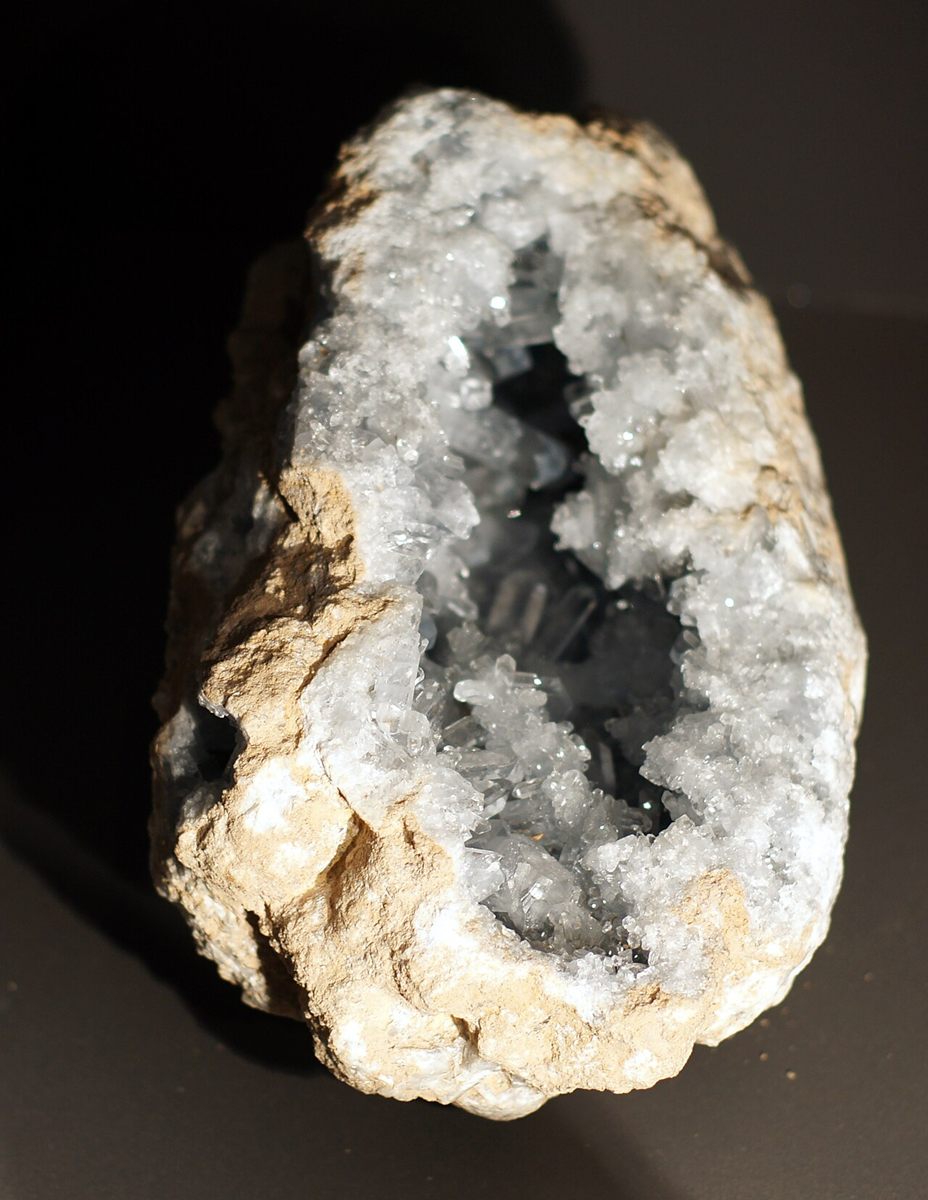
Celestite, or celestine, is strontium sulfate, SrSO₄, an orthorhombic mineral that often forms pale sky-blue crystals. The name comes from the Latin for 'heavenly,' after their delicate color.
Celestite, or celestine, is strontium sulfate, SrSO₄, an orthorhombic mineral that often forms pale sky-blue crystals. The name comes from the Latin for "heavenly," after their delicate color.
🪨 Geology Guide Specimen: Open Celestite (Celestine) in the CRV Science Rock & Mineral ID Guide to log the specimen, compare it with the other 8 mineral classes of Dana / Strunz Classes, and test your eye in LithoClade.
Sky-Blue Geodes: How Do You Recognize It?
Celestite grows as chisel-tipped prisms and blades lining cavities and geodes, with a hardness of 3 to 3.5. It has the same structure as barite and is somewhat lighter, about 4 grams per cubic centimeter. The blue color is pale and often tinted by traces of impurities.
Where It Forms: Evaporites and Limestones
Celestite occurs in sedimentary rocks such as limestone and dolostone, in association with rock gypsum and other evaporites, and in geodes. Famous specimens come from Madagascar, and from Ohio near Lake Erie.
Fireworks and Flares: What Is Strontium Used For?
Strontium gives a brilliant crimson-red flame, so celestite is the main ore for the element used in fireworks and road flares. It has also been used in glass and in making strontium compounds. See strontium.
Celestite at a Glance
| Property | Value |
|---|---|
| Type / variety | SrSO₄ • Orthorhombic Strontium Sulfate |
| Composition | SrSO₄ (47.7 wt% Strontium • Isostructural with Barite) |
| Geology Guide group | Minerals (8 Major Chemical Groups) |
| Mineral Group | Sulfates |
| Mohs hardness | Mohs 3–3.5 |
| Texture / habit | Chisel-tipped orthorhombic prisms lining large vugs and geodes |
| Density | 3.95–3.97 g/cm³ |
| Lustre and cleavage | Delicate sky-blue ('celestial') vitreous prisms; colors a flame crimson-red |
| Geological setting | Evaporitic limestones, dolostones, and sedimentary geodes (e.g., Madagascar, Ohio) |
| Diagnostic feature (Geology Guide) | Geode clusters of delicate, sky-blue ('celestial blue'), chisel-tipped orthorhombic prisms (Mohs 3–3.5) with a moderately high density (3.96 g/cm³) whose element imparts a brilliant crimson-red color to fireworks. |
| Formula | SrSO₄ |
| Flame color | Crimson red |