Barite
Barite, or baryte, is barium sulfate, BaSO₄, an orthorhombic mineral that is unusually heavy for a pale, non-metallic stone, with a density of about 4.5 grams per cubic centimeter. The name comes from the Greek for 'heavy.'
Barite, or baryte, is barium sulfate, BaSO₄, an orthorhombic mineral that is unusually heavy for a pale, non-metallic stone, with a density of about 4.5 grams per cubic centimeter. The name comes from the Greek for "heavy."
🪨 Geology Guide Specimen: Open Barite (Baryte) in the CRV Science Rock & Mineral ID Guide to log the specimen, compare it with the other 8 mineral classes of Dana / Strunz Classes, and test your eye in LithoClade.
Heavy Pale Blades: How Do You Recognize It?
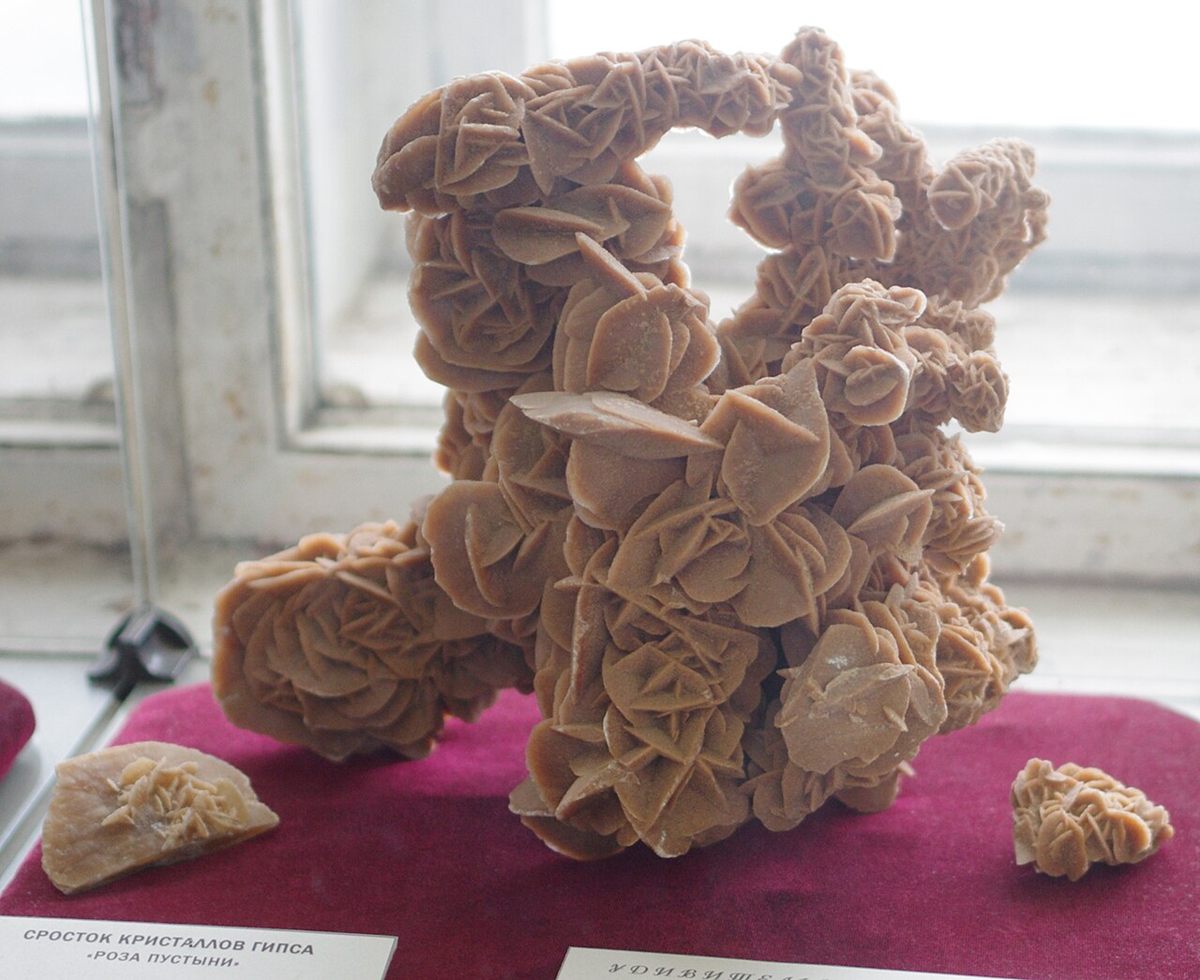
Barite grows as tabular blades, in crested clusters, or as sand-filled rosettes. It is colorless, white, honey or pale blue, with a hardness of 3 to 3.5 and three directions of cleavage. The surprising heft in the hand is the quickest clue.
Where It Forms: Veins and Cold Seeps
Barite forms in hydrothermal veins and in cavities in sandstone and limestone, and it also precipitates at cold seeps on the sea floor, where barium-rich fluids meet sulfate in seawater. It is insoluble and stable, and weathers out of rocks as a resistant mineral.
Uses: Drilling Mud and Medicine
Barite at a Glance
| Property | Value |
|---|---|
| Type / variety | BaSO₄ • Orthorhombic Barium Sulfate |
| Composition | BaSO₄ (58.8 wt% Barium) |
| Geology Guide group | Minerals (8 Major Chemical Groups) |
| Mineral Group | Sulfates |
| Mohs hardness | Mohs 3–3.5 |
| Texture / habit | Thin tabular orthorhombic blades ('crested barite') or sand-included 'barite roses' |
| Density | 4.48 g/cm³ (unusually heavy for a pale non-metallic mineral!) |
| Lustre and cleavage | Vitreous-to-pearly colourless, honey, or sky-blue blades with 3 cleavage directions |
| Geological setting | Hydrothermal metalliferous veins, cold seeps, and sandstone concretions |
| Diagnostic feature (Geology Guide) | Pale honey, white, or sky-blue crested tabular blades (Mohs 3–3.5) with a non-metallic vitreous lustre that feel unexpectedly heavy in the hand (specific gravity 4.5, nearly twice as dense as quartz!). |
| Formula | BaSO₄ |
| Density | About 4.5 g/cm³ |