Rock Gypsum
Rock gypsum is a sedimentary rock made of the hydrated calcium sulfate mineral gypsum, CaSO₄·2H₂O. It forms by evaporation in lagoons and coastal flats, is so soft that a fingernail scratches it, and does not fizz in acid.
Rock gypsum is a sedimentary rock made of the hydrated calcium sulfate mineral gypsum, CaSO₄·2H₂O. It forms by evaporation in lagoons and coastal flats, is so soft that a fingernail scratches it, and does not fizz in acid.
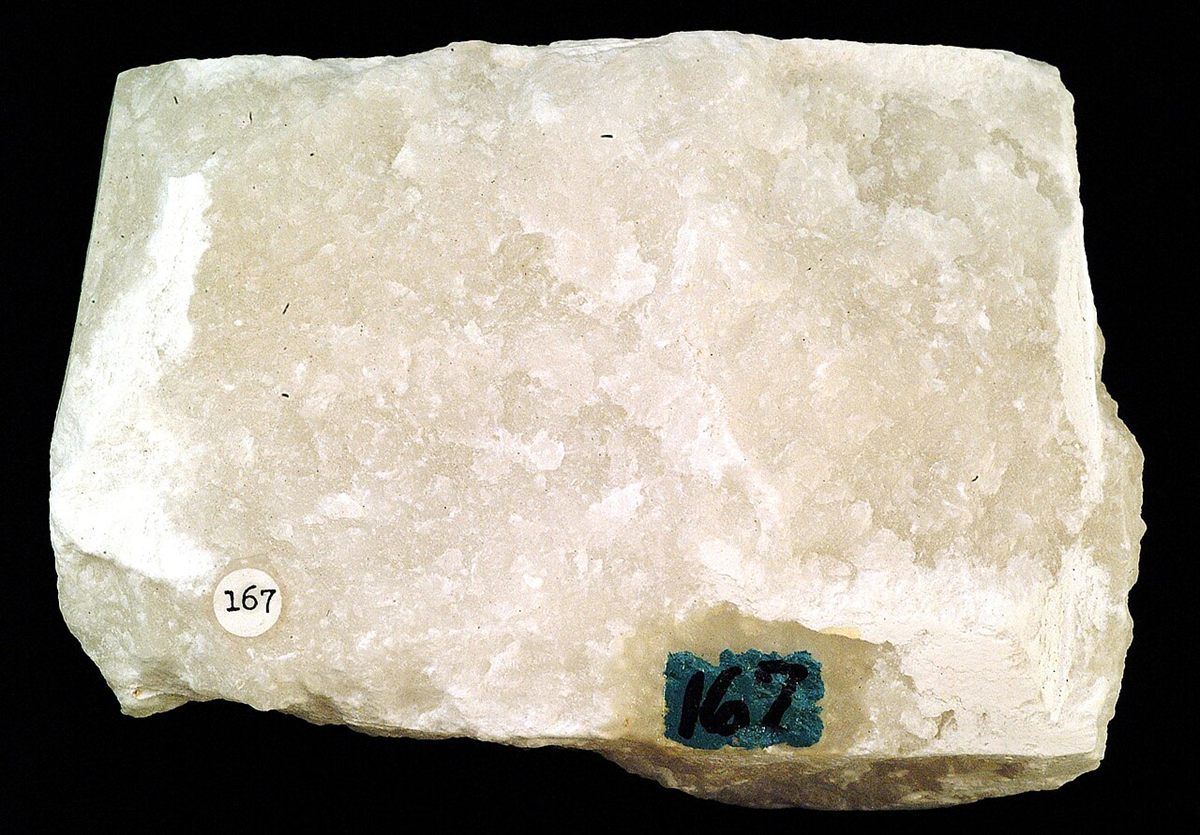
🪨 Geology Guide Specimen: Open Rock Gypsum (Alabaster) in the CRV Science Rock & Mineral ID Guide to log the specimen, compare it with the other 6 subgroups of Sedimentary, and test your eye in LithoClade.
Evaporite Sequence: When Does Gypsum Precipitate?
As seawater evaporates, gypsum precipitates after carbonates but well before rock salt, when roughly four-fifths of the water has evaporated. It forms in lagoons and in coastal salt flats called sabkhas, where it also grows as crystals in the mud.
Alabaster and Selenite: What Are the Varieties?
Fine-grained, massive gypsum is called alabaster and has been carved since antiquity into vases and sculptures. Clear crystals are selenite and fibrous silky veins are satin spar, all the same mineral.
Plaster and Wallboard: What Is Gypsum Used For?
Heating gypsum drives off its water to make plaster of Paris, and the ground rock is used in drywall, cement and soil conditioner. At White Sands in New Mexico, the dunes are made of gypsum sand rather than quartz, and the sulfate also ties gypsum to the sulfur cycle.
Rock Gypsum at a Glance
| Property | Value |
|---|---|
| Type / variety | Massive Hydrous Calcium Sulfate Evaporite |
| Composition | Gypsum (CaSO₄·2H₂O) ± Minor Anhydrite & Calcite Laminae |
| Geology Guide group | Sedimentary Rocks (Clastic, Chemical & Biogenic) |
| Rock Classification | Evaporites (Saline Precipitates) |
| Mohs hardness | Mohs 2 (easily scratched with a fingernail) |
| Texture / habit | Fine sugary massive (alabaster), laminated, or fibrous satin-spar beds |
| Density | 2.30–2.35 g/cm³ |
| Lustre and cleavage | Pearly-to-silky white or pink; does not fizz in acid |
| Geological setting | Coastal sabkha tidal flats and evaporating marine lagoons |
| Diagnostic feature (Geology Guide) | Snow-white to pale pink, finely crystalline or laminated rock so soft (Mohs 2) that it can be easily scratched with a human fingernail, yet it does not fizz in hydrochloric acid. |
| Main mineral | Gypsum, CaSO₄·2H₂O |
| Hardness | About 2, scratched by a fingernail |