Rock Salt
Rock salt is a sedimentary rock made of the mineral halite, sodium chloride (NaCl), formed by evaporation of seawater or salt-lake water. It occurs as thick beds and as salt domes in sedimentary basins.
Rock salt is a sedimentary rock made of the mineral halite, sodium chloride (NaCl), formed by evaporation of seawater or salt-lake water. It occurs as thick beds and as salt domes in sedimentary basins.
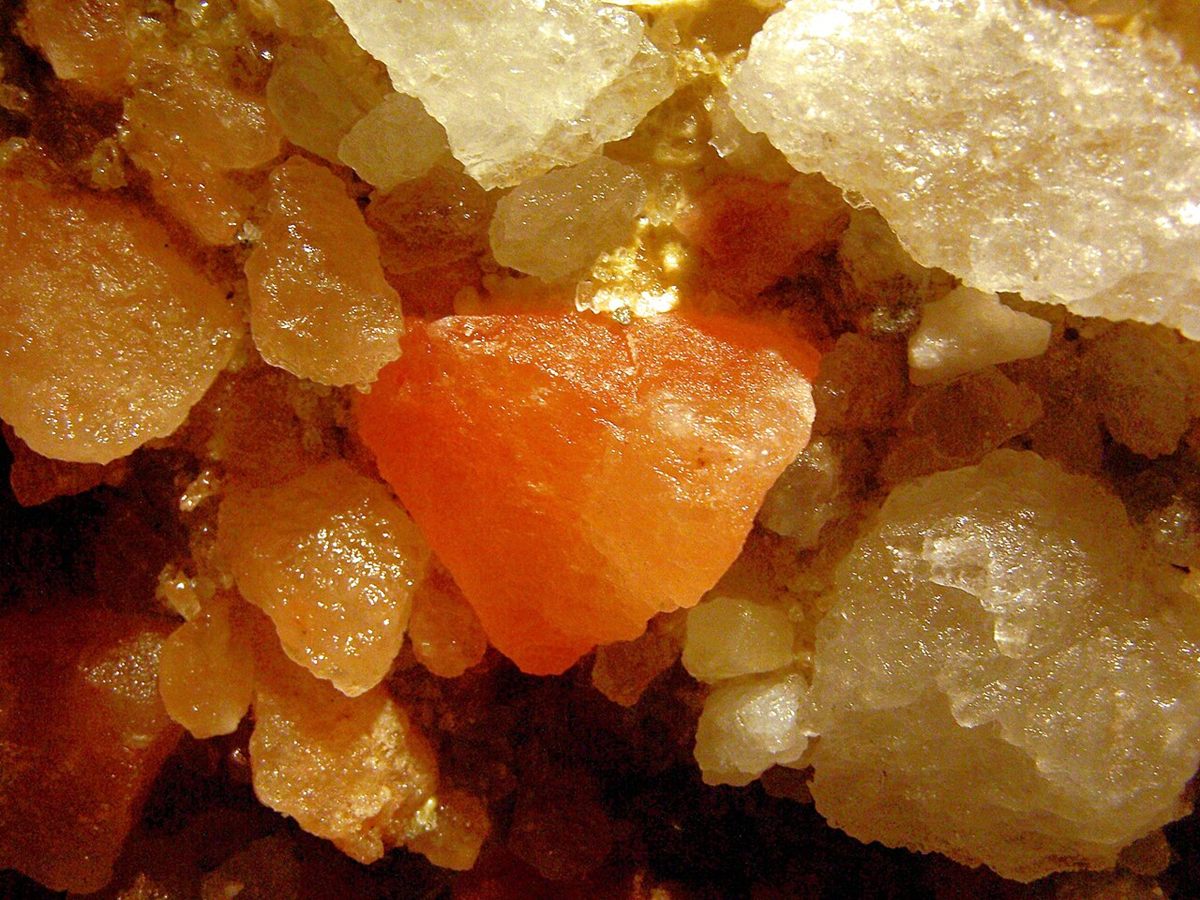
🪨 Geology Guide Specimen: Open Rock Salt (Halite Evaporite) in the CRV Science Rock & Mineral ID Guide to log the specimen, compare it with the other 6 subgroups of Sedimentary, and test your eye in LithoClade.
Evaporation: How Does Seawater Become Salt?
In a restricted, hot, dry basin, water evaporates faster than it is replaced. Carbonates drop out first, then gypsum, and halite only when roughly nine-tenths of the water has gone. Thick salt beds show that this repeated evaporation went on for a long time, as in the Messinian salt of the Mediterranean about six million years ago.
Salt Domes: Why Does Salt Flow?
Salt is less dense than most buried sediment and flows slowly under pressure, so it rises through overlying rock as diapirs and domes. Such domes can trap oil and gas along their flanks, which is why they are important in the Gulf Coast of the United States.
Mining and Use: What Is Salt For?
Rock salt is mined or recovered by solution mining. Most is used to make chemicals such as chlorine and sodium hydroxide, with the remainder used for road de-icing and food. See sodium for the element and its place in biology.
Rock Salt at a Glance
| Property | Value |
|---|---|
| Type / variety | Bedded Crystalline Sodium Chloride Evaporite |
| Composition | >95% Halite (NaCl) + Trace Sylvite, Anhydrite & Iron-Oxide Inclusions |
| Geology Guide group | Sedimentary Rocks (Clastic, Chemical & Biogenic) |
| Rock Classification | Evaporites (Saline Precipitates) |
| Mohs hardness | Mohs 2.5 |
| Texture / habit | Coarse interlocking cubic crystals in bedded or diapiric masses |
| Density | 2.16 g/cm³ |
| Lustre and cleavage | Glassy colourless, white, or salmon-pink with perfect cubic cleavage and salty taste |
| Geological setting | Restricted arid marine basins, salt domes, and desiccating salt flats |
| Diagnostic feature (Geology Guide) | Translucent white-to-salmon-pink crystalline rock (Mohs 2.5) with interlocking cubic cleavage planes, low density (2.16 g/cm³), and a distinctly salty taste, formed when ~90% of a seawater basin dries up. |
| Main mineral | Halite (NaCl) |
| Density | About 2.16 g/cm³, low for a rock |