Sylvite
Sylvite is potassium chloride, KCl, a soft, glassy mineral with isometric crystals and cubic cleavage, like halite. It is the main ore of potash, the potassium fertilizer essential to modern agriculture.
Sylvite is potassium chloride, KCl, a soft, glassy mineral with isometric crystals and cubic cleavage, like halite. It is the main ore of potash, the potassium fertilizer essential to modern agriculture.
🪨 Geology Guide Specimen: Open Sylvite in the CRV Science Rock & Mineral ID Guide to log the specimen, compare it with the other 8 mineral classes of Dana / Strunz Classes, and test your eye in LithoClade.
Halite Look-Alike: How Do You Tell Them Apart?
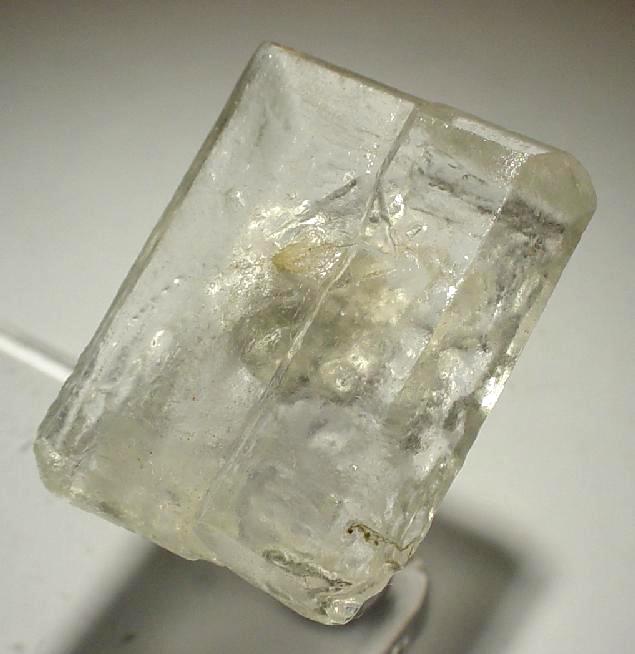
Sylvite looks very much like halite, but it tastes more bitter, is slightly softer and lighter, and gives a lilac-violet flame from potassium. Its crystals are colorless to white, and hematite inclusions make some brick red.
Last to Crystallize: Where Does It Form?
Potassium stays dissolved in the brine until almost all the water has gone, so sylvite forms at the very end of the evaporite sequence, above rock salt and rock gypsum. Thick beds are found in Saskatchewan, where Canada is the world's largest potash producer.
Fertilizer: Why Does It Matter?
Plants need potassium, and most mined potash goes to fertilizer. The mineral is named for Franciscus Sylvius, a 17th-century physician who studied the salt, and "potash" for the pots in which wood ash was once leached.
Sylvite at a Glance
| Property | Value |
|---|---|
| Type / variety | KCl • Isometric Potassium Chloride |
| Composition | KCl (52.4 wt% Potassium, 47.6 wt% Chlorine) |
| Geology Guide group | Minerals (8 Major Chemical Groups) |
| Mineral Group | Halides |
| Mohs hardness | Mohs 2 (softer and slightly more waxilysectile than halite) |
| Texture / habit | Cubic and cubo-octahedral crystalline masses |
| Density | 1.99 g/cm³ (very low density) |
| Lustre and cleavage | Vitreous colourless to brick-red (from microscopic hematite); sharp bitter taste; violet K flame |
| Geological setting | Final stage of extreme marine basin desiccation and volcanic fumaroles |
| Diagnostic feature (Geology Guide) | Glassy colourless-to-brick-red isometric crystal (Mohs 2, density 1.99 g/cm³) with perfect cubic cleavage like halite, but distinguished by its pungent, sharply bitter taste and lilac-violet flame test. |
| Formula | KCl |
| Flame test | Lilac-violet |