Halite
Halite is sodium chloride, NaCl, the mineral form of common salt, with isometric crystals, perfect cubic cleavage and a hardness of 2.5. It forms thick beds of rock salt and is the main mineral of dried-up seas and salt lakes.
Halite is sodium chloride, NaCl, the mineral form of common salt, with isometric crystals, perfect cubic cleavage and a hardness of 2.5. It forms thick beds of rock salt and is the main mineral of dried-up seas and salt lakes.
🪨 Geology Guide Specimen: Open Halite (Hopper Crystal) in the CRV Science Rock & Mineral ID Guide to log the specimen, compare it with the other 8 mineral classes of Dana / Strunz Classes, and test your eye in LithoClade.
Hopper Crystals: Why Do Cubes Have Steps?
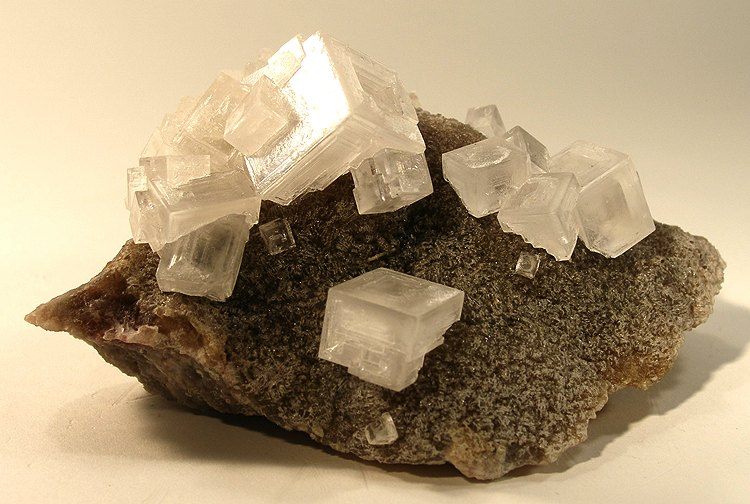
Where halite grows quickly from an evaporating brine, the edges of a cube grow faster than the faces, so the faces become hollowed into stepped, staircase-like depressions called hoppers. The crystals are clear to white, and impurities and radiation damage can make them pink, orange or deep blue.
Identification: The Taste Test
Halite splits into cubes along three directions at right angles and tastes salty, a test that geologists use sparingly. Like sylvite, it dissolves readily in water, which is why it is found only in dry regions and underground.
Occurrence and Use: Where Is It Found?
Halite at a Glance
| Property | Value |
|---|---|
| Type / variety | NaCl • Isometric Sodium Chloride |
| Composition | NaCl (39.3 wt% Sodium, 60.7 wt% Chlorine) |
| Geology Guide group | Minerals (8 Major Chemical Groups) |
| Mineral Group | Halides |
| Mohs hardness | Mohs 2.5 |
| Texture / habit | Isometric cubes, often with stepped sunken faces ('hopper crystals') |
| Density | 2.16 g/cm³ |
| Lustre and cleavage | Vitreous clear, white, pink, or deep violet-blue; perfect 3-way 90° cubic cleavage; salty taste |
| Geological setting | Hyper-saline lakes (e.g., Dead Sea, Great Salt Lake), salt flats, and marine evaporites |
| Diagnostic feature (Geology Guide) | Translucent cubic crystal (Mohs 2.5) that frequently grows with sunken, staircase-like 'hopper' faces when crystal edges grow faster than face centers in evaporating brines; splits at 90° angles and tastes of table salt. |
| Formula | NaCl |
| Cleavage | Perfect cubic |