Atacamite
Atacamite is a copper chloride hydroxide, Cu₂Cl(OH)₃, a bright green mineral that forms in the dry, salty oxidized zones of copper deposits. It is named for the Atacama Desert of Chile, where it was first described.
Atacamite is a copper chloride hydroxide, Cu₂Cl(OH)₃, a bright green mineral that forms in the dry, salty oxidized zones of copper deposits. It is named for the Atacama Desert of Chile, where it was first described.
🪨 Geology Guide Specimen: Open Atacamite in the CRV Science Rock & Mineral ID Guide to log the specimen, compare it with the other 8 mineral classes of Dana / Strunz Classes, and test your eye in LithoClade.
Copper and Salt: How Does Atacamite Form?
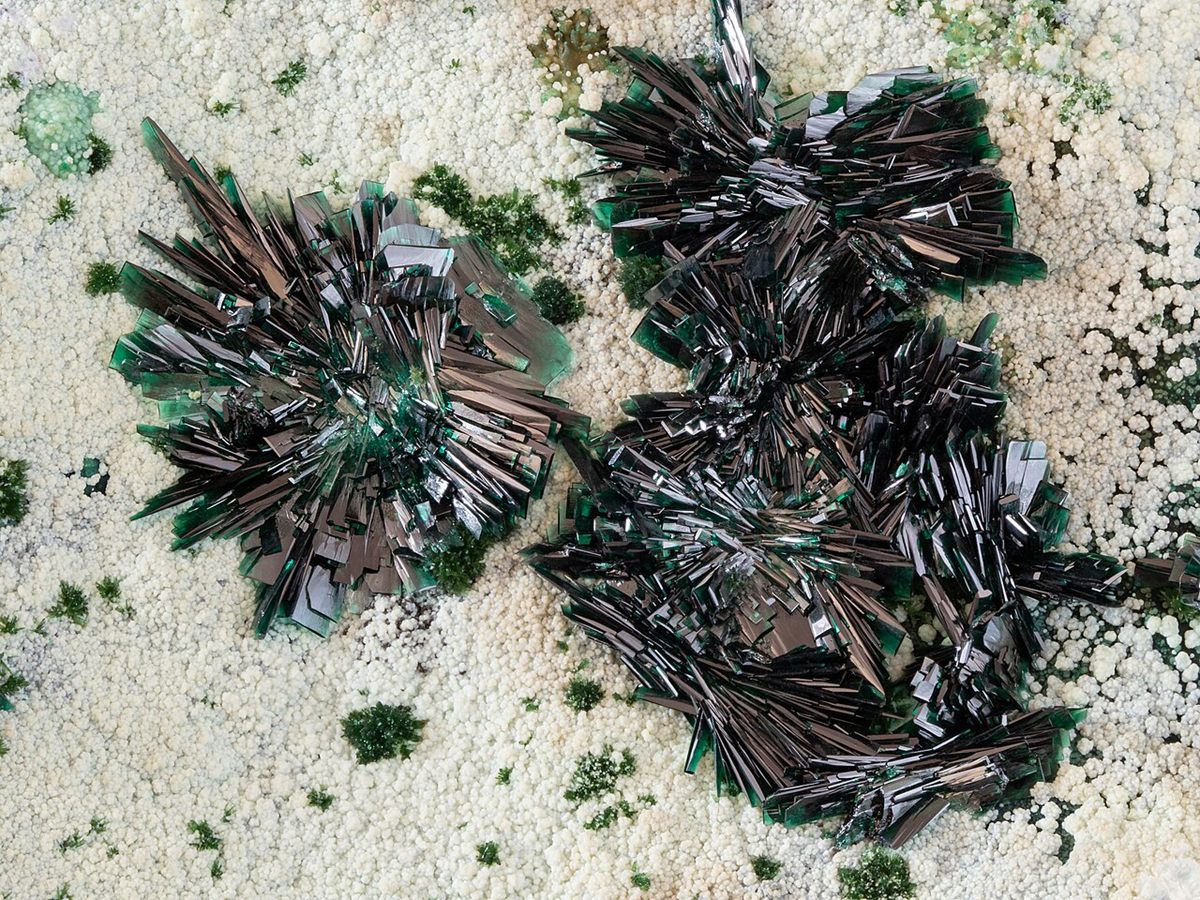
In very dry climates, groundwater rich in chloride from salt weathers copper sulfides and carries copper into the surface zone. There copper, chloride and hydroxide combine to make atacamite, as slender, striated, bottle-green prisms. It is a halide because chlorine is bonded in the structure.
Identification: How Do You Tell It from Malachite?
Atacamite and malachite are both green copper minerals. Malachite fizzes in hydrochloric acid and atacamite does not, and atacamite gives an apple-green streak and has a hardness of 3 to 3.5.
Other Settings: Bronze and Black Smokers
Atacamite and its relatives form on ancient bronze objects as a powdery green corrosion called bronze disease, and they are found at deep-sea vents. Chile's copper mines were a source of atacamite pigment for centuries.
Atacamite at a Glance
| Property | Value |
|---|---|
| Type / variety | Cu₂Cl(OH)₃ • Orthorhombic Copper Halide |
| Composition | Cu₂Cl(OH)₃ (59.5 wt% Copper) |
| Geology Guide group | Minerals (8 Major Chemical Groups) |
| Mineral Group | Halides |
| Mohs hardness | Mohs 3–3.5 |
| Texture / habit | Slender striated orthorhombic prisms and radiating acicular sprays |
| Density | 3.75–3.78 g/cm³ |
| Lustre and cleavage | Brilliant adamantine-to-vitreous bottle-green crystals; apple-green streak; does NOT fizz in HCl |
| Geological setting | Hyper-arid saline oxidation zones of copper deposits (named after the Atacama Desert) & deep-sea vents |
| Diagnostic feature (Geology Guide) | Deep bottle- to emerald-green striated orthorhombic needles (Mohs 3–3.5) from hyper-arid coastal deserts that color a flame bright blue-green without acid, proving chlorine is bonded in its lattice. |
| Formula | Cu₂Cl(OH)₃ |
| Streak | Apple green |