Anhydrite
Anhydrite is the water-free form of calcium sulfate, CaSO₄, and the rock made of it. It occurs in evaporite beds and as nodules in arid coastal flats, and it is harder and denser than its hydrated relative gypsum.
Anhydrite is the water-free form of calcium sulfate, CaSO₄, and the rock made of it. It occurs in evaporite beds and as nodules in arid coastal flats, and it is harder and denser than its hydrated relative gypsum.
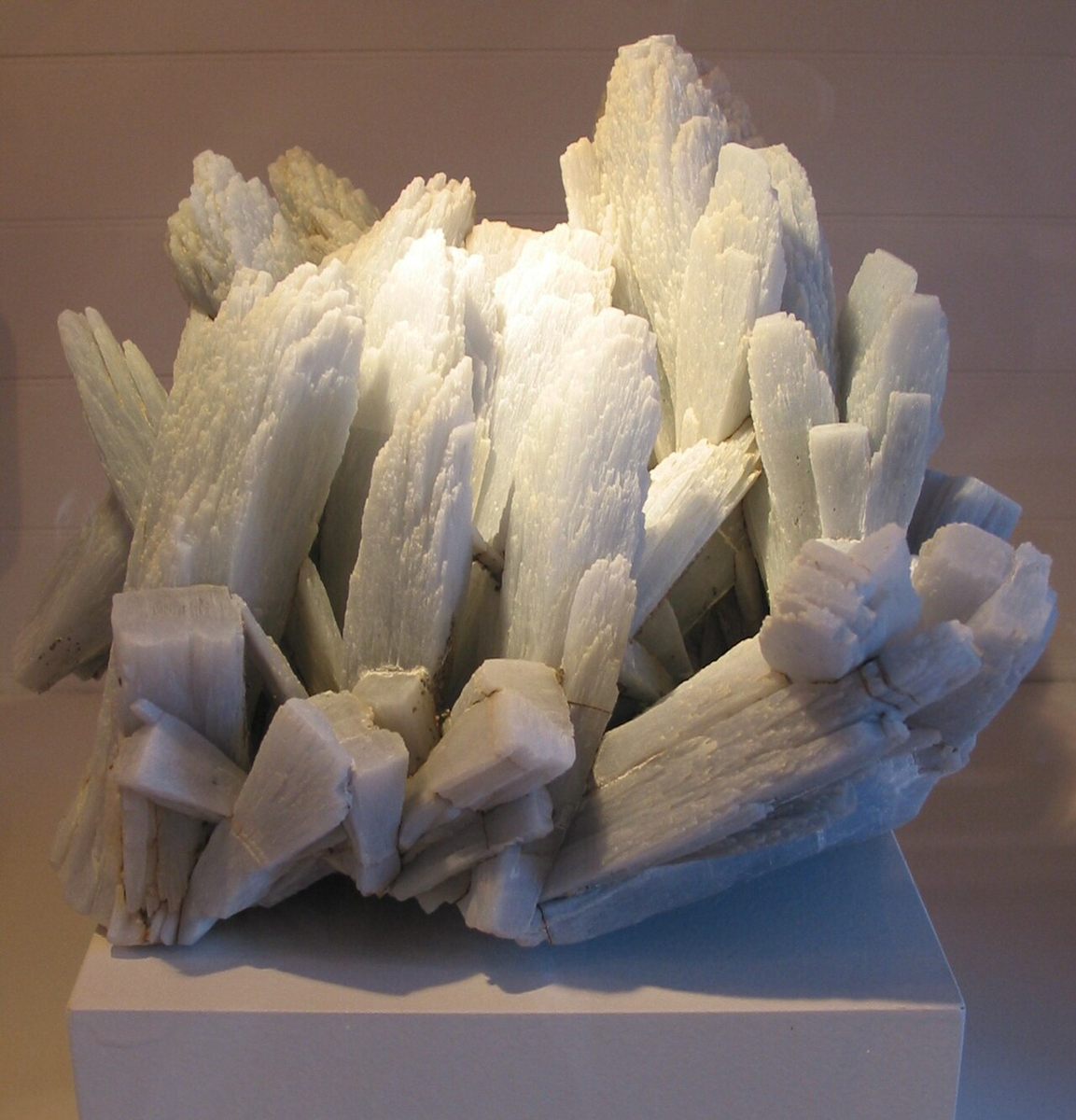
🪨 Geology Guide Specimen: Open Bedded Anhydrite in the CRV Science Rock & Mineral ID Guide to log the specimen, compare it with the other 6 subgroups of Sedimentary, and test your eye in LithoClade.
Dehydrated Sulfate: How Does Anhydrite Differ from Gypsum?
Anhydrite has no water in its crystal structure, so it is slightly harder, about Mohs 3.5, and denser at roughly 2.9 to 3.0 grams per cubic centimeter, and it cannot be scratched by a fingernail. Its three cleavages meet at right angles, giving blocky fragments. See rock gypsum for the hydrated form.
Sabkha and Burial: How Does It Form?
Anhydrite precipitates directly in hot, very saline sabkha settings, often as "chicken-wire" nodules in carbonate mud. It also forms when buried gypsum loses its water at depth, so much of the anhydrite in old evaporite basins is a product of burial.
Swelling: Why Is Anhydrite an Engineering Hazard?
When anhydrite meets water it takes it up and converts to gypsum, which can expand in volume substantially. This swelling has damaged tunnels and building foundations in anhydrite-bearing rocks, such as parts of the Keuper in Europe.
Anhydrite at a Glance
| Property | Value |
|---|---|
| Type / variety | Anhydrous Calcium Sulfate Sabkha Evaporite |
| Composition | Anhydrite (CaSO₄, water-free calcium sulfate) |
| Geology Guide group | Sedimentary Rocks (Clastic, Chemical & Biogenic) |
| Rock Classification | Evaporites (Saline Precipitates) |
| Mohs hardness | Mohs 3–3.5 (harder than fingernail, softer than steel) |
| Texture / habit | Nodular 'chicken-wire' mosaic or laminated crystalline beds |
| Density | 2.90–2.98 g/cm³ |
| Lustre and cleavage | Pearly pale blue-grey to white with three right-angle pseudo-cubic cleavages |
| Geological setting | Hot (>42 °C) arid sabkhas and deep burial dehydration of gypsum beds |
| Diagnostic feature (Geology Guide) | Pale bluish-grey to white crystalline basin rock with three right-angle cleavage directions; unlike its hydrated relative, it has a hardness of Mohs 3.5 (cannot be scratched by a fingernail) and a higher density (2.95 g/cm³). |
| Formula | CaSO₄ |
| Hardness | About 3.5 |