Native Sulfur
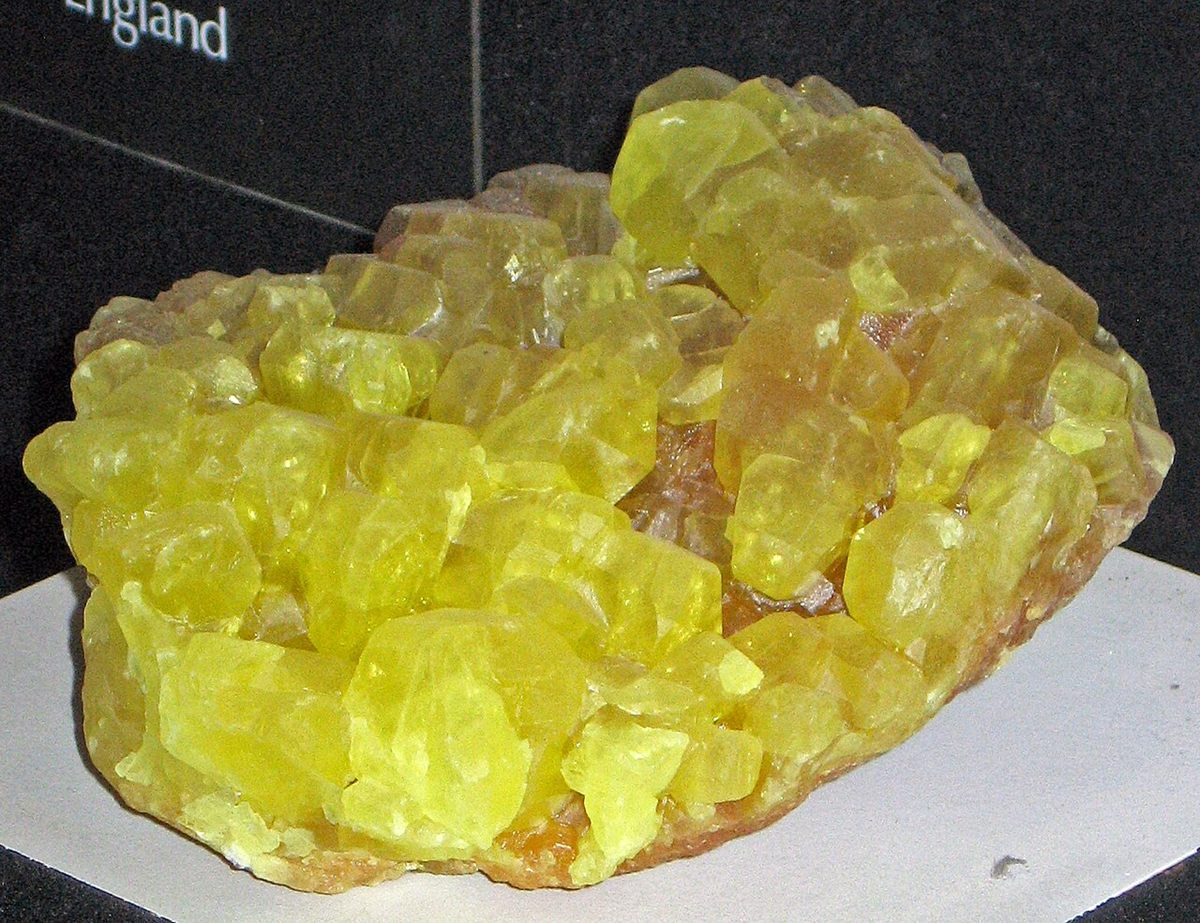
Native sulfur is the element sulfur, S, found as bright yellow crystals and crusts made of crown-shaped S₈ rings. It forms around volcanic vents and in some sedimentary deposits.
Native sulfur is the element sulfur, S, found as bright yellow crystals and crusts made of crown-shaped S₈ rings. It forms around volcanic vents and in some sedimentary deposits.
🪨 Geology Guide Specimen: Open Native Sulfur in the CRV Science Rock & Mineral ID Guide to log the specimen, compare it with the other 8 mineral classes of Dana / Strunz Classes, and test your eye in LithoClade.
Yellow Crystals: How Do You Recognize It?
Sulfur forms lemon-yellow orthorhombic crystals with a resinous luster, a hardness of 1.5 to 2.5 and a density of about 2.1 grams per cubic centimeter. It burns with a blue flame and a sharp odor, and a crystal held in the hand may crackle as it warms unevenly, because sulfur conducts heat poorly.
Fumaroles and Salt Domes: Where Does It Form?
Volcanic gases deposit sulfur around vents, called fumaroles or solfataras, as at Indonesia's Ijen crater. Large deposits also form in sedimentary rocks when bacteria reduce sulfate in evaporites such as rock gypsum and salt domes, as in the Gulf Coast.
Uses: What Is Sulfur For?
Native Sulfur at a Glance
| Property | Value |
|---|---|
| Type / variety | S₈ • Orthorhombic Molecular Native Element |
| Composition | S₈ (Crown-shaped 8-atom covalent rings) |
| Geology Guide group | Minerals (8 Major Chemical Groups) |
| Mineral Group | Native Elements |
| Mohs hardness | Mohs 1.5–2.5 |
| Texture / habit | Steep orthorhombic dipyramidal crystals and bright yellow fumarolic crusts |
| Density | 2.07 g/cm³ |
| Lustre and cleavage | Resinous-to-greasy bright lemon-yellow crystals; cracks from the warmth of a human hand! |
| Geological setting | Volcanic fumarole vents (solfataras) and bacterial reduction of evaporite salt-dome gypsum |
| Diagnostic feature (Geology Guide) | Bright canary- to lemon-yellow orthorhombic crystal (Mohs 2, density 2.07 g/cm³) with a warm resinous lustre that is such a poor conductor of heat that holding a cold crystal in your hand can make it crackle internally. |
| Formula | S₈ |
| Typical setting | Volcanic fumaroles and evaporite deposits |
See Also
- Sulfur — the element
- Rock Gypsum — a sulfate rock sulfur can form from
- Pyrite — a sulfur-bearing iron mineral