Cloud Sponge
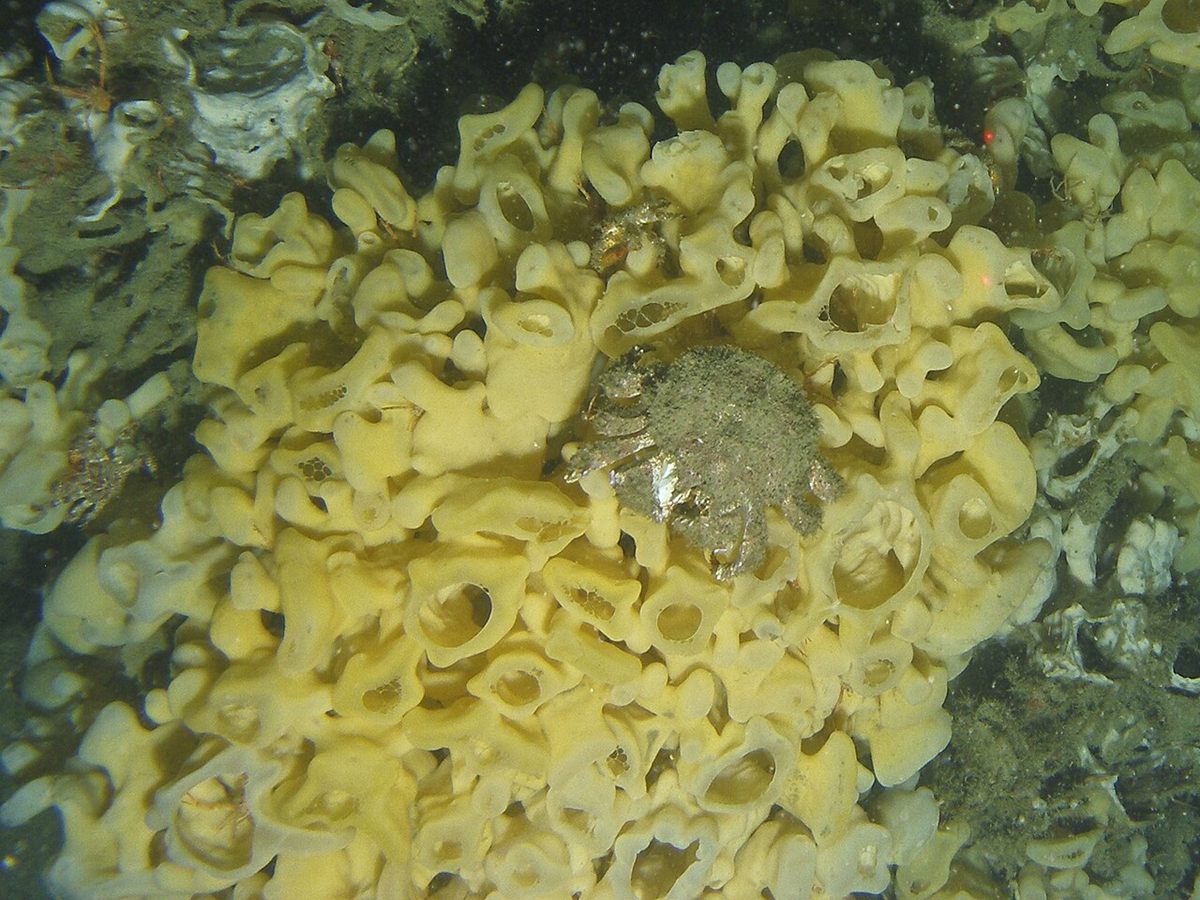
The cloud sponge (Aphrocallistes vastus) is a glass sponge that builds reefs in the cool, deep waters off British Columbia. Such reefs were believed to have gone extinct 40 million years ago until live ones were found in 1987.
The cloud sponge (Aphrocallistes vastus) is a glass sponge that builds reefs in the cool, deep waters off British Columbia. Such reefs were believed to have gone extinct 40 million years ago until live ones were found in 1987.
🧬 Field Guide Specimen: Open Cloud Sponge in the CRV Science Field Guide to log the specimen, see its place among the Metazoa lineages in the Cladogram Explorer, and test your recall in the Red List conservation game.
Reefs Thought Extinct: A Rediscovery
Glass sponge reefs flourished in the Jurassic seas, then were known only as fossils. In the late 1980s, scientists mapping the seafloor of Hecate Strait and the Strait of Georgia found living reefs up to 20 meters tall, a major discovery. See Venus' Flower Basket.
Slow Builders
Dead sponge skeletons of silica provide a framework on which new sponges settle, and reefs have been growing for thousands of years. They filter seawater and shelter rockfish and crabs.
Fragile Habitat
Bottom trawling can crush the reefs. Canada has closed areas to bottom fishing to protect them, and researchers monitor warming and acidification.
Cloud Sponge at a Glance
| Property | Value |
|---|---|
| Scientific name | Aphrocallistes vastus |
| Kingdom | Animalia |
| Phylum | Porifera |
| Class | Hexactinellida |
| Order | Sceptrulophora |
| Family | Aphrocallistidae |
| Field Guide group | Porifera: Sponges (Basal Metazoans) |
| Diagnostic feature (Field Guide) | Cloud-like folded mounds built from a fused silica-spicule skeleton; forms ancient reefs off British Columbia. |
| IUCN Red List status | Not Evaluated (NE): no global IUCN assessment |
| Class | Hexactinellida |
| Reef height | Up to about 20 meters |
See Also
- Venus' Flower Basket — another glass sponge
- Goblet Glass Sponge — another reef-building glass sponge