Common Tusk Shell
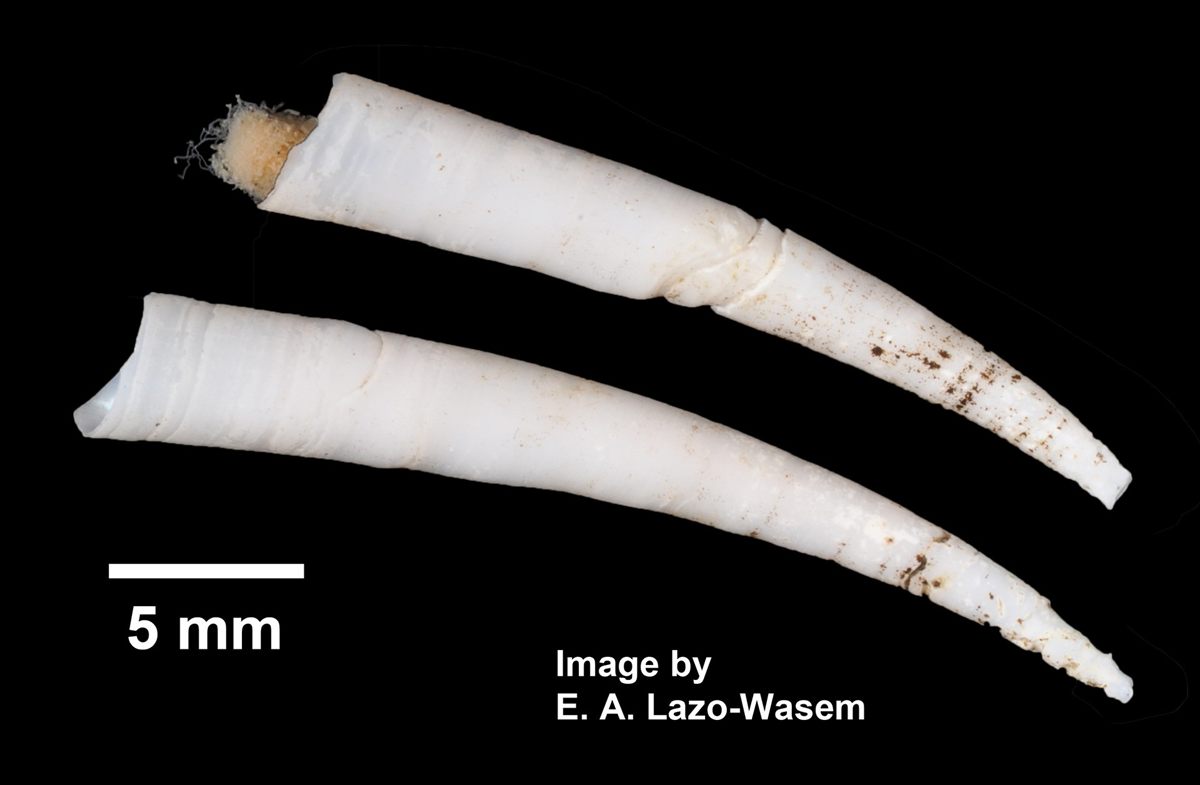
The common tusk shell (Antalis entalis) is a scaphopod of the northeastern Atlantic whose shell is a slightly curved, tapering tube open at both ends. It lives buried in sand and mud.
The common tusk shell (Antalis entalis) is a scaphopod of the northeastern Atlantic whose shell is a slightly curved, tapering tube open at both ends. It lives buried in sand and mud.
🧬 Field Guide Specimen: Open Common Tusk Shell in the CRV Science Field Guide to log the specimen, see its place among the Lophotrochozoa lineages in the Cladogram Explorer, and test your recall in the Red List conservation game.
Head Down in Sediment
The mollusc burrows with a muscular foot at the wide end and keeps the narrow tip above the surface to take in water. Captacula (thread-like tentacles) hunt microscopic organisms in the sediment.
No Gills, No Eyes
Tusk shells breathe through the mantle and lack both gills and eyes, an unusual arrangement among molluscs. See Elephant Tusk Shell.
Beach Finds
Empty shells wash up on beaches and have been used as beads and currency by many peoples.
Common Tusk Shell at a Glance
| Property | Value |
|---|---|
| Scientific name | Antalis entalis |
| Kingdom | Animalia |
| Phylum | Mollusca |
| Class | Scaphopoda |
| Order | Dentaliida |
| Family | Dentaliidae |
| Field Guide group | Lophotrochozoa: Mollusca (Mollusks) |
| Diagnostic feature (Field Guide) | Slightly curved, tapering white tube up to 4 cm long and open at both ends; buried head-down in seafloor mud, it gathers food with dozens of thread-like tentacles (captacula). |
| Class | Scaphopoda |
| Shell | Curved tube open at both ends |
See Also
- Elephant Tusk Shell — an Indo-Pacific tusk shell
- European Tusk Shell — another Atlantic tusk shell