Elephant Tusk Shell
The elephant tusk shell (Dentalium elephantinum) is an Indo-Pacific mollusc whose shell is a curved tube open at both ends, resembling a small tusk. Tusk shells belong to the class Scaphopoda.
The elephant tusk shell (Dentalium elephantinum) is an Indo-Pacific mollusc whose shell is a curved tube open at both ends, resembling a small tusk. Tusk shells belong to the class Scaphopoda.
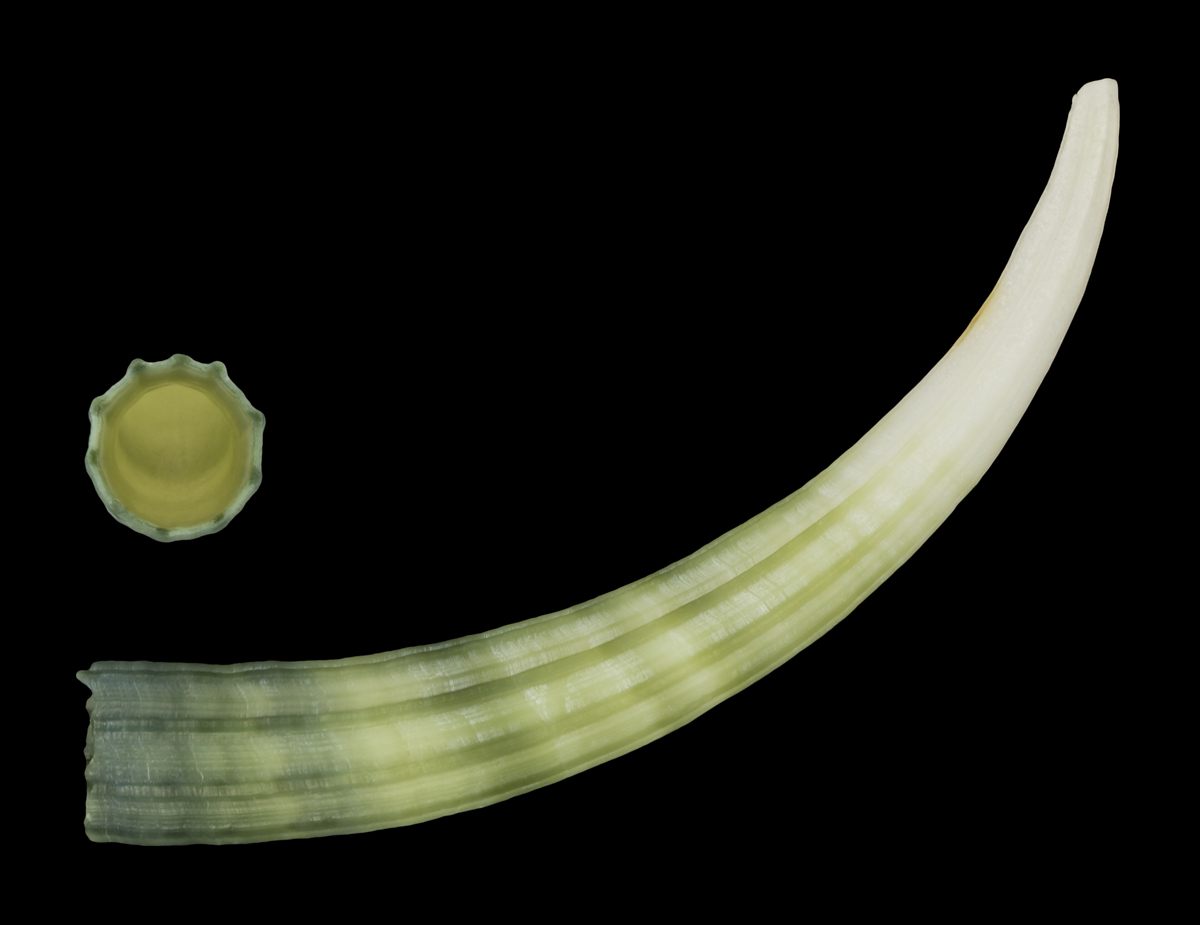
🧬 Field Guide Specimen: Open Elephant Tusk Shell in the CRV Science Field Guide to log the specimen, see its place among the Lophotrochozoa lineages in the Cladogram Explorer, and test your recall in the Red List conservation game.
Life Head-Down in Sand
The animal buries the larger end of its tube in sediment and projects the narrow tip up into the water for breathing. It has no gills and no eyes; oxygen is taken up through the mantle.
Feeding With Tentacles
Thread-like tentacles (captacula) extend into the sand to catch foraminifera and other microscopic prey, which are drawn back and ground by the radula.
Shells as Money
Related species were used as currency and as ornaments by Native peoples of the Pacific Northwest, and polished tusk shells have been traded widely.
Elephant Tusk Shell at a Glance
| Property | Value |
|---|---|
| Scientific name | Dentalium elephantinum |
| Kingdom | Animalia |
| Phylum | Mollusca |
| Class | Scaphopoda |
| Family | Dentaliidae |
| Field Guide group | Lophotrochozoa: Mollusca (Mollusks) |
| Diagnostic feature (Field Guide) | Tapering curved tubular shell open at both anterior and posterior ends, prehensile captacula tentacles. |
| Class | Scaphopoda |
| Shell | A curved tube open at both ends |
See Also
- Evolution — molluscan body plans
- Biodiversity — seafloor communities