European Stag Beetle
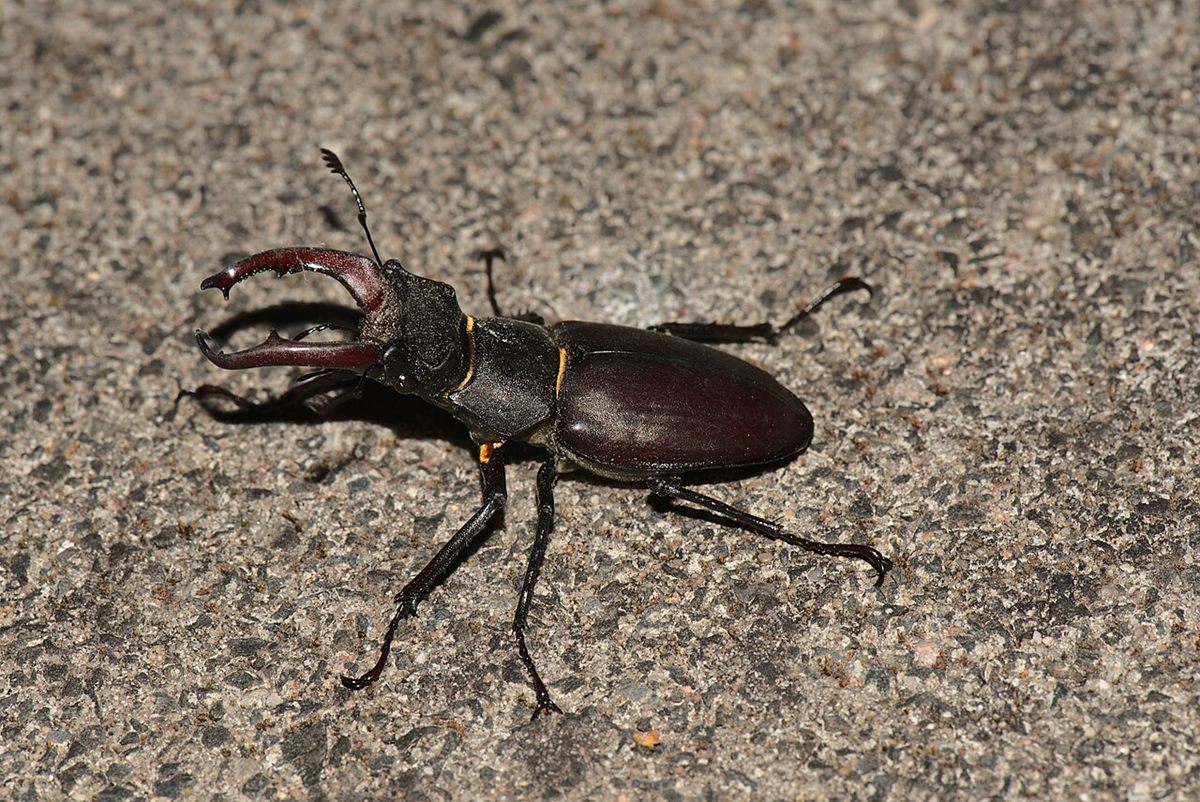
The European stag beetle (Lucanus cervus) is the largest beetle in Europe, males measuring up to about 8 centimeters including their antler-like jaws. It is protected under European law because it has declined across much of its range.
The European stag beetle (Lucanus cervus) is the largest beetle in Europe, males measuring up to about 8 centimeters including their antler-like jaws. It is protected under European law because it has declined across much of its range.
🧬 Field Guide Specimen: Open European Stag Beetle in the CRV Science Field Guide to log the specimen, see its place among the Ecdysozoa lineages in the Cladogram Explorer, and test your recall in the Red List conservation game.
Antlers for Wrestling
The male's enormous mandibles are weapons in contests over females, in which two males try to lift and throw one another off a branch. They are too weak to bite hard. Females have small jaws and a stronger bite.
Years as a Grub
The larva lives in rotting wood and tree roots for three to seven years before pupating. The adult lives for only a few weeks in summer. Without dead wood, the beetle cannot complete its life cycle.
Why It Is Declining
Removal of dead trees and stumps from woods, parks and gardens is the main cause of its decline. Log piles ("loggeries") built to mimic dead wood are used for conservation. See Hercules Beetle.
European Stag Beetle at a Glance
| Property | Value |
|---|---|
| Scientific name | Lucanus cervus |
| Kingdom | Animalia |
| Phylum | Arthropoda |
| Class | Insecta |
| Order | Coleoptera |
| Family | Lucanidae |
| Field Guide group | Ecdysozoa: Hexapoda (Insects) |
| Diagnostic feature (Field Guide) | Males carry enormous antler-like mandibles for wrestling rivals; larvae spend years chewing rotting wood underground. |
| IUCN Red List status | Near Threatened (NT), assessed 2010 |
| Larval stage | Three to seven years |
| Habitat need | Decaying wood |
See Also
- Hercules Beetle — another horned giant beetle
- Sacred Scarab — another famous beetle