Giant African Millipede
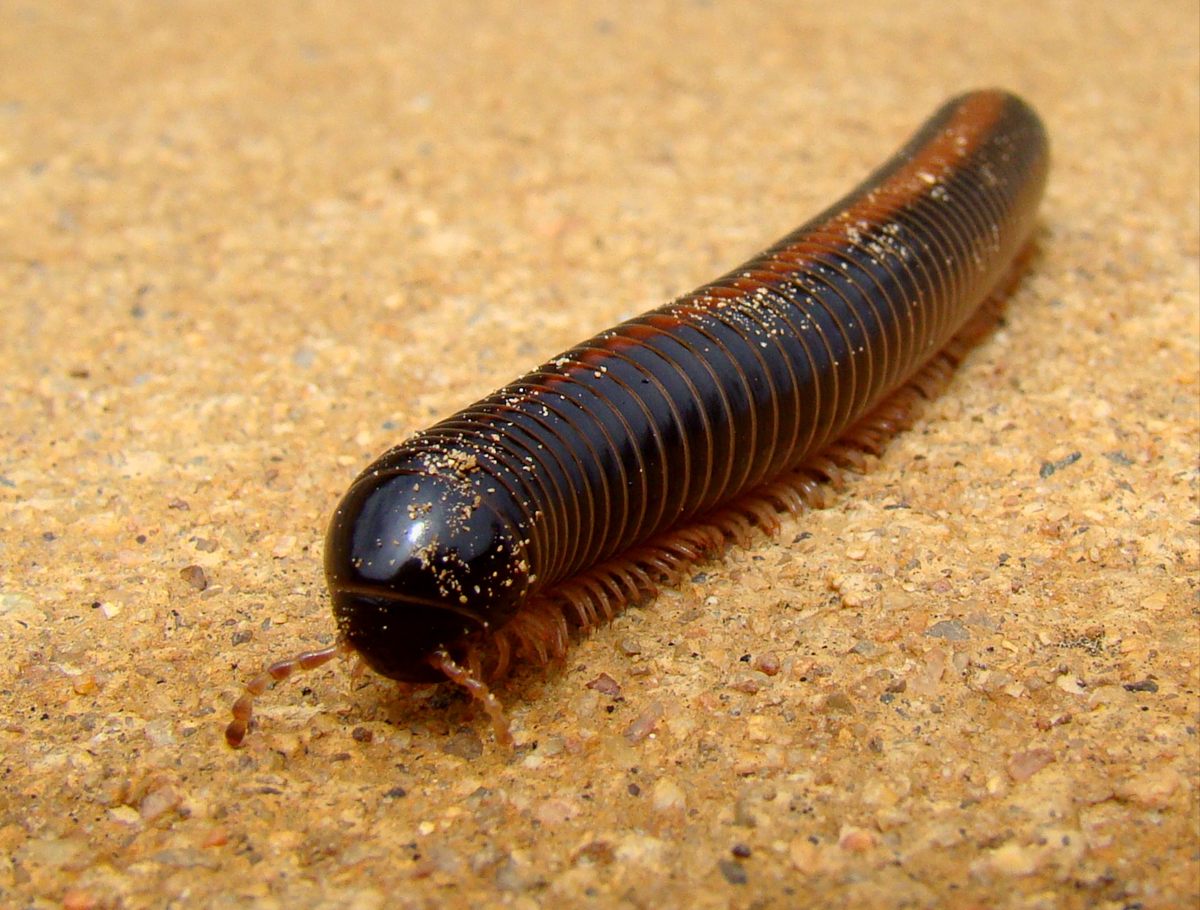
The giant African millipede (Archispirostreptus gigas) is one of the largest millipedes, growing to about 30 centimeters. It lives in the savannas and forests of East Africa and eats rotting plant matter.
The giant African millipede (Archispirostreptus gigas) is one of the largest millipedes, growing to about 30 centimeters. It lives in the savannas and forests of East Africa and eats rotting plant matter.
🧬 Field Guide Specimen: Open Giant African Millipede in the CRV Science Field Guide to log the specimen, see its place among the Ecdysozoa lineages in the Cladogram Explorer, and test your recall in the Red List conservation game.
Two Pairs of Legs per Segment: What Makes a Millipede?
Each body ring of a millipede is a fusion of two segments, carrying two pairs of legs, and the animal has hundreds of legs in total. Waves of leg movement carry it slowly along. Centipedes, by contrast, have one pair per segment and are fast predators.
Chemical Defense
When disturbed, millipedes coil into a spiral and release defensive fluids from pores along the body, which can irritate skin and eyes. Some species make hydrogen cyanide, though this species makes quinones.
Recyclers
Millipedes eat leaf litter and dead wood, breaking it into fragments that bacteria and fungi decompose. They are common pets because they are harmless to hold.
Giant African Millipede at a Glance
| Property | Value |
|---|---|
| Scientific name | Archispirostreptus gigas |
| Kingdom | Animalia |
| Phylum | Arthropoda |
| Subphylum | Myriapoda |
| Class | Diplopoda |
| Order | Spirostreptida |
| Family | Spirostreptidae |
| Field Guide group | Ecdysozoa: Mandibulata (Mandibulates) |
| Diagnostic feature (Field Guide) | Largest extant millipede reaching 38 cm, cylindrical annulated body with up to 256 legs (two pairs per diplosegment), defensive coiling spiral. |
| IUCN Red List status | Least Concern (LC), assessed 2021 |
| Class | Diplopoda |
| Diet | Decaying plant matter |
See Also
- House Centipede — a fast predatory myriapod
- Amazonian Giant Centipede — a venomous myriapod