Great Hammerhead
The great hammerhead (Sphyrna mokarran) is the largest hammerhead shark, reaching about 6 meters, and is found in warm coastal and offshore waters worldwide. It is listed as Critically Endangered.
The great hammerhead (Sphyrna mokarran) is the largest hammerhead shark, reaching about 6 meters, and is found in warm coastal and offshore waters worldwide. It is listed as Critically Endangered.
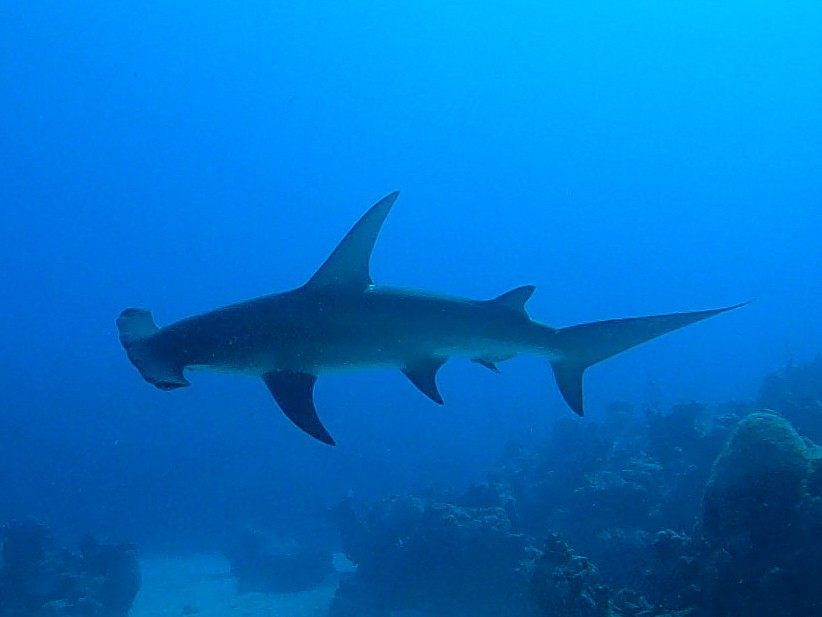
🧬 Field Guide Specimen: Open Great Hammerhead in the CRV Science Field Guide to log the specimen, see its place among the Vertebrates lineages in the Cladogram Explorer, and test your recall in the Red List conservation game.
Great Hammerhead at a Glance
| Property | Value |
|---|---|
| Scientific name | Sphyrna mokarran |
| Kingdom | Animalia |
| Phylum | Chordata |
| Class | Chondrichthyes |
| Order | Carcharhiniformes |
| Family | Sphyrnidae |
| Field Guide group | Marine and Freshwater Fish |
| Diagnostic feature (Field Guide) | Cephalofoil hammer-shaped head with broad lateral eye placement, tall sickle-shaped first dorsal fin, electroreception sweep. |
| IUCN Red List status | Critically Endangered (CR), assessed 2019 |
| Prey | Stingrays and fish |
Taxonomy, Phylogenetics, and the Miocene Origin of the Cephalofoil
Originally described by German naturalist Eduard Rüppell in 1837 as Zygaena mokarran from the Red Sea at Massawa, Eritrea, the great hammerhead (Sphyrna mokarran) is the largest of the nine extant species in the family Sphyrnidae (order Carcharhiniformes, the ground sharks, which diverged from lamniform sharks such as the great white shark Carcharodon carcharias and squaliform sharks such as the spiny dogfish Squalus acanthias during the Jurassic). Within Sphyrnidae, morphological classifications traditionally assumed that the narrow, shovel-headed bonnethead (Sphyrna tiburo) represented the ancestral transitional state toward the wide-hammered giants (Sphyrna lewini, Sphyrna mokarran, and the winghead shark Eusphyra blochii).
However, time-calibrated mitochondrial and nuclear multi-gene phylogenies by Andrew P. Martin (1993) and Gavin J. P. Naylor, Lim, and colleagues (2010) overturned this gradualist hypothesis:
- Recent Miocene Divergence (~20 Million Years Ago): Sphyrnid sharks represent the youngest family-level radiation of modern sharks, having diverged from requiem sharks (Carcharhinidae) during the Early Miocene (~20–23 million years ago).
- Large-Cephalofoil Ancestral State: In molecular trees, the winghead shark (Eusphyra blochii, whose cephalofoil spans up to 40%–50% of its total body length) and the great hammerhead (Sphyrna mokarran) occupy the basal branches of the family, whereas the small-headed bonnethead (S. tiburo) and scoophead (S. media) are recently derived lineages that secondarily reduced the width of the hammer.
Adult Sphyrna mokarran average 3.5 to 4.6 m in total length and 230 to 450 kg in body mass, with verified maximum females reaching 5.5 to 6.1 m and 580 kg. The species is immediately distinguished from the scalloped hammerhead (Sphyrna lewini) and smooth hammerhead (Sphyrna zygaena) by three anatomical characters: a nearly straight anterior margin of the cephalofoil with prominent median and lateral indentations, an immense, strongly falcate (sickle-shaped) first dorsal fin whose height reaches up to 80–100 cm in large adults, and a tall, deeply concave pelvic fin rear margin.
Cephalofoil Biomechanics, 360° Stereopsis, Electroreception, and Rolled Swimming
The laterally expanded, dorsoventrally flattened rostral chondrocranium—the cephalofoil—of Sphyrna mokarran spans 23% to 27% of the shark's total body length. Experimental hydrodynamics, visual field mapping, and neurophysiological recordings by Stephen M.aji Kajiura, Michelle M. McComb, and colleagues have elucidated the multifunctional role of this cranial structure:
- Panoramic 360° Vertical Visual Field and Anterior Binocular Stereopsis: Because the eyes and nostrils are seated at the extreme lateral tips of the cephalofoil, one might expect a wide blind spot directly in front of the snout. On the contrary, retinoscopic visual-field mapping by McComb et al. (2009) proved that the canted optical axes of the laterally displaced eyes overlap anteriorly to produce a 32° to 34° binocular stereoscopic visual field (triple the ~10° overlap of typical carcharhinid sharks), while simultaneously granting a complete 360° visual sweep in the vertical plane—allowing the swimming shark to see above and below its body simultaneously as its head yaws from side to side.
- Wide-Swath Electroreception (Ampullae of Lorenzini) and Olfactory Tropotaxis: The ventral surface of the broad cephalofoil is perforated by more than 2,500 to 3,000 electroreceptive pores leading to gel-filled ampullae of Lorenzini tuned to weak bioelectric dipoles as low as 0.5 to 1.0 nanovolt per centimeter (nV cm−1). While behavioral conditioning trials show that hammerheads and sandbar sharks share similar absolute single-channel voltage sensitivity, the lateral expansion of the cephalofoil acts like a wide-swath metal detector head, sampling a seabed path two to three times wider per head sweep and providing wider spatial separation between left and right olfactory nares to resolve odor plume gradients via bilateral tropotaxis.
- Yaw-Turn Maneuverability versus Hydrodynamic Lift: Computational fluid dynamics (CFD) models confirm that while the cephalofoil does not generate major steady-state upward lift during level cruising, tilting the flat cranial hydrofoil during high-speed pursuit creates large pitching and banking moments that allow S. mokarran to execute tight-radius 180° pivot turns at nearly double the angular velocity of fusiform carcharhinid sharks.
- Energy-Saving 60° Rolled-Sideways Swimming: Biologging accelerometer deployments by Royer, Payne, and colleagues (2016) revealed a remarkable kinematic adaptation for the shark's towering falcate first dorsal fin: during routine cruising, Sphyrna mokarran spends up to 90% of its time swimming rolled on its side at a 50° to 75° roll angle. Rolling onto its flank recruits the huge first dorsal fin as an auxiliary hydrofoil wing, expanding effective span beyond the pectoral fins and reducing the metabolic cost of transport by roughly 10% in a negatively buoyant shark lacking a swim bladder.
| Anatomical or Sensory Trait | Great Hammerhead (Sphyrna mokarran) | Scalloped Hammerhead (Sphyrna lewini) | Great White Shark (Carcharodon carcharias) |
|---|---|---|---|
| Order & Family | Carcharhiniformes (Sphyrnidae) | Carcharhiniformes (Sphyrnidae) | Lamniformes (Lamnidae) |
| Maximum Length & Mass | 5.5–6.1 m; 450–580 kg | 3.7–4.3 m; 150–250 kg | 5.5–6.4 m; 1,500–2,200 kg |
| Cephalofoil Anterior Margin | Nearly straight with median notch | Strongly arched with 3 scallops | Conical snout (no cephalofoil) |
| Anterior Binocular Overlap | ~32°–34° (with 360° vertical view) | ~34°–48° | ~10°–15° |
| Tooth Shape & Primary Diet | Triangular, strongly serrated; stingrays, sharks | Narrow, smooth-to-weakly-serrated; squid, teleosts | Large triangular serrated; marine mammals, tunas |
Batoid Predation, Capture Myopathy, and Critically Endangered Status
Inhabiting tropical and warm-temperate coastal shelves, coral reef drop-offs, island lagoons, and continental slopes from the surface to 300 m depth between 40°N and 37°S worldwide, Sphyrna mokarran is a solitary, nomadic apex predator. Unlike Sphyrna lewini, which forms daytime schools of hundreds of individuals around seamounts and feeds heavily on pelagic cephalopods and clupeids, S. mokarran possesses broadly triangular, labiolingually flattened teeth with coarse serrations along both cutting edges (dental formula 17-1-17 / 16-to-17-1-16-to-17), equipping it to dismember large elasmobranchs and bony fishes.
Its signature predatory specialization is hunting venomous batoid rays—including whiptail stingrays (Dasyatis and Hypanus spp.), eagle rays (Aetobatus narinari), cownose rays (Rhinoptera), guitarfishes, and fellow sharks (such as blacktip and reef sharks):
- Sweeping its cephalofoil 10 to 20 cm above sandy bottoms, Sphyrna mokarran detects the respiratory bioelectric dipole of a stingray buried completely beneath the sediment.
- Pivoting in a fraction of a second, the shark uses the broad underside of its cephalofoil as a battering ram and vise to pin the stingray flat against the seabed.
- While holding the ray immobilized beneath its snout, the shark pivots its jaws to bite a crescent chunk out of the ray's muscular pectoral disc (wing), crippling its propulsion before consuming the carcass bit by bit. Wild S. mokarran are routinely captured with dozens of serrated venomous stingray tail spines embedded through their jaws, buccal cavity, and cephalofoil cartilage without apparent toxic mortality or behavioral impairment.
Reproduction in Sphyrna mokarran is placental viviparous: after an 11-month gestation in which the depleted yolk sac transforms into a vascularized umbilical placenta nourishing the embryos inside the maternal uterus, females give birth once every two years in late spring or summer to litters of 13 to 42 pups (measuring 50 to 70 cm at birth, with their soft, flexible cephalofoil lobes folded backward along the head to prevent birth-canal trauma).
In 2019, the IUCN Red List uplisted Sphyrna mokarran globally to Critically Endangered (CR) (and CITES added it to Appendix II), estimating a >80% global population collapse over three generations (70–75 years). Two factors drive this extreme vulnerability:
- High Fin-Trade Value: Because the towering falcate first dorsal fin and large caudal fin of S. mokarran possess exceptionally dense, thick collagenous ceratotrichia (fin needles), its fins command top-tier prices in the international shark-fin soup market, driving intense targeted gillnet and longline harvesting across the Indian Ocean, West Africa, and Indo-Pacific.
- Extreme Post-Release Capture Mortality (Lactic Acidosis): Even in regulated fisheries where great hammerheads are caught unintentionally as bycatch and released alive, satellite-tag and blood-chemistry studies by Gallagher et al. (2014) reveal at-vessel and post-release mortality rates of 50% to >90%. As an obligate ram-ventilator with high metabolic oxygen demand, a hooked S. mokarran fights to exhaustion via anaerobic white-muscle glycolysis, accumulating lethal blood concentrations of lactate (>15–25 mmol L−1), intracellular K+ efflux (hyperkalemia), and severe metabolic acidosis (blood pH < 6.9) within 30 to 60 minutes on a longline or rod-and-reel.
Frequently Asked Questions
How does the wide "hammer" head help a great hammerhead see and hunt better than a normal-snouted shark?
For decades, scientists assumed that placing the eyes at the far tips of a wide hammer head would degrade forward depth perception by creating a blind spot in front of the mouth. In 2009, visual-field mapping by McComb, Kajiura, and colleagues proved the exact opposite: because the eyes at the ends of the cephalofoil are canted slightly forward and combined with side-to-side head yaw during swimming, the great hammerhead enjoys a 32°–34° binocular stereoscopic overlap in front of its snout (nearly three times wider than a bull or lemon shark) plus a 360° vertical field of view that lets it see above and below its body at all times. Simultaneously, the underside of the wide cephalofoil spreads over 2,500 electroreceptive ampullae of Lorenzini across a broad swath, allowing the shark to scan the sandy seafloor like a wide-beam metal detector for the bioelectric heartbeat of buried stingrays.
Why do great hammerheads spend most of their time swimming tilted sideways at a 60° angle?
The great hammerhead has an extraordinarily tall, sickle-shaped first dorsal fin that is actually longer than its pectoral fins. Biologging accelerometer tags deployed by Royer, Payne, and colleagues (2016) revealed that wild great hammerheads spend up to 90% of their cruising time swimming rolled on their side at a 50° to 75° angle, alternating between left and right tilts every few minutes. Because sharks lack a gas-filled swim bladder and are denser than seawater, rolling sideways converts the tall dorsal fin into a second horizontal hydrofoil wing that acts alongside the lower pectoral fin to generate hydrodynamic lift, cutting drag and saving roughly 10% of the energy required for continuous swimming.
Why do great hammerheads die so quickly when caught on fishing lines, even when fishermen try to release them unharmed?
Great hammerheads are obligate ram-ventilators that must swim forward continuously to force oxygenated water across their gills, and their active predatory physiology relies on explosive anaerobic white-muscle bursts. When restrained on a commercial longline, gillnet, or heavy recreational tackle, Sphyrna mokarran thrashes at maximum exertion while its gill ventilation is restricted. Within 30 to 45 minutes, anaerobic glycolysis floods the shark's bloodstream with lactic acid and potassium ions (K+), dropping blood pH below 6.9 and inducing irreversible cardiac arrhythmia and capture myopathy—causing more than half to 90% of hooked great hammerheads to die either on the line or within hours of release.
References
- McComb, D. M., Tricas, T. C., & Kajiura, S. M. (2009). "Enhanced visual fields in hammerhead sharks." Journal of Experimental Biology, 212(24), 4010–4018. https://doi.org/10.1242/jeb.032615
- Payne, N. L., Iosilevskii, G., Barnett, A., Fischer, C., Graham, R. T., Gleiss, A. C., & Watanabe, Y. Y. (2016). "Great hammerhead sharks swim on their side to reduce transport costs." Nature Communications, 7, 12289. https://doi.org/10.1038/ncomms12289
- Strong, W. R. Jr., Snelson, F. F. Jr., & Gruber, S. H. (1990). "Hammerhead shark predation on stingrays: an observation of prey handling by Sphyrna mokarran." Copeia, 1990(3), 836–840. https://doi.org/10.2307/1446449
- Gallagher, A. J., Serafy, J. E., Cooke, S. J., & Hammerschlag, N. (2014). "Physiological stress response, reflex impairment, and survival of five sympatric shark species following experimental capture and release." Marine Ecology Progress Series, 496, 207–218. https://doi.org/10.3354/meps10490