Great White Shark
The great white shark (Carcharodon carcharias) is the largest predatory fish, reaching about 6 meters in length, and is found in coastal and offshore waters of all temperate and subtropical seas. It is listed as Vulnerable.
The great white shark (Carcharodon carcharias) is the largest predatory fish, reaching about 6 meters in length, and is found in coastal and offshore waters of all temperate and subtropical seas. It is listed as Vulnerable.
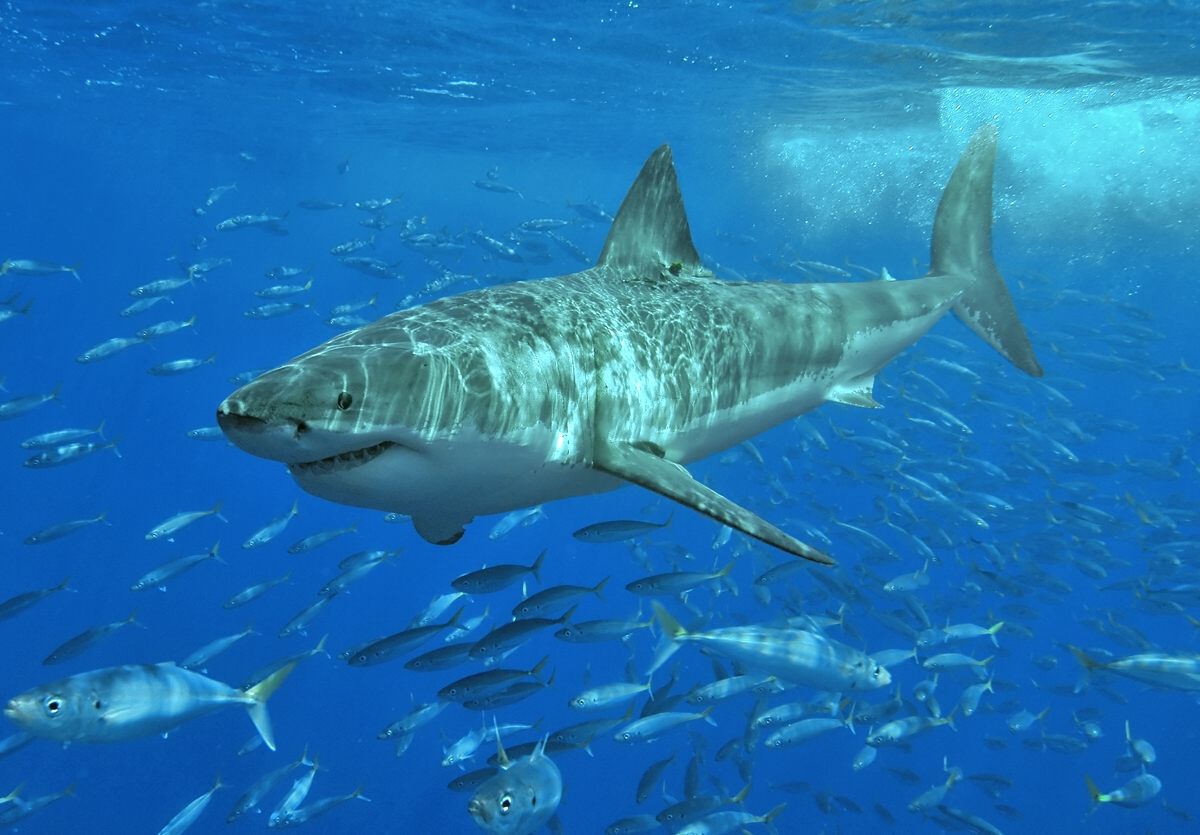
🧬 Field Guide Specimen: Open Great White Shark in the CRV Science Field Guide to log the specimen, see its place among the Vertebrates lineages in the Cladogram Explorer, and test your recall in the Red List conservation game.
Great White Shark at a Glance
| Property | Value |
|---|---|
| Scientific name | Carcharodon carcharias |
| Kingdom | Animalia |
| Phylum | Chordata |
| Class | Chondrichthyes |
| Subclass | Elasmobranchii |
| Field Guide group | Marine and Freshwater Fish |
| Diagnostic feature (Field Guide) | Apex predator with triangular serrated teeth, a cartilaginous skeleton, a countershaded torpedo body, and electrosensory pores on the snout. |
| IUCN Red List status | Vulnerable (VU), assessed 2022 |
| Maximum length | About 6 meters |
Taxonomy, Phylogenetics, and Evolutionary History
Placement in the Family Lamnidae and Cenozoic Dental Evolution
Described by Carl Linnaeus in Systema Naturae (1758) as Squalus carcharias and placed in the monotypic genus Carcharodon by Andrew Smith in 1838, the great white shark belongs to the family Lamnidae (mackerel sharks, order Lamniformes). Molecular phylogenies place Carcharodon carcharias as the sister taxon to the clade uniting the mako sharks (Isurus oxyrinchus and I. paucus) and porbeagle/salmon sharks (Lamna nasus and L. ditropis). Unlike ectothermic squaliforms such as the Spiny Dogfish (Squalus acanthias), all five extant lamnid species share a spindle-shaped body, a lunate caudal fin supported by lateral keels, and vascular countercurrent heat exchangers.
Miocene and Pliocene fossil sequences from the Pisco Formation of Peru and Chile resolved long-standing debates over white shark origins by documenting a continuous evolutionary transition from the smooth-toothed Miocene mako Carcharodon hastalis via Carcharodon hubbelli (6.5–5.5 million years ago) to modern Carcharodon carcharias through the progressive acquisition of marginal tooth serrations. Conversely, the giant Neogene megatooth shark (Otodus megalodon) belonged to the separate extinct family Otodontidae and evolved serrated teeth and gigantism independently by convergent evolution.
Comparative Anatomy, Physiology, and Genome Stability
Regional Endothermy, Ampullae of Lorenzini, and the 4.63-Gb Genome
Whereas most fishes equilibrate thermally with ambient seawater as venous blood crosses the gills, Carcharodon carcharias is a regional endotherm that keeps its aerobic red swimming musculature, stomach, liver, and brain 4 °C to 14 °C warmer than the surrounding ocean. Its oxidative red myotomal muscle is internalized near the vertebral column and supplied by paired lateral cutaneous arteries and veins that branch into countercurrent vascular bundles—the lateral cutaneous, suprahepatic, and cranial retia mirabilia—where warm venous blood leaving active tissues transfers heat to cold oxygenated arterial blood arriving from the gills.
| Physiological or Anatomical System | Structural Mechanism in Carcharodon carcharias | Quantitative Performance / Functional Outcome |
|---|---|---|
| Red-muscle vascular heat exchanger | Internalized axial red myotomes perfused by lateral cutaneous retia mirabilia | Elevates muscle temperature 8–14 °C above ambient water; boosts myofibrillar ATPase power |
| Visceral & cranial retia mirabilia | Suprahepatic gastric plexus and orbital vascular network warmed by extraocular muscles | Maintains stomach (~26 °C) and brain/retina warmth during dives to 1,200 m depth (4–6 °C) |
| Ampullae of Lorenzini | Subdermal cephalic pores filled with proton-conductive keratan-sulfate hydrogel | Detects bioelectric dipoles down to 0.5–5 nV cm−1 via voltage-gated Ca2+ and BK K+ channels |
| Mineralized jaw cartilage & dentition | Palatoquadrate reinforced by surface layers of hydroxyapatite tesserae, Ca10(PO4)6(OH)2 | Generates ~18,216 N posterior bite force in 6.4 m adults with serrated triangular upper teeth |
| 4.63-Gb nuclear genome | Gene duplications and positive selection in DNA-repair (FOXO3, ATM, TP53) and fibrinogen pathways | Preserves chromosomal stability and rapid wound healing across a >70-year lifespan |
The conical snout bears hundreds of ampullae of Lorenzini, electroreceptive organs whose keratan-sulfate jelly canals detect weak voltage gradients down to 0.5 to 5 nV cm−1 produced by prey gill ventilation (Na+/K+ ion fluxes) and cardiac contractions. Sequencing of the 4.63-gigabase nuclear genome (2*n* = 82) by Mahmood Shivji, Nicholas Marra, and colleagues (2019) revealed lineage-specific gene duplications and positive selection across DNA double-strand break repair, chromatin remodeling (ATM, ATR, BRCA2, FOXO3), and blood-clotting fibrinogen pathways. Bomb-radiocarbon (14C) dating of calcified vertebral rings by Li Ling Hamady et al. (2014) demonstrated that male white sharks live at least 73 years and females 40 to 70+ years, maturing late at 26 years in males (~3.6 m) and 33 years in females (~4.8 m).
Trophic Ecology, Transoceanic Migration, and Conservation
Juvenile white sharks (<2.5 meters) feed primarily on demersal teleosts, elasmobranchs, and squid before undergoing an ontogenetic dietary shift at ~3.0 meters length—accompanied by tooth broadening and multilayered mineralization of the jaw cartilage with hydroxyapatite tesserae—to hunt pinnipeds, small cetaceans, and whale carcasses at the apex of the marine Food web. Satellite tagging by Ramon Bonfil, Barbara Block, and colleagues showed that Carcharodon carcharias crosses ocean basins and dives to 1,200 meters, including a 99-day, 11,100-kilometer transit from South Africa to Australia and seasonal migrations to the mid-Pacific White Shark Café. Reproduction is aplacental viviparous with oophagy, producing litters of 2 to 14 neonates (1.2–1.5 m long) after a 12- to 18-month gestation. Assessed as Vulnerable (VU) on the IUCN Red List (2022) and listed on CITES Appendix II, the species remains threatened by commercial bycatch, beach meshing, and the fin and jaw trade.
Frequently Asked Questions
How does a great white shark keep its body warmer than the surrounding ocean water?
Unlike most fish, which lose metabolic heat to the water as blood flows through the gills, the great white shark routes blood to its deep red swimming muscles, stomach, and eyes through countercurrent vascular networks called retia mirabilia. In these dense bundles of parallel arteries and veins, warm venous blood leaving active tissues transfers heat directly to cold oxygenated arterial blood arriving from the gills, maintaining internal temperatures 4 °C to 14 °C above ambient seawater.
How did scientists discover that great white sharks can live for more than 70 years?
Researchers used bomb-radiocarbon (14C) dating on growth rings in the calcified vertebral centra of white sharks from the northwestern Atlantic. Atmospheric nuclear weapons testing in the late 1950s and early 1960s created a global pulse in ocean 14C levels; locating this radiocarbon marker inside the vertebrae proved that growth bands form much more slowly in older adults than previously assumed, extending verified lifespans beyond 70 years.
Why do great white sharks switch from eating fish to hunting seals as they grow?
Young white sharks under 3 meters long have narrower, pointed teeth suited for grasping slippery bony fishes and squid, and their jaws are not yet heavily mineralized. As a shark reaches 3.0 to 3.5 meters in length, its jaw cartilage adds surface layers of mineralized calcium-phosphate tiles (tesserae) and its teeth broaden into serrated triangular blades capable of shearing marine mammal blubber and bone.
References
- Hamady, L. L., Natanson, L. J., Skomal, G. B., & Thorrold, S. R. (2014). Vertebral bomb radiocarbon suggests extreme longevity in white sharks. PLOS ONE, 9(1), e84006. https://doi.org/10.1371/journal.pone.0084006
- Marra, N. J., Stanhope, M. J., Jue, N. K., Wang, M., Sun, Q., Pavinski Bitar, P., Locarnini, S. P., et al. (2019). White shark genome reveals ancient elasmobranch adaptations associated with wound healing and the maintenance of genome stability. Proceedings of the National Academy of Sciences, 116(10), 4446–4455. https://doi.org/10.1073/pnas.1819778116
- Bonfil, R., Meÿer, M., Scholl, M. C., Johnson, R., O'Brien, S., Oosthuizen, H., Swanson, S., Kotze, D., & Paterson, M. (2005). Transoceanic migration, spatial dynamics, and population linkages of white sharks. Science, 310(5745), 100–103. https://doi.org/10.1126/science.1114898
- Wroe, S., Huber, D. R., Lowry, M., McHenry, C., Moreno, K., Clausen, P., Ferrara, T. L., Cunningham, E., Dean, M. N., & Summers, A. P. (2008). Three-dimensional computer analysis of white shark jaw mechanics: how hard can a great white bite? Journal of Zoology, 276(4), 336–342. https://doi.org/10.1111/j.1469-7998.2008.00494.x