Spiny Dogfish
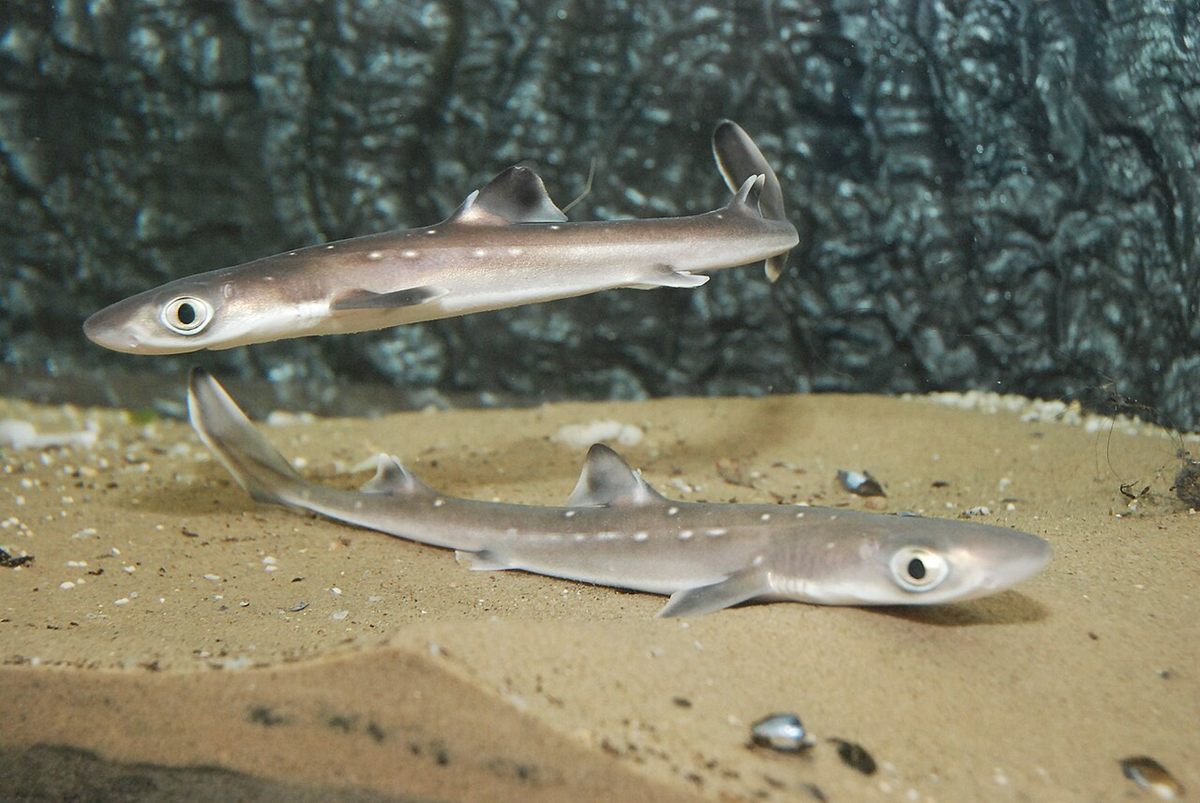
The spiny dogfish (Squalus acanthias) is a small shark found in cool temperate seas worldwide, known for the venom-tipped spine in front of each of its two dorsal fins. Globally it is listed as Vulnerable.
The spiny dogfish (Squalus acanthias) is a small shark found in cool temperate seas worldwide, known for the venom-tipped spine in front of each of its two dorsal fins. Globally it is listed as Vulnerable.
🧬 Field Guide Specimen: Open Spiny Dogfish in the CRV Science Field Guide to log the specimen, see its place among the Vertebrates lineages in the Cladogram Explorer, and test your recall in the Red List conservation game.
Spiny Dogfish at a Glance
| Property | Value |
|---|---|
| Scientific name | Squalus acanthias |
| Kingdom | Animalia |
| Phylum | Chordata |
| Class | Chondrichthyes |
| Subclass | Elasmobranchii |
| Field Guide group | Marine and Freshwater Fish |
| Diagnostic feature (Field Guide) | Standard vertebrate dissection model highlighting a heterocercal tail, placoid scales, and a massive oily liver. |
| IUCN Red List status | Vulnerable (VU), assessed 2020 |
| Gestation | About two years |
Evolutionary Systematics & Comparative Anatomy
Squalus acanthias is the type species of the family Squalidae within the order Squaliformes (dogfish sharks), belonging to the superorder Squalomorphii—one of the two major crown divisions of modern selachians alongside Galeomorphii (which includes lamniforms such as the Great White Shark) and sister to Batoidea (skates and rays such as the Little Skate). Squaliform sharks are characterized by the absence of an anal fin, absence of a nictitating lower eyelid, presence of five gill slits situated anterior to the pectoral fin base, and relatively large spiracles behind the eyes. Molecular phylogenetic revisions resolved North Pacific populations formerly assigned to S. acanthias as a distinct species, the Pacific spiny dogfish (Squalus suckleyi), restricting S. acanthias sensu stricto to the North Atlantic, Mediterranean and Black Seas, and temperate Southern Hemisphere oceans.
Because of its manageable size (typically 75 to 105 cm total length, with females reaching up to 125 cm and 9 kg) and retention of ancestral gnathostome traits, S. acanthias serves as the classic comparative vertebrate anatomy dissection model. Its endoskeleton is composed of hyaline cartilage reinforced in high-stress zones—such as the palatoquadrate (upper jaw), Meckel's cartilage (lower jaw), and amphicoelous vertebral centra—by surface tesserae of prismatic hydroxyapatite (Ca10(PO4)6(OH)2). Jaw suspension is hyostylic: the palatoquadrate articulates loosely with the chondrocranium via orbital processes and ligaments while being braced posteriorly by the hyomandibular cartilage, permitting rapid upper-jaw protrusion during biting.
The outer integument is covered in placoid scales (dermal denticles), which are structurally homologous to vertebrate teeth, possessing a central pulp cavity, a dentine layer secreted by odontoblasts, and an outer enameloid cap. Immediately anterior to both the first and second dorsal fins sits a stout, mineralized spine anchored deep onto the cartilaginous basal pterygiophores. Each dorsal spine carries a shallow anterolateral groove lined by secretory epithelial tissue that produces a mild, proteinaceous venom; when a predator seizes the shark, the dogfish arches its back defensively to drive the spines upward. Internally, the digestive tract features a short, J-shaped stomach leading to a compact valvular intestine containing a spiral valve of 14 to 16 turns, which maximizes absorptive surface area without requiring elongated intestinal loops.
Physiology, Biomechanics & Sensory Biology
Like all marine elasmobranchs, Squalus acanthias lacks a gas-filled swim bladder and regulates vertical buoyancy through its massive, bilobed liver, which accounts for 15 to 25 percent of total body mass. The hepatocyte lipid reserves are rich in low-density squalene (C30H50, specific gravity ≈ 0.858 g cm-3), an isoprenoid hydrocarbon precursor in cholesterol biosynthesis, alongside diacylglyceryl ethers and triacylglycerols. Combined with the low density of unossified cartilage (≈ 1.1 g cm-3) and forward lift generated by the wing-like pectoral fins and asymmetric heterocercal caudal fin, the lipid-rich liver brings the shark close to neutral buoyancy in seawater (≈ 1.026 g cm-3).
Osmoregulation in S. acanthias follows the marine chondrichthyan ureosmotic strategy. Whereas marine teleosts remain hypo-osmotic to seawater and lose water across their gills, the spiny dogfish maintains plasma osmolarity slightly hyper-osmotic to ambient seawater (roughly 1,000 to 1,050 mOsm L-1 versus ~1,000 mOsm L-1 in seawater) while keeping inorganic plasma Na+ and Cl- concentrations at roughly half those of seawater (~250 to 280 mmol L-1). The osmotic gap is filled by retaining 350 to 400 mmol L-1 of urea (CO(NH2)2) synthesized via the hepatic ornithine-urea cycle, paired with 70 to 120 mmol L-1 of trimethylamine N-oxide (TMAO, (CH3)3NO), which counteracts the protein-denaturing effects of high urea concentrations at a roughly 2:1 urea-to-TMAO ratio. Excess Na+ and Cl- diffusing inward across the branchial epithelium are actively excreted into the hindgut by the specialized rectal gland, a finger-like tubular organ whose epithelial cells couple basolateral Na+/K+-ATPase and Na+-K+-2Cl- cotransporters (NKCC1) with apical CFTR chloride channels.
In 1993, biochemical screening of S. acanthias stomach and liver tissues isolated squalamine, a water-soluble cationic aminosterol consisting of a sulfated bile-salt steroid nucleus conjugated to a spermidine polyamine chain. Because elasmobranchs rely on variable lymphocyte receptors and low-affinity IgM antibodies with slow secondary immune kinetics, endogenous squalamine acts as a broad-spectrum innate antimicrobial agent that disrupts anionic bacterial membranes and inhibits endothelial Na+/H+ exchangers, blocking pathological angiogenesis. Sensory integration combines a mechanosensory lateral line canal system with cranial ampullae of Lorenzini—jelly-filled pores tuned to weak bioelectric fields down to 5 nV cm-1 generated by the branchial ion pumps of buried teleost and crustacean prey.
Trophic Ecology, Life History & Reproduction
Squalus acanthias is a benthopelagic, schooling predator inhabiting continental shelves and upper slopes from the intertidal zone down to 900 m depth, preferring water temperatures between 7 °C and 15 °C. Schools segregate by body size and sex—with large mature females aggregating in shallower coastal bays and males and juveniles occupying deeper offshore waters—and execute seasonal latitudinal and bathymetrical migrations tracking thermal fronts and forage fish schools. The diet consists of pelagic and demersal teleosts (including herring, menhaden, capelin, hake, sand lance, and cod), squids (Loligo and Illex), ctenophores, polychaetes, and brachyuran crabs. Equipped with oblique, blade-like teeth that form a continuous cutting edge along both jaws, packs of dogfish can shear chunks of flesh from prey larger than themselves.
Reproduction occurs via aplacental viviparity (lecithotrophic ovoviviparity). During winter mating, the male inserts one of his paired pelvic claspers—grooved cartilaginous extensions of the pelvic fins supported by subcutaneous siphon sacs that flush seminal fluid with seawater—into the female's cloaca. Fertilized ova are packaged within thin, translucent amber-colored keratinous egg cases ("candles"), each holding 1 to 6 embryos inside the paired uteri. After approximately 4 to 6 months, the fragile candle membrane ruptures, and the embryos complete development free within the uterine lumen, nourished by their external yolk sacs.
At 18 to 24 months, the gestation period of S. acanthias (and S. suckleyi) is among the longest known across all vertebrates. During the second year of gestation, the mother periodically flushes the uterine chambers with oxygenated seawater through the cloaca to remove embryonic metabolic ammonia and supply dissolved O2. Litter sizes range from 2 to 16 live pups measuring 22 to 30 cm at birth. Combined with late female sexual maturity (12 to 20 years of age in the North Atlantic, and over 35 years in the North Pacific S. suckleyi) and lifespans reaching 40 to 75 years, this low intrinsic rate of population growth makes dogfish stocks susceptible to recruitment collapse when commercial trawling and gillnet fisheries target aggregating pregnant females for European "rock salmon" and Asian fin markets.
Frequently Asked Questions
How does the spiny dogfish maintain salt and water balance in the ocean?
Unlike bony fishes that constantly drink seawater to replace lost water, the spiny dogfish keeps its blood slightly more concentrated than seawater by retaining high levels of urea and trimethylamine N-oxide (TMAO). Water therefore enters the shark slowly by osmosis across the gills, while excess sodium and chloride ions are actively pumped out of the bloodstream by the specialized rectal gland.
What is squalamine, and why was it discovered in the spiny dogfish?
Squalamine is an antimicrobial aminosterol compound discovered in 1993 in the stomach and liver tissues of Squalus acanthias. It consists of a steroid ring attached to a positively charged spermidine chain, allowing it to disrupt negatively charged bacterial membranes and inhibit abnormal blood vessel growth (angiogenesis) as part of the shark's innate chemical defense system.
Why is the spiny dogfish vulnerable to overfishing despite being widespread?
The spiny dogfish has a slow life history characterized by late sexual maturity (12 to over 20 years in females), small litter sizes of 2 to 16 pups, and a 18-to-24-month gestation period—one of the longest pregnancies of any vertebrate. Because commercial fisheries preferentially capture large, schooling pregnant females, depleted populations require decades to recover.
References
- Moore, K. S., Wehrli, S., Roder, H., Rogers, M., Forrest, J. N., McCrimmon, D., & Zasloff, M. (1993). "Squalamine: an aminosterol antibiotic from the shark." Proceedings of the National Academy of Sciences, 90(4), 1354–1358. https://doi.org/10.1073/pnas.90.4.1354
- Ebert, D. A., White, W. T., Goldman, K. J., Compagno, L. J. V., Daly-Engel, T. S., & Ward, R. D. (2010). "Resurrection and redescription of Squalus suckleyi (Girard, 1854) from the North Pacific, with comments on the Squalus acanthias subgroup (Squaliformes: Squalidae)." Zootaxa, 2612(1), 22–40. https://doi.org/10.11646/zootaxa.2612.1.2
- Silva, P., Solomon, R. J., & Epstein, F. H. (1997). "Transport mechanisms that mediate the secretion of chloride by the rectal gland of Squalus acanthias." Journal of Experimental Zoology, 279(5), 504–508. https://doi.org/10.1002/(SICI)1097-010X(19971201)279:5<504::AID-JEZ14>3.0.CO;2-71097-010X(19971201)279:5<504::AID-JEZ14>3.0.CO;2-7)
- Fordham, S. V., Fowler, S. L., Coelho, R. P., Goldman, K. J., & Francis, M. P. (2016). "*Squalus acanthias*." The IUCN Red List of Threatened Species, e.T91209505A2898271. https://doi.org/10.2305/IUCN.UK.2016-1.RLTS.T91209505A2898271.en