Honduran White Bat
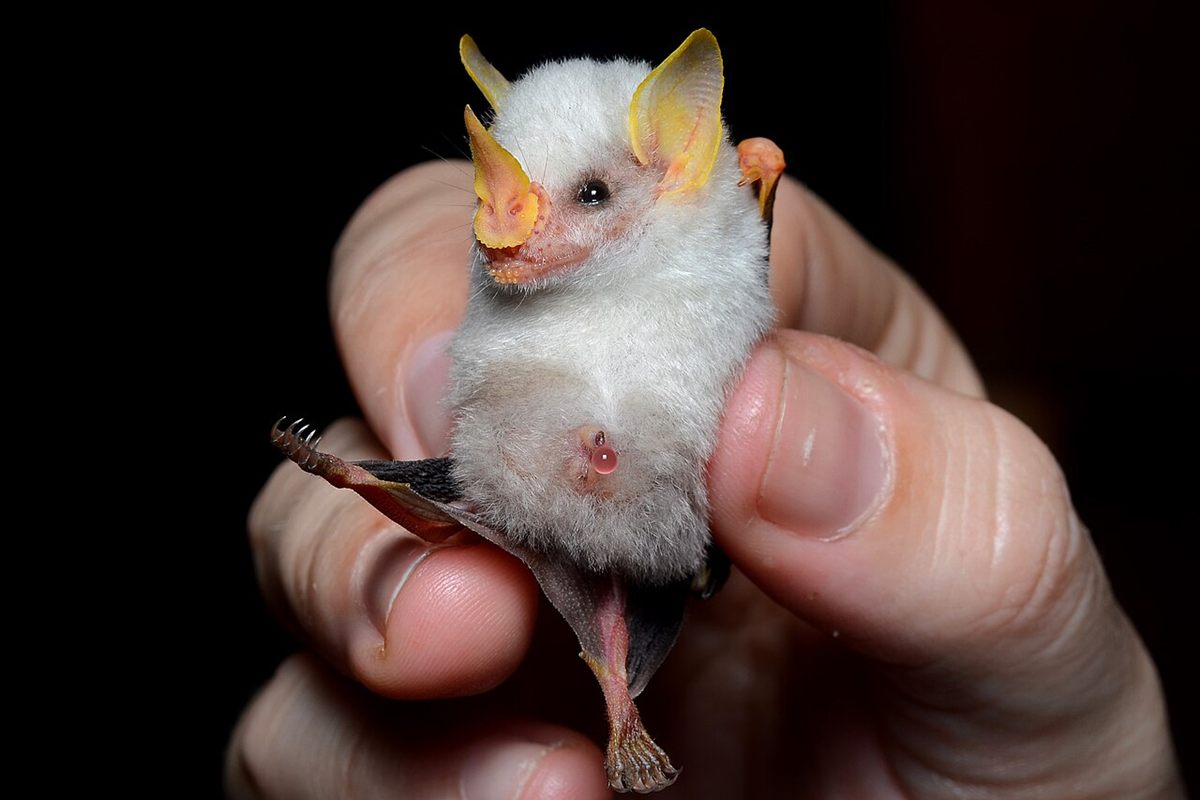
The Honduran white bat (Ectophylla alba) is a tiny, snow-white bat with a yellow nose and ears, found in the rainforests of Central America. It roosts under large leaves that it modifies into tents.
The Honduran white bat (Ectophylla alba) is a tiny, snow-white bat with a yellow nose and ears, found in the rainforests of Central America. It roosts under large leaves that it modifies into tents.
🧬 Field Guide Specimen: Open Honduran White Bat in the CRV Science Field Guide to log the specimen, see its place among the Mammals lineages in the Cladogram Explorer, and test your recall in the Red List conservation game.
A Tent of Leaves
The bat bites along the midrib of a large Heliconia leaf so that the two halves fold down into a tent. Groups of up to a dozen bats roost beneath it, protected from rain and predators.
Green Light for Camouflage
Sunlight filtering through the leaf turns green, which bathes the white bats in light that makes them look green and hides them from predators.
Fig Eaters
The bats feed mostly on figs, and disperse their seeds. Loss of lowland forest is the main threat. See Banyan Tree.
Honduran White Bat at a Glance
| Property | Value |
|---|---|
| Scientific name | Ectophylla alba |
| Kingdom | Animalia |
| Phylum | Chordata |
| Class | Mammalia |
| Order | Chiroptera |
| Family | Phyllostomidae |
| Field Guide group | Mammals: Eutheria (Placentals) |
| Diagnostic feature (Field Guide) | Tiny snow-white rainforest mammal with a bright yellow-orange leaf-shaped nose structure and ears, famous for chewing Heliconia leaf veins to fold green roosting tents. |
| IUCN Red List status | Near Threatened (NT), assessed 2015 |
| Family | Phyllostomidae |
| Roost | Leaf tents |
See Also
- Banyan Tree — a fig tree
- Large Flying Fox — another fruit-eating bat