Lobed Comb Jelly
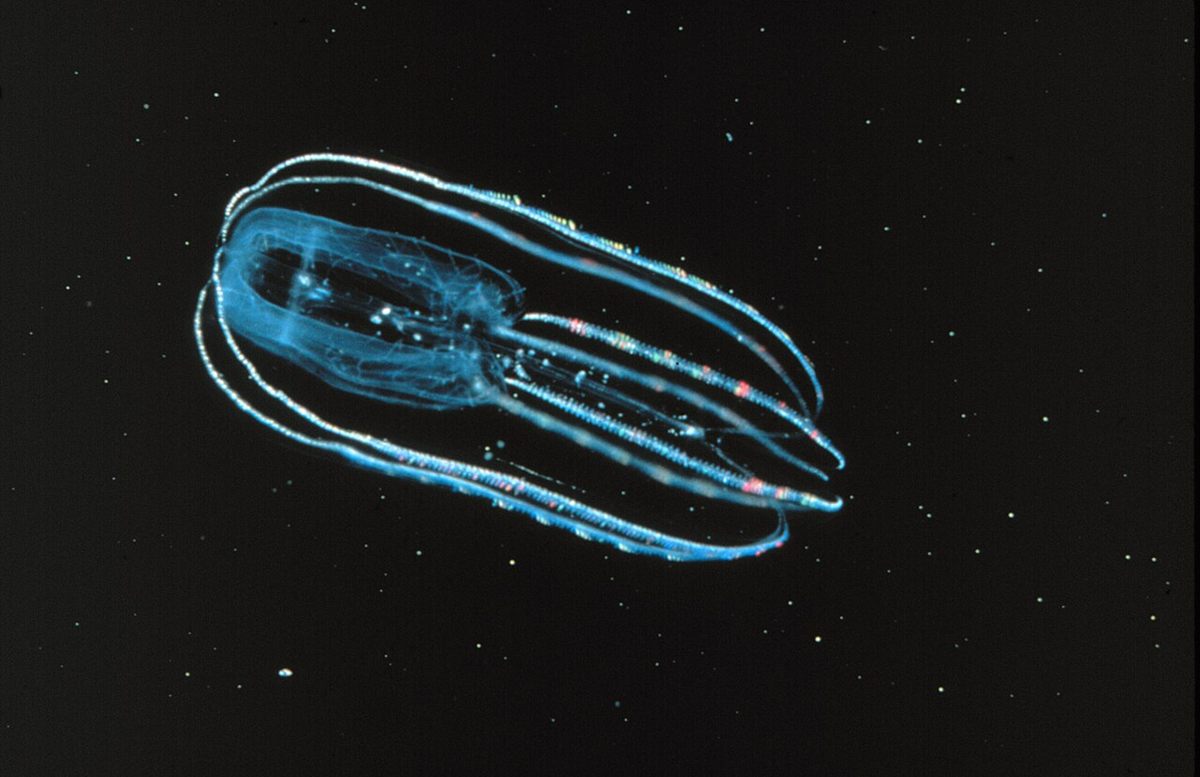
The lobed comb jelly (Bolinopsis infundibulum) is a transparent comb jelly of the northern Atlantic with two large, fleshy lobes around its mouth. It filters plankton as it swims slowly.
The lobed comb jelly (Bolinopsis infundibulum) is a transparent comb jelly of the northern Atlantic with two large, fleshy lobes around its mouth. It filters plankton as it swims slowly.
🧬 Field Guide Specimen: Open Lobed Comb Jelly in the CRV Science Field Guide to log the specimen, see its place among the Cnidaria+Ctenophora lineages in the Cladogram Explorer, and test your recall in the Red List conservation game.
Lobed Comb Jelly at a Glance
| Property | Value |
|---|---|
| Scientific name | Bolinopsis infundibulum |
| Kingdom | Animalia |
| Phylum | Ctenophora |
| Class | Tentaculata |
| Order | Lobata |
| Family | Bolinopsidae |
| Field Guide group | Cnidaria + Ctenophora (Radiata & Jellies) |
| Diagnostic feature (Field Guide) | Transparent walnut-sized body with two large oral lobes; eight rows of beating cilia scatter light into rainbows as it drifts through cold northern seas. |
| Phylum | Ctenophora |
| Feature | Two large oral lobes |
Evolutionary Systematics and Comparative Anatomy
Bolinopsis infundibulum is the type species of the genus Bolinopsis (family Bolinopsidae) within the order Lobata, class Tentaculata, phylum Ctenophora. Molecular phylogenetics using nuclear ribosomal (18S, 28S rRNA) and mitochondrial loci indicates that the order Lobata—which also includes the invasive western Atlantic sea walnut (Mnemiopsis leidyi)—is polyphyletic or paraphyletic with respect to cydippid and cestid ctenophores (such as Venus' Girdle, Cestum veneris), reflecting repeated evolutionary transitions from long-tentacled pelagic ambush predators to lobe-bearing continuous suspension feeders. On the broader metazoan tree, phylogenomic analyses and chromosomal synteny comparisons place Ctenophora as one of the earliest-diverging animal phyla, possessing a subepidermal polygonal nerve net that lacks classical bilaterian neurotransmitters such as serotonin, dopamine, and acetylcholine, relying instead on L-glutamate, glycine, and lineage-specific neuropeptides.
Like all ctenophores, B. infundibulum displays biradial (rotational) symmetry organized along an oral-aboral axis intersected by two orthogonal planes: the tentacular plane and the sagittal (stomodeal) plane. Adults are ovoid to pear-shaped and laterally compressed, typically reaching 50 to 150 mm in total length (with exceptional cold-water Arctic specimens reaching 180 mm). Making up roughly 45% to 55% of total body length is a pair of wide, muscular, gelatinous oral lobes that flare outward on either side of the mouth in the stomodeal plane. Flanking the bases of the oral lobes are four slender, ciliated ribbon-like projections called auricles, whose marginal cilia beat to generate localized eddies across the oral groove.
Whereas cydippid comb jellies (Pleurobrachia) trail two long branched fishing tentacles from deep sheaths throughout adulthood, adult B. infundibulum reduce their primary tentacular apparatus to a pair of short, recessed labial tentilla clusters housed near the corners of the mouth, from which fine secondary filaments extend over the inner surfaces of the oral lobes. Running down the transparent, colorless mesogleal body from the aboral sensory organ are eight meridian comb rows (costae) of fused macrocilia: four longer substomodeal rows extending onto the aboral surface of the oral lobes and four shorter subtentacular rows terminating near the auricle bases.
Physiology, Biomechanics, and Sensory Biology
Metachronal Ciliary Propulsion and Optical Iridescence
Bolinopsis infundibulum is among the largest organisms on Earth to propel itself via ciliary action. Each of the eight comb rows consists of 25 to 60 transverse paddle-like plates called ctenes (comb plates). A single ctene is formed by the lateral fusion of tens of thousands of individual cilia—each ~0.8 to 1.5 mm long and containing the standard eukaryotic 9 + 2 microtubule axoneme plus a specialized intraciliary compartmenting lamella that mechanically couples adjacent cilia along the beat plane.
Comb plates beat toward the aboral pole during their effective power stroke (pushing water toward the oral lobes and propelling the animal mouth-first through the sea at speeds of 2 to 15 mm s-1), while the recovery wave of activation propagates sequentially from the aboral pole toward the oral pole (antiplectic metachronism). Coordination between neighboring ctenes within a row is governed primarily by hydrodynamic and mechanical coupling paired with action potentials transmitted along the eight ciliated grooves running from the aboral apical organ. Housed beneath a transparent dome of fused cilia at the aboral pole, the apical organ contains a calcareous statolith balanced upon four tufts of mechanosensory balancer cilia (one tuft per body quadrant). When the ctenophore tilts away from vertical, the gravity-shifted statolith deflects the lower balancer cilia, opening stretch-activated ion channels that increase the beat frequency of the corresponding comb rows to restore upright orientation.
Although the rainbow-colored light flashes running down the eight comb rows of B. infundibulum are often mistaken for bioluminescence in illuminated photographs, this daytime shimmer is a structural optical phenomenon: the periodic array of microtubules and cilia within each moving ctene acts as a two-dimensional diffraction grating that scatters ambient light into spectral wavelengths. In total darkness, however, mechanical disturbance triggers true blue-green bioluminescence (λmax ~485 to 490 nm) produced inside photocytes along the meridional gastrovascular canals by the calcium-dependent photoprotein bolinopsin (a member of the berovin/mnemiopsin photoprotein family), which oxidizes a bound coelenterazine chromophore upon binding three Ca2+ ions without requiring free dissolved oxygen.
Stealth Hydrodynamics, Colloblasts, and Extreme Mesogleal Fragility
To capture highly perceptive copepods that dart away at the slightest fluid shear strain (threshold deformation rates of 0.5 to 2.0 s-1), B. infundibulum employs hydrodynamically stealthy feeding. As the ctenophore glides forward with its two oral lobes spread open like a funnel, the beating of the four ciliated auricles combined with slow peristaltic undulations of the lobe walls draws laminar sheets of water into the inter-lobe cavity at shear rates below the mechanosensory escape threshold of calanoid copepods. Once inside the oral funnel, prey are deflected onto the mucus-coated inner lobe surfaces and labial tentilla, which are studded with ctenophore-specific adhesive cells called colloblasts.
Each colloblast consists of a hemispherical apical head coated with eosinophilic secretory granules containing charged mucopolysaccharides and adhesive proteins, tethered to the mesoglea by a spiral contractile filament and a straight nuclear root. Contact with a crustacean ruptures the apical granules, gluing the prey fast without injecting venom; the oral lobe then folds inward or transports the trapped organism along ciliated labial grooves directly into the slit-like mouth.
The acellular mesoglea of B. infundibulum contains 95% to 96% seawater reinforced by a sparse network of collagen-like glycoproteins, elastic fibers, and branching smooth muscle cells, giving the animal a wet-weight carbon content below 0.1% to 0.2%. While this high gelatinous hydration allows B. infundibulum to grow rapidly into a large filtering funnel on a tiny metabolic investment (Q10-adjusted respiration rate of ~2 to 5 microliters O2 mg-1 dry weight h-1 at 8 °C), it makes the body wall very fragile: standard plankton nets shear the lobes into unidentifiable mucus shreds, and even contact with the air-water interface or vigorous wave turbulence causes immediate tissue autolysis.
Trophic Ecology, Life History, and Reproduction
Zooplankton Grazing and Intraguild Predation by Beroe
Bolinopsis infundibulum has a circumpolar Arctic, subarctic, and cold-temperate North Atlantic distribution, occurring from the high Arctic fjords of Svalbard, Greenland, and the Barents Sea south to the North Sea, the Scottish sea lochs, the Gulf of Maine, and Nova Scotia, with closely related populations in the subarctic North Pacific. It inhabits coastal surface waters and midwater pycnoclines from 0 to 200 m depth across temperatures of -1.5 °C to 15 °C. During late spring and summer phytoplankton and copepod blooms, B. infundibulum forms dense seasonal swarms reaching 10 to 100 individuals per cubic meter.
Clearance rate experiments show that an adult B. infundibulum filters 0.5 to 3.5 liters of seawater per hour, consuming calanoid copepods (Calanus finmarchicus, Pseudocalanus, Acartia), cladocerans (Evadne), barnacle nauplii, bivalve and gastropod veligers, appendicularians, and fish eggs. Digested nutrients pass from the laterally flattened stomodeum (pharynx) into the central infundibulum (stomach) and out through the branching gastrovascular canal system that underlies the eight comb rows and loops through the oral lobes; indigestible chitinous exoskeletons are egested primarily back out the mouth, while soluble metabolic wastes and fine particulates exit through two small aboral anal pores that open intermittently near the apical organ.
In northern marine food webs, swarms of B. infundibulum are regulated top-down by their specialist predator, the Melon Comb Jelly (Beroe cucumis) and its congener Beroe gracilis. Lacking tentacles or lobes, Beroe tracks the chemical trail of B. infundibulum, flares its wide muscular mouth upon contact, and either swallows smaller Bolinopsis whole or uses rows of fused sickle-shaped macrocilia lining its lips to bite chunks out of the oral lobes. Additional predators include the lion's mane jellyfish (Cyanea capillata), lumpfish (Cyclopterus lumpus), Atlantic mackerel, and spiny dogfish.
Simultaneous Hermaphroditism and the Cydippid Larva
Like almost all ctenophores, Bolinopsis infundibulum is a simultaneous hermaphrodite capable of both cross-fertilization and self-fertilization. Running alongside the inner wall of each of the eight meridional gastrovascular canals beneath the comb rows are paired longitudinal gonads—a band of ovaries facing one side of the canal and a band of testes facing the other. Triggered by changes in ambient light and food availability during spring and summer, mature spermatozoa are released first through temporary gonopores above the comb rows into the seawater, followed minutes later by hundreds of transparent, yolk-poor ova (180 to 250 micrometers in diameter).
Fertilized eggs undergo the invariant, deterministic ctenophore cleavage pattern (biradial cleavage into E endomesodermal and M macromere lineages) and hatch within 24 to 48 hours (at 10 °C to 12 °C) into a free-swimming cydippid larva measuring 0.3 to 0.5 mm in diameter. Unlike the lobed adult, the cydippid larva is spherical, lacks oral lobes and auricles, and hunts microzooplankton (tintinnids, rotifers, and copepod nauplii) by trailing two long, retractile, branched fishing tentacles from deep tentacle sheaths—recapitulating the ancestral tentaculate cydippid body plan. Only when the juvenile reaches a body length of 3 to 6 mm do the two oral lobes and four auricles bud outward from the oral margin, progressively resorbing the long primary tentacles into short labial tentilla as the animal transitions from tentacular ambush predation to lobate funnel suspension feeding. Moreover, B. infundibulum exhibits larval dissogony: cydippid larvae can transiently mature miniature gonads and spawn viable gametes at a body size of ~1 to 2 mm before resorbing the larval gonads, growing into lobed adults, and reproducing a second time.
Frequently Asked Questions
Why do the comb rows of the lobed comb jelly flash with rainbow colors?
The shimmering rainbow colors traveling down the eight comb rows of Bolinopsis infundibulum are not bioluminescence, which only occurs as a brief blue-green flash in darkness when the animal is disturbed. Instead, each comb plate (ctene) is built from tens of thousands of microscopic cilia packed in regular rows that act as a diffraction grating, splitting ambient sunlight or dive-torch light into moving rainbow spectra as the combs beat.
How does Bolinopsis infundibulum catch fast-swimming copepods while moving so slowly?
Copepods escape predators by detecting tiny fluid disturbances with mechanosensory hairs on their antennae. Bolinopsis infundibulum overcomes this defense by spreading its two wide, gelatinous oral lobes like a silent glider and using four ciliated auricles to draw seawater gently into the space between the lobes at shear rates below the copepod's detection threshold, trapping the unaware crustacean against sticky colloblast cells before it ever senses a threat.
Why do baby lobed comb jellies look so different from the adults?
Newly hatched Bolinopsis infundibulum pass through a spherical "cydippid larva" stage that has no oral lobes at all and instead trails two long, branched fishing tentacles like a sea gooseberry (Pleurobrachia). As the larva grows past 4 to 6 millimeters in length, it grows two large oral lobes and four auricles around its mouth while shrinking its long tentacles into short oral fringes, shifting its diet from microplankton to larger copepods.
References
- Clancy, M. (1997). Feeding behavior of the lobate ctenophore Bolinopsis infundibulum on small copepods. Marine Ecology Progress Series, 158, 121–129. https://doi.org/10.3354/meps158121
- Podar, M., Haddock, S. H. D., Sogin, M. L., & Harbison, G. R. (2001). A molecular phylogenetic framework for the phylum Ctenophora using 18S rRNA genes. Molecular Phylogenetics and Evolution, 21(2), 218–230. https://doi.org/10.1006/mpev.2001.1036
- Greve, W. (1970). Cultivation experiments on North Sea ctenophores. Helgoländer wissenschaftliche Meeresuntersuchungen, 20(1), 304–317. https://doi.org/10.1007/BF01609908
- Tamm, S. L. (2014). Cilia and the life of ctenophores. Invertebrate Biology, 133(1), 1–46. https://doi.org/10.1111/ivb.12042