Venus' Girdle
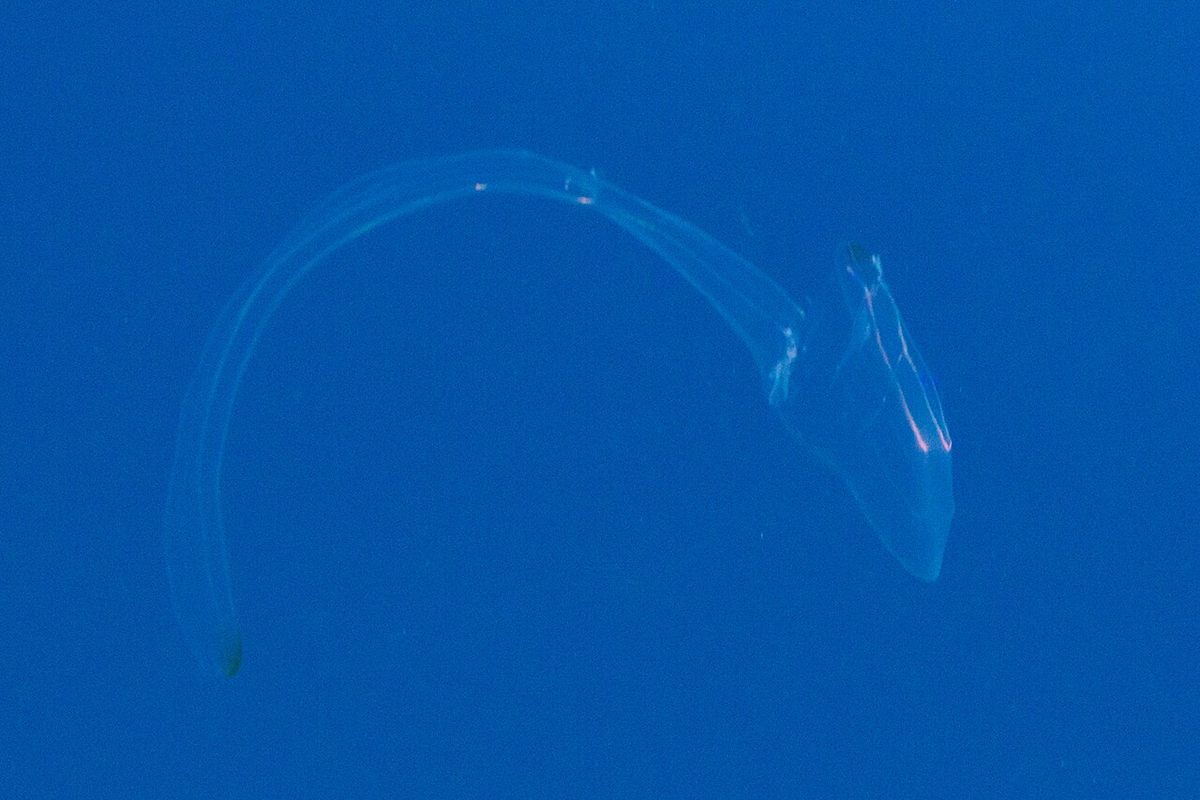
Venus' girdle (Cestum veneris) is a ribbon-shaped comb jelly of warm seas that can be over a meter long. It swims by wavy movements of its body and rows of beating combs.
Venus' girdle (Cestum veneris) is a pelagic, gelatinous marine comb jelly of the phylum Ctenophora (class Tentaculata, order Cestida, family Cestidae) distributed across warm-temperate, subtropical, and tropical open oceans worldwide, including the Mediterranean Sea, Atlantic, Indian, and Pacific oceans. Named after the mythical enchanted belt (girdle) of the Roman goddess Venus by French naturalist Charles Alexandre Lesueur in 1813, Cestum veneris is the largest and most geometrically modified of all ctenophores: its transparent, glass-clear gelatinous body is compressed along the tentacular plane and stretched along the sagittal (stomodeal) plane into a flat, iridescent swimming ribbon up to 1.0 to 1.5 meters long, capable of both slow ciliary cruising via eight modified comb rows (ctenes) and rapid anguilliform (eel-like) muscular escape undulation.
🧬 Field Guide Specimen: Open Venus' Girdle in the CRV Science Field Guide to log the specimen, see its place among the Cnidaria+Ctenophora lineages in the Cladogram Explorer, and test your recall in the Red List conservation game.
Venus' Girdle at a Glance
| Property | Value |
|---|---|
| Scientific name | Cestum veneris |
| Kingdom | Animalia |
| Phylum | Ctenophora |
| Class | Tentaculata |
| Order | Cestida |
| Family | Cestidae |
| Field Guide group | Cnidaria + Ctenophora (Radiata & Jellies) |
| Diagnostic feature (Field Guide) | Flattened transparent ribbon up to 1.5 m long that swims by undulating like a belt; its edges shimmer violet-blue in sunlight. |
| Phylum | Ctenophora |
| Shape | Ribbon, up to over a meter |
Taxonomy, Cydippid Ontogeny, and Cestid Evolution
Described by Charles Alexandre Lesueur in 1813 from specimens collected in the Mediterranean Sea off Nice, France, Cestum veneris is the type and sole confirmed species of the genus Cestum, which sits alongside the smaller, cold-water and mesopelagic ribbon genus Velamen (Velamen parallelum, reaching ~15–20 cm) as the only two genera in the family Cestidae and order Cestida (class Tentaculata, phylum Ctenophora).
Although an adult Cestum veneris looks nothing like a spherical sea gooseberry (Pleurobrachia pileus), its ontogeny directly recapitulates its cydippid ancestry:
- The Cydippid Larva: Fertilized eggs hatch into a microscopic, spherical-to-pear-shaped cydippid larva equipped with eight equal meridional comb rows, an apical statocyst (gravity-sensing organ), and a pair of long, branched retractable tentacles emerging from aboral tentacle sheaths.
- 90-Degree Axial Compression and Wing Elongation: As the larva grows past a few millimeters, the body undergoes differential allometric expansion: the tentacular axis becomes compressed flat (to a thickness of only 2 to 5 mm), while the stomodeal (pharyngeal) plane elongates laterally in both directions into two symmetrical, blade-like gelatinous wings up to 50–75 cm on each side of the central mouth (total span 80 to 150 cm, height 4 to 8 cm). Consequently, the central mouth sits at the midpoint of the long lower (oral) margin of the ribbon, directly opposite the apical sensory organ (statocyst) at the midpoint of the long upper (aboral) margin.
Comparative Anatomy: Dimorphic Comb Rows, Oral Groove Colloblasts, and Dual Locomotion
1. Remodeling of the Eight Comb Rows (Subtentacular vs. Subsagittal Ctenes)
To accommodate its 1.5-meter ribbon geometry, the eight meridional ctenophore comb rows (ctenes, each composed of thousands of fused giant macrocilia that diffract incident sunlight like a diffraction grating into shimmering rainbow bands) are partitioned into two unequal sets:
- Four Subsagittal Comb Rows (Long Aboral Edge): Run all the way along both sides of the upper (aboral) edge of the ribbon from the central statocyst out to the left and right wingtips, providing the steady metachronal ciliary thrust that propels Cestum veneris smoothly forward or obliquely upward through the water column during foraging.
- Four Subtentacular Comb Rows (Rudimentary): Greatly reduced to four short tracts flanking the central body near the tentacle bulbs.
2. The Oral Tentacular Groove and Adhesive Colloblast Curtain
In a spherical cydippid comb jelly, two long tentacles trail behind the body to snag prey. In Cestum veneris, the primary tentacles themselves are reduced to short filaments inside the central tentacle bulbs, but each tentacle base gives rise to hundreds of fine secondary tentilla that emerge from a pair of oral grooves running the entire 1.5-meter length of the lower (oral) edge of the ribbon.
During cruising, these thousands of microscopic tentilla stream upward over both flat faces of the ribbon wings like a transparent veil. Unlike cnidarians (jellyfish, corals, and siphonophores), which capture prey with venom-injecting nematocysts, ctenophores like Cestum veneris possess zero stinging cells: their tentilla are studded with specialized epidermal adhesive cells called colloblasts (consisting of a hemispherical head coated in eosinophilic adhesive granules tethered to a helical, shock-absorbing contractile filament and a straight nuclear root).
3. Fluid Mechanics of Dual-Mode Locomotion (Ciliary Gliding + Muscular Undulation)
Analyzed kinematically in situ by G. Richard Harbison, Laurence P. Madin, and William M. Kier, Cestum veneris is a biomechanical marvel that switches between two decoupled propulsion modes:
- Low-Reynolds-Number Ciliary Gliding (Foraging Mode): While hunting calanoid and cyclopoid copepods, euphausiid larvae, and pteropods, the four long aboral subsagittal comb rows beat metachronally, gliding the stiffened ribbon silently through the water at 1 to 3 cm·s−1 without creating hydrodynamic bow-waves that would trigger the mechanosensory escape jumps of copepods. When a copepod contacts the flat surface of the wing, it adheres to the colloblast tentilla curtain; coordinated ciliary tracts and tentillar contractions transport the trapped copepod onto the lower oral groove, which acts as a 1.5-meter conveyor belt carrying prey horizontally all the way to the central mouth and pharynx!
- High-Speed Anguilliform Muscular Escape (Sinusoidal Undulation): When disturbed by a predator or diver's pressure wave, Cestum veneris inhibits its comb rows and activates cross-helical subepidermal smooth muscle fibers anchored against the elastic collagenous mesoglea of the ribbon wings. Traveling sinusoidal waves pass along the 1.5-meter ribbon (exactly like a swimming ribbon eel or sea snake), propelling the animal away at 10 to 20+ cm·s−1.
| Anatomical or Functional Trait | Venus' Girdle (Cestum veneris) | Sea Walnut (Mnemiopsis leidyi) | Sea Gooseberry (Pleurobrachia pileus) |
|---|---|---|---|
| Order & Adult Body Geometry | Cestida: Compressed 1.0–1.5 m flat ribbon (wings in stomodeal plane) | Lobata: Oval body (7–12 cm) with two large oral lobes & 4 auricles | Cydippida: Spherical-to-ovoid marble (1.5–3 cm); radially globose |
| Comb Row (Ctene) Layout | 4 long aboral subsagittal rows along top edge + 4 rudimentary rows | 8 meridional comb rows running down outer body wall | 8 equal meridional comb rows from statocyst toward mouth |
| Prey Capture Apparatus | Tentillar colloblast curtain spread across both flat wing faces → oral groove | Hydrodynamic shear flow drawn between muscular oral lobes | Two long, retractable branched tentacles trailing up to 30 cm |
| Escape Locomotion | Sinusoidal anguilliform muscular undulation of the whole ribbon | Ciliary acceleration + lobe closure | Ciliary reversal / acceleration only |
Optical Iridescence versus Calcium-Activated Bioluminescence
In sunlit epipelagic waters (0–50 m), Cestum veneris shimmers with an electric violet-blue iridescent sheen along its upper and lower margins and wingtips (due to structural light interference across ordered submicroscopic structures and diffractile macrociliary ctenes). In darkness or at mesopelagic depths, mechanical stimulation triggers brilliant blue-green intrinsic bioluminescence (λmax ≈ 485–490 nm) along the meridional gastrointestinal canals running the length of the ribbon. Like Mnemiopsis and Beroe, this flash is catalyzed by a Ca2+-regulated photoprotein (clytin/mnemiopsin/berovin homolog) that oxidizes bound coelenterazine into excited coelenteramide upon Ca2+ influx without requiring free molecular oxygen at the moment of the flash.
Frequently Asked Questions
How does a 1.5-meter ribbon-shaped Venus' girdle get food caught at the tip of its wing into its tiny mouth in the center?
In Cestum veneris, the single mouth sits at the exact center of the lower (oral) edge of the ribbon—up to 75 cm away from the left and right wingtips! Running all the way from each wingtip to the central mouth along the bottom edge of the ribbon is a ciliated oral groove containing the bases of hundreds of sticky, colloblast-covered tentilla that drape upward over the flat sides of the ribbon like a flypaper curtain. Whenever a copepod brushes against the flat face of the wing and sticks to a tentillum, that tentillum contracts downward into the oral groove, which then transports the prey item horizontally along the bottom edge of the belt into the central mouth.
Does Venus' girdle sting swimmers like a jellyfish?
No. Cestum veneris belongs to the phylum Ctenophora (comb jellies), not Cnidaria (true jellyfish, box jellies, and hydrozoans). It possesses zero stinging nematocysts and is completely harmless to humans; its prey-capturing colloblasts release only microscopic droplets of mucopolysaccharide glue designed to hold millimeter-sized planktonic crustaceans.
Why do the edges of Venus' girdle flash rainbow colors in the daytime and blue-green light at night?
The two optical displays come from completely different physical mechanisms:
- Daytime Rainbow Shimmer (Structural Diffraction, Not Bioluminescence): Each comb plate (ctene) along the upper edge of the ribbon consists of thousands of aligned cilia spaced ~0.5–1.0 μm apart—matching the wavelength of visible sunlight. As the comb plates beat in metachronal waves, they act as physical diffraction gratings that split ambient downwelling sunlight into traveling rainbow spectra (coupled with structural violet-blue reflectance at the wingtips).
- Nighttime Blue-Green Flash (Chemical Bioluminescence): When disturbed in the dark, specialized photocytes lining the internal gastrovascular canals release calcium ions (Ca2+), triggering a coelenterazine-binding photoprotein to emit true chemical light at ~485–490 nm (blue-green), which startles nocturnal predators or illuminates them to higher-trophic-level visual hunters (the "burglar alarm" hypothesis).
References
- Matsumoto, G. I., & Harbison, G. R. (1993). "In situ observations of foraging, feeding, and escape behavior in three orders of oceanic ctenophores: Lobata, Cestida, and Beroida." Marine Biology, 117(2), 279–287. https://doi.org/10.1007/BF00345673
- Harbison, G. R., Madin, L. P., & Swanberg, N. R. (1978). "On the natural history and distribution of oceanic ctenophores." Deep Sea Research, 25(3), 233–256. https://doi.org/10.1016/0146-6291(78)90590-890590-8)
- Tamm, S. L. (2014). "Cilia and the life of ctenophores." Invertebrate Biology, 133(1), 1–46. https://doi.org/10.1111/ivb.12042
- Haddock, S. H. D., Moline, M. A., & Case, J. F. (2010). "Bioluminescence in the sea." Annual Review of Marine Science, 2, 443–493. https://doi.org/10.1146/annurev-marine-120308-081028