Sea Walnut
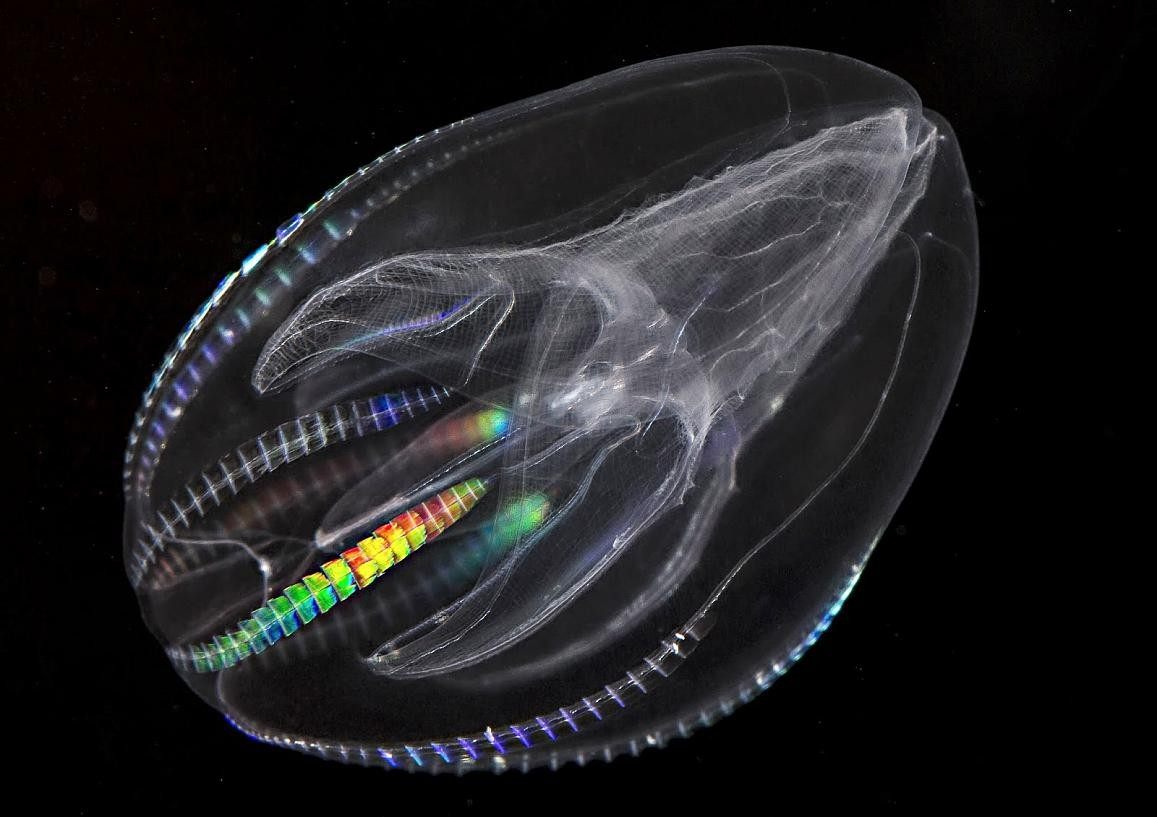
The sea walnut (Mnemiopsis leidyi) is a comb jelly of the western Atlantic coast, a transparent, bioluminescent animal that propels itself with rows of beating cilia.
The sea walnut (Mnemiopsis leidyi) is a comb jelly of the western Atlantic coast, a transparent, bioluminescent animal that propels itself with rows of beating cilia. Comb jellies are ctenophores, not true jellyfish, and some genetic studies place them on a very early branch of the animal tree.
🧬 Field Guide Specimen: Open Sea Walnut Comb Jelly in the CRV Science Field Guide to log the specimen, see its place among the Cnidaria+Ctenophora lineages in the Cladogram Explorer, and test your recall in the Red List conservation game.
Sea Walnut at a Glance
| Property | Value |
|---|---|
| Scientific name | Mnemiopsis leidyi |
| Kingdom | Animalia |
| Phylum | Ctenophora |
| Class | Tentaculata |
| Order | Lobata |
| Field Guide group | Cnidaria + Ctenophora (Radiata & Jellies) |
| Diagnostic feature (Field Guide) | Eight meridional rows of fused cilia plates (ctenes) that diffract light into shimmering rainbows; sticky colloblast cells instead of stinging cells. |
| Phylum | Ctenophora (not Cnidaria) |
| Invasive range | Black, Caspian and Baltic seas |
Evolutionary Systematics & Comparative Anatomy
Mnemiopsis leidyi (described by Alexander Agassiz in 1865) is a pelagic comb jelly in the family Bolinopsidae and order Lobata within the class Tentaculata of the phylum Ctenophora. The sequencing of the 150-megabase nuclear genome of M. leidyi in 2013 transformed debates over early animal Evolution: phylogenomic analyses of conserved orthologous gene families and chromosome-scale synteny linkage groups indicate that Ctenophora—rather than Porifera (sponges)—occupies the sister-group position to all other extant metazoans. Under this "Ctenophora-sister" topology, either the last common ancestor of all animals possessed a nervous system and striated/smooth musculature that were subsequently lost in sponges and placozoans, or ctenophores evolved synapses, voltage-gated ion channels, and mesodermal muscle cells independently from Cnidaria and Bilateria. Notably, M. leidyi lacks canonical Hox genes, microRNA machinery (Drosha and Pasha), and bilaterian-type gap junctions composed of connexins, utilizing instead pannexin/innexin proteins and syncytial nerve nets in which neurons fuse directly without synaptic clefts in the subepithelial network.
Adult M. leidyi reach 7 to 12 cm in total oral–aboral length and possess a laterally compressed, translucent gelatinous body consisting of ~97% water and ~3% salts and structural glycoproteins. Unlike cydippid ctenophores that trail long pair-tentacles throughout life, adult lobates expand the oral region into two large, muscular oral lobes (derived from the tentacular plane) flanked by four ribbon-like, ciliated projections called auricles. Eight meridional comb rows (costae) of fused macrociliary plates (ctenes) run longitudinally down the outer body wall: four longer sub-tentacular rows extend onto the oral lobes, while four shorter sub-sagittal rows terminate along the sides of the body.
Although larval M. leidyi hatch as spherical cydippids with two long, retractable fishing tentacles, during metamorphosis into the lobate adult the primary tentacles regress into tiny tentacular bulbs situated near the mouth, and fine secondary tentilla coated with adhesive colloblasts line the labial grooves along the inner surfaces of the oral lobes. Internally, the mouth opens into an elongated, flattened stomodeum (pharynx) that connects to an infundibulum (stomach) branching into eight meridional gastrovascular canals and terminating in two aboral anal pores that periodically open to void indigestible exoskeletons, demonstrating a functional through-gut with unidirectional digestive transport.
Physiology, Biomechanics & Sensory Biology
Whereas true jellyfish rely on muscular bell contractions and vortex rings described under Scyphozoa propulsion, Mnemiopsis leidyi swims continuously via the antiplectic metachronal beating of its eight comb rows, coordinated by an aboral statocyst supported on four mechanosensory balancer-cilia tufts. During foraging, the ciliary beat is tuned to create a laminar, hydrodynamically stealthy feeding current. Rather than disturbing the surrounding water and triggering the mechanosensory escape jumps of calanoid copepods, the beating cilia on the four auricles draw water smoothly between the gaping oral lobes at shear strain rates below the detection threshold of crustacean antennal setae. Fast-swimming copepods are entrained in the inter-lobe vortex and swept against the inner lobe surfaces, while slower microplankton and fish larvae are captured directly on the colloblast-lined labial tentilla and conveyed along ciliated oral grooves to the mouth.
In addition to the rainbow iridescence generated during daylight by optical diffraction across the periodic arrays of ctenes, M. leidyi produces bright blue-green bioluminescence (peak emission at 485 to 490 nm) in darkness when mechanically disturbed. Luminescence originates inside specialized endodermal photocytes aligned along the meridional gastrovascular canals directly beneath the eight comb rows. Instead of a separate luciferin-luciferase enzyme pair, photocytes synthesize the photoprotein mnemiopsin—a single-chain polypeptide pre-bound to a coelenterazine chromophore and molecular oxygen (O2). When mechanical stimulation opens voltage-gated Ca2+ channels, influx of three Ca2+ ions into the EF-hand domains of mnemiopsin triggers conformational oxidation of coelenterazine to coelenteramide, emitting a flash of blue-green light; subsequent exposure to light photoinactivates the photoprotein until coelenterazine is regenerated in the dark.
Mnemiopsis leidyi also exhibits remarkable whole-body regeneration and wound healing: individuals bisected longitudinally or deprived of their aboral apical organ can reconstitute a functional statocyst, comb rows, and oral lobes within 48 to 96 hours via migration of somatic stem cells and transdifferentiation of muscle cells, or alternatively stabilize as fertile "half-animals" with four comb rows.
Trophic Ecology, Life History & Reproduction
Native to temperate and subtropical estuaries along the western Atlantic coast from Massachusetts to southern Argentina, Mnemiopsis leidyi is an euryhaline and eurythermal generalist capable of surviving salinities from 2 to 38 PSU and water temperatures from 1 to 32 °C. In its native range, population growth is regulated by intraguild predators such as the beroid ctenophore Beroe ovata, the scyphozoan sea nettle (Chrysaora quinquecirrha), and butterfish (Peprilus triacanthus).
In the early 1980s, M. leidyi was accidentally transported in merchant ship ballast water from the western Atlantic into the Black Sea, where it encountered an eutrophic pelagic ecosystem devoid of coevolved ctenophore predators. By 1989, M. leidyi biomass in the Black Sea exceeded 1 billion metric tons (with local densities surpassing 300 individuals per m3). Grazing voraciously on copepods, cladocerans, and pelagic fish eggs and yolk-sac larvae, the invasive ctenophore precipitated the collapse of the Black Sea European anchovy (Engraulis encrasicolus) and sprat fisheries, causing hundreds of millions of dollars in annual economic losses. Subsequent invasions reached the Sea of Azov, the Sea of Marmara, the Caspian Sea (in 1999, threatening the endemic Caspian seal Pusa caspica via food-web depletion of kilkas), and the North and Baltic Seas (2006). In the Black Sea, M. leidyi blooms finally subsided after 1997 following the accidental ballast-water arrival of its specialist predator Beroe ovata, which feeds strictly on other ctenophores.
Invasion success is driven by simultaneous hermaphroditism, self-fertility, and rapid life-history plasticity. Under abundant food conditions, an adult M. leidyi can spawn 8,000 to 14,000 viable self-fertilized eggs every night, while cydippid larvae can reproduce via dissogony within days of hatching. Conversely, during prolonged winter starvation, adults shrink their somatic body volume by up to 80% while resorbing gonadal tissue, resuming growth and reproduction within days once zooplankton prey return.
Frequently Asked Questions
How does the sea walnut catch fast-swimming copepods that normally sense approaching predators?
Copepods escape most predators by detecting water-flow shear with mechanosensory hairs on their antennae. Instead of lunging, Mnemiopsis leidyi uses the cilia on its four auricles to generate a smooth, laminar feeding current between its two wide oral lobes. Because the fluid deformation rate inside the lobes stays below the copepod's sensory threshold, the crustacean swims unsuspectingly into the mucus and colloblast traps lining the inner lobes.
What is the difference between the rainbow shimmer and the nighttime glow of a sea walnut?
The rainbow colors seen along a sea walnut in daylight or under a flashlight are not bioluminescence; they are physical light diffraction caused by microscopic arrays of fused cilia in the eight comb rows splitting white light like a prism. True bioluminescence occurs in darkness when Ca2+ ions bind to the photoprotein mnemiopsin inside cells beneath the comb rows, oxidizing coelenterazine to emit blue-green light (485–490 nm).
How was the devastating invasion of sea walnuts in the Black Sea brought under control?
After arriving in ship ballast water in the 1980s, Mnemiopsis leidyi lacked natural predators in the Black Sea and decimated anchovy stocks by consuming zooplankton and fish eggs. In 1997, another comb jelly native to the Atlantic—Beroe ovata, an obligate predator that swallows Mnemiopsis whole—was also introduced via ballast water, rapidly reducing sea walnut biomass and allowing zooplankton and anchovy populations to recover.
References
- Colin, S. P., Costello, J. H., Hansson, L. J., Titelman, J., & Dabiri, J. O. (2010). Stealth predation and the predatory success of the invasive ctenophore Mnemiopsis leidyi. Proceedings of the National Academy of Sciences, 107(40), 17223–17227. https://doi.org/10.1073/pnas.1003170107
- Kideys, A. E. (2002). Fall and rise of the Black Sea ecosystem. Science, 297(5586), 1482–1484. https://doi.org/10.1126/science.1073002
- Ryan, J. F., Pang, K., Schnitzler, C. E., Nguyen, A. D., Moreland, R. T., Simmons, D. K., ... & Baxevanis, A. D. (2013). The genome of the ctenophore Mnemiopsis leidyi and its implications for cell type evolution. Science, 342(6164), 1242592. https://doi.org/10.1126/science.1242592
- Schultz, D. T., Haddock, S. H. D., Bredeson, J. V., Green, R. E., Simakov, O., & Rokhsar, D. S. (2023). Ancient gene linkages support ctenophores as sister to other animals. Nature, 618(7963), 110–117. https://doi.org/10.1038/s41586-023-05936-6