Mylonite
Mylonite is a fine-grained, streaky rock formed in deep fault zones, where intense shearing has stretched and ground crystals into thin ribbons without breaking the rock into pieces.
Mylonite is a fine-grained, streaky rock formed in deep fault zones, where intense shearing has stretched and ground crystals into thin ribbons without breaking the rock into pieces. It records the slow, plastic flow of rock beneath the depth where earthquakes happen.
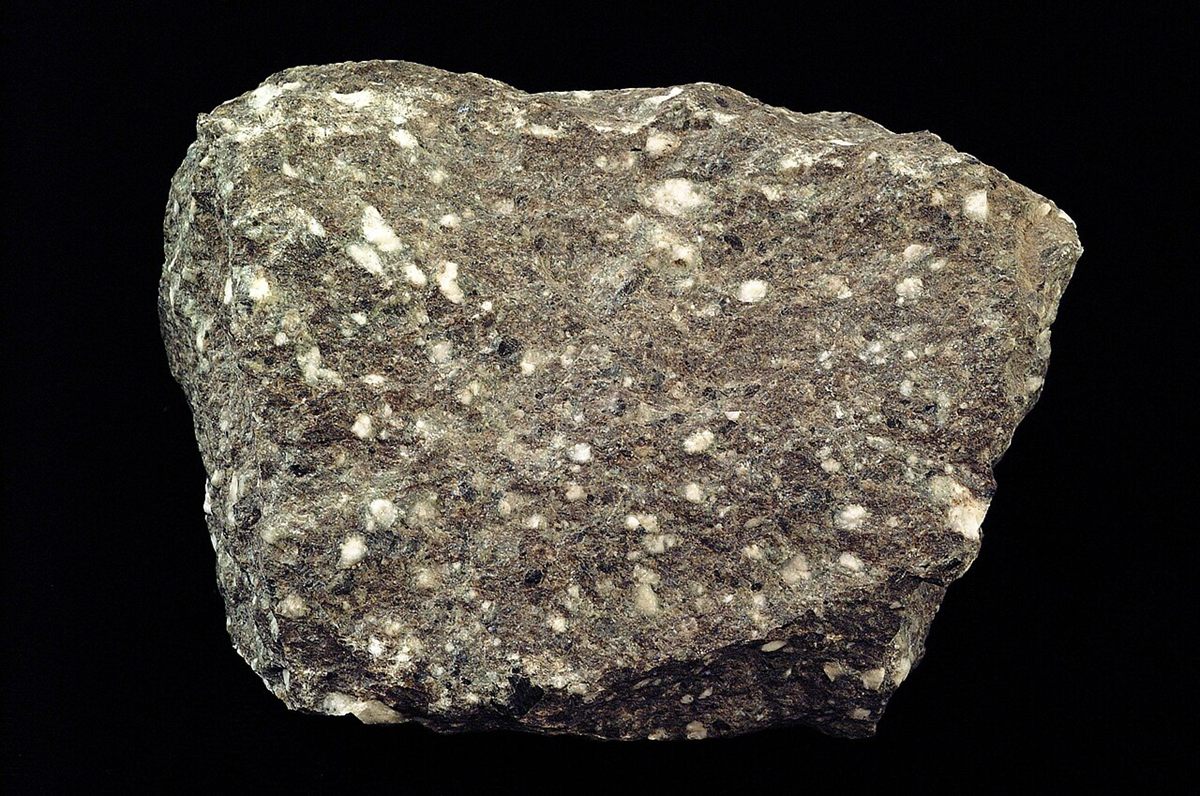
🪨 Geology Guide Specimen: Open Mylonite in the CRV Science Rock & Mineral ID Guide to log the specimen, compare it with the other 6 subgroups of Metamorphic, and test your eye in LithoClade.
Ductile Shear: How Does Mylonite Form?
At depths of roughly 10 to 25 kilometers and temperatures above about 300 degrees Celsius, quartz and other minerals deform by creeping rather than fracturing. Grains shrink by recrystallization and are stretched into flinty ribbons that wrap around stronger crystals of feldspar, which survive as rounded clasts with tails.
Brittle to Ductile: What Is the Transition?
Near the surface faults break in earthquakes and make crushed rocks. Deeper, they flow, forming mylonite. The change, often at about 10 to 15 kilometers in continental crust, is called the brittle-ductile transition. Rocks may record both, as when a deep mylonite is later overprinted by brittle faulting during uplift.
Reading Motion: What Do the Clasts Show?
Tails on the clasts are asymmetric, so they show the direction of shear. Mylonite grades from weakly sheared rock, such as augen gneiss, through to extremely fine-grained ultramylonite, and marks major structures in plate tectonics.
Mylonite at a Glance
| Property | Value |
|---|---|
| Type / variety | Ductile Shear-Zone Ribbon-Quartz Mylonite |
| Composition | Plastically Stretched Quartz Ribbons + Rotated Feldspar Porphyroclasts |
| Geology Guide group | Metamorphic Rocks (Foliated, Granoblastic & High-P) |
| Rock Classification | Hydrothermal & Fault Zone |
| Mohs hardness | Mohs 6–7 |
| Texture / habit | Finely laminated, streaky ductile flow banding with rotated 'delta/sigma' clasts |
| Density | 2.65–2.80 g/cm³ |
| Lustre and cleavage | Flinty, finely striped ribbon fabric with strong stretching lineation |
| Geological setting | Deep ductile fault zones (10–25 km depth, >300 °C) below the brittle earthquake zone |
| Diagnostic feature (Geology Guide) | Finely striped, flinty rock from deep within a ductile crustal shear corridor where extreme plastic deformation stretched quartz into paper-thin ribbons that swirl around rotated, tail-bearing feldspar grains. |
| Typical depth | About 10-25 km |
| Texture | Ribbons and rotated clasts |