Banded Orthogneiss
Banded orthogneiss is a coarse, high-grade metamorphic rock with alternating light and dark bands, derived from an igneous rock such as granite. The prefix 'ortho' refers to the igneous parent, in contrast to a paragneiss from sediment.
Banded orthogneiss is a coarse, high-grade metamorphic rock with alternating light and dark bands, derived from an igneous rock such as granite. The prefix "ortho" refers to the igneous parent, in contrast to a paragneiss from sediment.
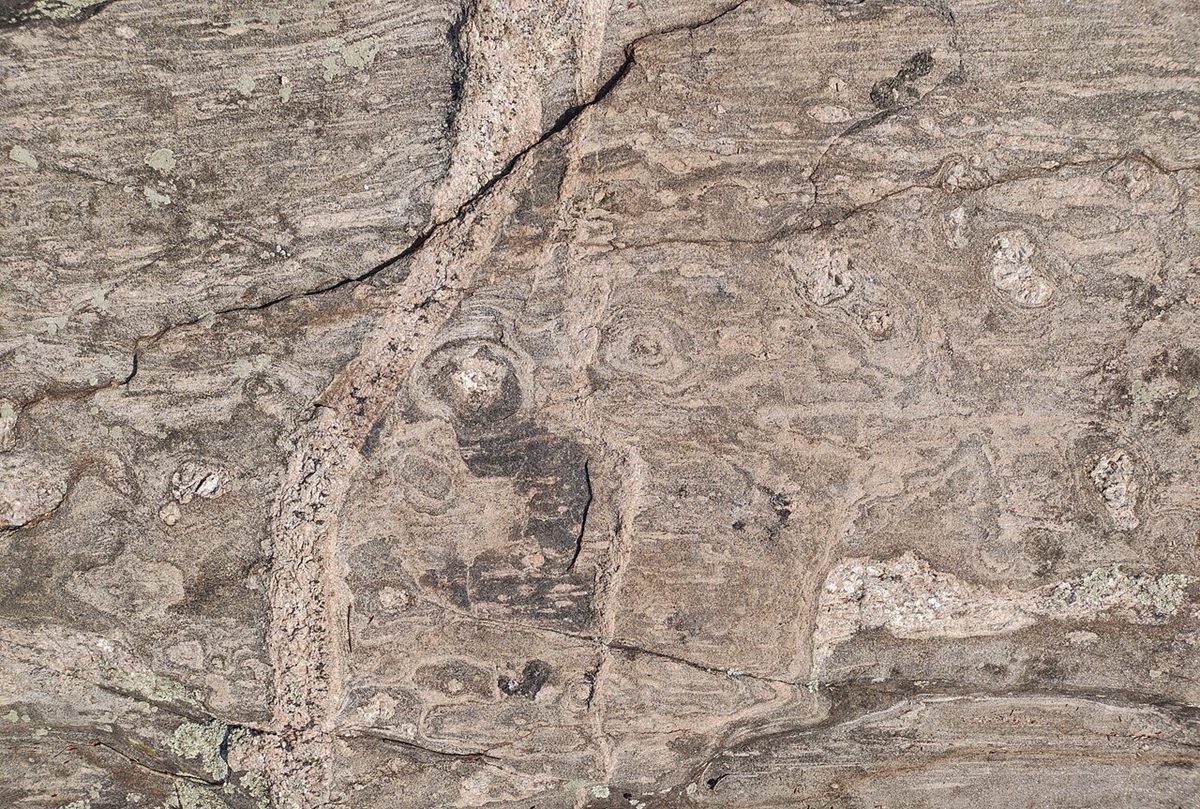
🪨 Geology Guide Specimen: Open Banded Orthogneiss in the CRV Science Rock & Mineral ID Guide to log the specimen, compare it with the other 6 subgroups of Metamorphic, and test your eye in LithoClade.
Gneissic Banding: How Does It Form?
At temperatures of 600 to 750 degrees Celsius, minerals sort themselves into layers: light bands of quartz and feldspar alternate with dark bands rich in biotite and hornblende. The segregation arises from deformation, chemical reactions in the solid and, at the upper end, small amounts of partial melting. The rock is hard and does not split easily.
Ortho or Para: What Was the Parent?
Geologists identify an orthogneiss by clues that point to an igneous protolith, such as the chemistry of granite, relics of igneous crystals and cross-cutting relationships. Paragneiss, in contrast, preserves traces of sedimentary layering and has the composition of clay-rich sediment.
Deep Crust and the Oldest Rocks: Where Are Gneisses Found?
Gneiss forms the roots of mountain belts and the cores of old continents. The Acasta Gneiss of northern Canada, about 4.0 billion years old, includes some of the oldest intact rocks known. See augen gneiss and migmatite for related rocks.
Banded Orthogneiss at a Glance
| Property | Value |
|---|---|
| Type / variety | Compositional Felsic–Mafic Banded Gneiss |
| Composition | Light Bands (Quartz + K-Feldspar + Plagioclase) + Dark Bands (Biotite + Hornblende) |
| Geology Guide group | Metamorphic Rocks (Foliated, Granoblastic & High-P) |
| Rock Classification | High-Grade Foliated (Gneiss & Migmatite) |
| Mohs hardness | Mohs 6–7 |
| Texture / habit | Coarse millimeter-to-centimeter compositional banding (does not split easily) |
| Density | 2.70–2.90 g/cm³ |
| Lustre and cleavage | Zebra-like alternating pink/white granular stripes and black mafic ribbons |
| Geological setting | Deep orogenic roots at 600–750 °C and 6–12 kbar (Granite or Shale protolith) |
| Diagnostic feature (Geology Guide) | Hard, coarse-grained deep-crustal rock displaying striking zebra-like alternating bands of pink-and-white quartz-feldspar and dark black hornblende-biotite that does not split readily along its bands. |
| Protolith | Granite or other igneous rock |
| Typical temperature | About 600-750 °C |