Augen Gneiss
Augen gneiss is a coarse metamorphic rock with large, eye-shaped crystals of feldspar wrapped by streaky ribbons of biotite and quartz. 'Augen' is German for 'eyes.'
Augen gneiss is a coarse metamorphic rock with large, eye-shaped crystals of feldspar wrapped by streaky ribbons of biotite and quartz. "Augen" is German for "eyes."
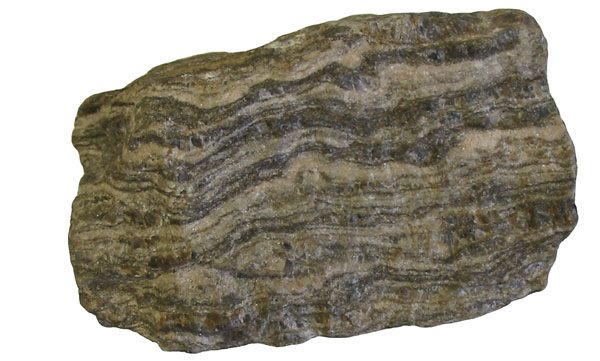
🪨 Geology Guide Specimen: Open Augen Gneiss in the CRV Science Rock & Mineral ID Guide to log the specimen, compare it with the other 6 subgroups of Metamorphic, and test your eye in LithoClade.
Augen Gneiss at a Glance
| Property | Value |
|---|---|
| Type / variety | Porphyroclastic K-Feldspar Augen Gneiss |
| Composition | Lenticular Pink K-Feldspar Porphyroclasts ('Eyes') Wrapped by Biotite & Quartz Ribbons |
| Geology Guide group | Metamorphic Rocks (Foliated, Granoblastic & High-P) |
| Rock Classification | High-Grade Foliated (Gneiss & Migmatite) |
| Mohs hardness | Mohs 6–6.5 |
| Texture / habit | Coarse almond/eye-shaped feldspar megacrysts (1–4 cm) in dark streaky matrix |
| Density | 2.70–2.85 g/cm³ |
| Lustre and cleavage | Pink or white oval feldspar 'eyes' framed by dark anastomosing biotite |
| Geological setting | Deep ductile shear zones deforming porphyritic granite batholiths (>600 °C) |
| Diagnostic feature (Geology Guide) | Coarse, high-temperature rock characterized by large, almond- or eye-shaped pink potassium feldspar crystals (1–4 cm across) wrapped by dark, flowing ribbons of biotite and quartz. |
| Eye size | About 1-4 cm |
| Name origin | German Augen, "eyes" |
Petrography, Porphyroclast vs. Porphyroblast Mechanics, and Microstructures
Modal Composition and Structural Definition of "Eye" Gneiss
Augen gneiss (from the German Augen, "eyes," introduced by early nineteenth-century German petrographers) is a coarse-grained, high-grade foliated metamorphic rock characterized by lenticular, almond- or eye-shaped mineral megacrysts (typically 1 to 5 cm across) embedded within a ductilely sheared, anastomosing matrix of quartz ribbons, plagioclase, and dark micaceous bands.
Compositionally, most augen gneisses are granitic or granodioritic orthogneisses consisting of 25–40 vol% potassium feldspar (orthoclase or microcline perthite), 25–35 vol% quartz, 15–25 vol% sodic-to-intermediate plagioclase (oligoclase–andesine), and 10–20 vol% ferromagnesian minerals—principally dark brown biotite and green-black hornblende, with accessory almandine garnet, titanite, epidote, allanite, apatite, and zircon. Because granular quartz and feldspar exceed 75–85 vol% and micas make up <20%, augen gneiss exhibits a strong gneissosity and stretching lineation (L–S tectonite fabric) without splitting easily like a schist.
Porphyroclasts vs. Porphyroblasts and Core-and-Mantle Microstructures
Structural geologists distinguish two mechanisms that produce feldspar "eyes" in augen gneiss:
- Relict Igneous Porphyroclasts (Deformed Megacrystic Granite): In most augen gneisses, the feldspar eyes are porphyroclasts—mechanically rounded, surviving relics of large potassium-feldspar phenocrysts from a pre-existing porphyritic granite or granodiorite batholith. In thin section, these porphyroclasts preserve primary igneous features in their cores, including simple Carlsbad twinning, concentric barium (Ba) zoning, and zonally arranged inclusions of small euhedral plagioclase laths and biotite.
- Metamorphic Porphyroblasts and Peritectic Growth: In high-grade paragneisses and migmatitic shear zones (>650–700 °C), feldspar augen can also grow during metamorphism as syntectonic porphyroblasts or peritectic K-feldspar crystals produced by muscovite or biotite dehydration melting, subsequently sheared into lenses.
Under the microscope, feldspar augen display core-and-mantle structures: a coarse K-feldspar crystal core (showing undulose extinction and flame perthite) is rimmed by a fine-grained mantle (10 to 200 μm) of dynamically recrystallized neo-grains of microcline, albite, and wormy myrmekite (quartz–plagioclase intergrowths along high-stress quarters), while surrounding quartz forms polycrystalline platy quartz ribbons.
| High-Grade Shear Rock | Megacryst / Clast Proportion | Matrix Grain Size & Fabric | Deformation Temperature | Diagnostic Textural Criterion |
|---|---|---|---|---|
| Porphyritic Granite | 15–35% euhedral K-feldspar phenocrysts | Coarse (2–10 mm) isotropic matrix | Magmatic (>650–750 °C) | Rectangular phenocrysts; no foliation or dynamic recrystallization |
| Augen Gneiss | 15–40% lenticular feldspar augen (1–5 cm) | Medium-coarse (0.5–3 mm) ribbons | 500–700 °C | Eye-shaped porphyroclasts with asymmetric tails wrapped by biotite |
| Banded Orthogneiss | <5% isolated augen | Coarse (1–5 mm) felsic/mafic layers | 600–750 °C | Zebra-like millimeter-to-centimeter compositional banding |
| Protomylonite / Mylonite | 10–50% smaller rounded clasts (<1 cm) | Fine-grained (10–100 μm) matrix | 350–550 °C | Grain-size reduction; planar ribbon mylonite foliation |
| Ultramylonite | <10% tiny surviving porphyroclasts | Cryptocrystalline (<10–20 μm) matrix | 300–500 °C | Resembles dark chert or pseudotachylyte in hand specimen |
Rheology, Crystal-Plasticity, and Kinematic Shear-Sense Indicators
The formation of augen gneiss is governed by the contrasting crystal-plastic rheology of quartz, biotite, and potassium feldspar. Between 300 and 450 °C, quartz and biotite deform ductilely by dislocation creep while feldspar fractures brittlely. Between 500 and 700 °C (amphibolite to lower granulite facies at 15–30 km depth), feldspar enters the regime of dislocation creep and subgrain rotation / bulging recrystallization, yet large K-feldspar megacrysts remain several times more viscous than the surrounding quartz + biotite matrix.
As ductile shear strain accumulates, the weaker quartz and biotite matrix flows plastically around the rigid K-feldspar phenocrysts. High shear stress along the corners of each rectangular K-feldspar crystal strips away its edges via dynamic recrystallization, rounding the crystal into an elliptical almond ("eye") while feeding fine recrystallized feldspar grains into tapering strain-shadow wings (tails) along the foliation plane.
When viewed on a rock face cut perpendicular to the gneissic foliation and parallel to the stretching lineation (the XZ plane of finite strain), the geometry of the recrystallized tails reveals the sense of shear (Passchier & Trouw, 2005):
- σ-Type (Sigma) Porphyroclasts: Wide wedge-shaped tails extend outward from opposite sides of the eye without crossing the central reference plane, stepping upward in the direction of shear.
- δ-Type (Delta) Porphyroclasts: When the rigid feldspar eye rotates faster than its tails recrystallize, thin wings curve across the central reference plane into tight embayments before trailing into the matrix.
Tectonic Settings, Classic Localities, and Architectural Stone
Augen gneiss forms in collisional orogenic thrust nappes (such as the Tännäs Augen Gneiss Nappe of the Scandinavian Caledonides and the Canigou massif of the Pyrenees), Cordilleran metamorphic core complexes (such as the Catalina–Rincon detachment footwall in Arizona), and deep transcurrent shear zones—most famously the Neoproterozoic Gnaisse Facoidal framing Sugarloaf Mountain (Pão de Açúcar) in Rio de Janeiro, Brazil, designated a Global Heritage Stone Resource for its use in historic architecture.
Frequently Asked Questions
What is the difference between a "porphyroclast" in augen gneiss and a "porphyroblast" in garnet schist?
In a garnet schist, a large garnet is a porphyroblast that nucleated and grew during metamorphism. In most augen gneisses, the pink feldspar "eyes" are porphyroclasts—pre-existing large phenocrysts from an older porphyritic granite that survived high-temperature ductile shearing while the surrounding quartz and mica matrix recrystallized into smaller grains.
How do geologists use the "tails" on feldspar eyes to tell which way a fault moved?
During ductile shearing at 500–650 °C, the outer edges of rigid feldspar clasts recrystallize into fine-grained "tails" along the foliation. Under simple shear, these tails form an asymmetric stair-step geometry (σ-type or δ-type porphyroclasts) on faces parallel to the stretching lineation, stepping upward in the transport direction of the hanging wall.
How does augen gneiss differ from banded orthogneiss and mylonite?
Moderate-to-high ductile shearing of a porphyritic granite at 550–700 °C rounds phenocrysts into 1–4 cm eyes wrapped by biotite and quartz ribbons (augen gneiss). Equigranular parents or extreme high-temperature strain flatten domains into continuous layers (banded orthogneiss), whereas cooler shearing (350–550 °C) produces fine-grained (<0.1 mm) ribbon mylonite.
References
- Passchier, C. W., & Trouw, R. A. J. (2005). Microtectonics (2nd ed.). Springer-Verlag. https://doi.org/10.1007/3-540-29359-0
- Simpson, C., & Schmid, S. M. (1983). An evaluation of criteria to deduce the sense of movement in sheared rocks. Geological Society of America Bulletin, 94(11), 1281–1288. https://doi.org/10.1130/0016-7606(1983)94<1281:AEOCTT>2.0.CO;294%3C1281:AEOCTT%3E2.0.CO;2)
- Vernon, R. H. (2018). A Practical Guide to Rock Microstructure (2nd ed.). Cambridge University Press. https://doi.org/10.1017/9781108654609
- Tullis, J., & Yund, R. A. (1985). Dynamic recrystallization of feldspar: A mechanism for ductile shear zone formation. Geology, 13(4), 238–241. https://doi.org/10.1130/0091-7613(1985)13<238:DROFAM>2.0.CO;213%3C238:DROFAM%3E2.0.CO;2)