Migmatite
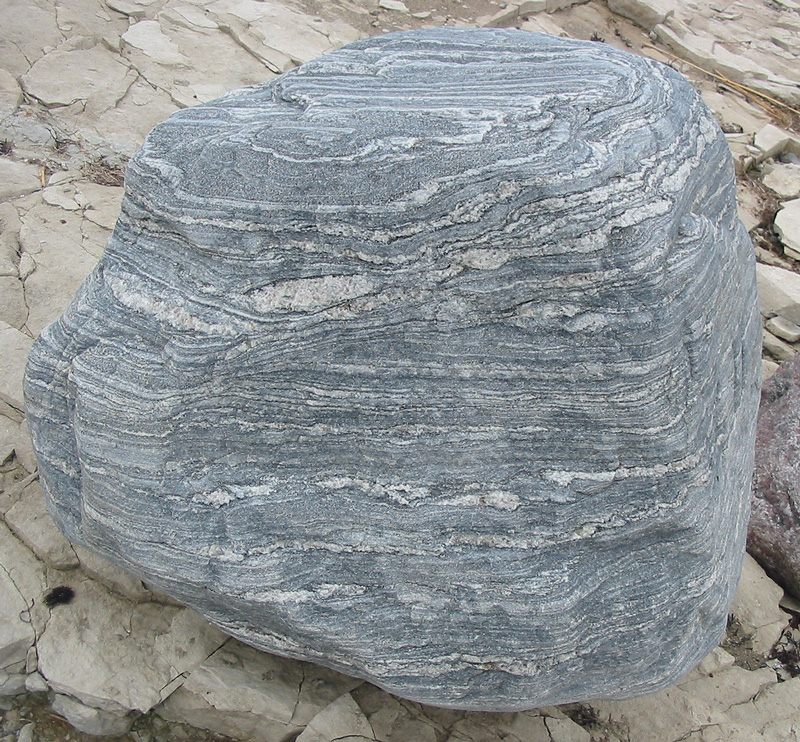
Migmatite is a 'mixed rock' in which pale veins of granite-like material, formed by partial melting, are intermingled with darker metamorphic rock. It records the threshold where metamorphism turns into magma production.
Migmatite is a "mixed rock" in which pale veins of granite-like material, formed by partial melting, are intermingled with darker metamorphic rock. It records the threshold where metamorphism turns into magma production.
🪨 Geology Guide Specimen: Open Migmatite in the CRV Science Rock & Mineral ID Guide to log the specimen, compare it with the other 6 subgroups of Metamorphic, and test your eye in LithoClade.
Partial Melting: What Are the Light and Dark Parts?
At high temperature the easiest-melting minerals, quartz and feldspar, start to melt and the liquid segregates into light-colored veins called leucosome. The dark, refractory residue of hornblende and biotite is the melanosome. Veins are often folded into contorted patterns, called ptygmatic folds, because the rock was soft.
Anatexis: Where Does Metamorphism Become Magmatism?
Migmatites form at roughly 650 to 800 degrees Celsius in the deep crust, depending on how much water is present. They are the place where granite magma is generated, and in many cases the melt escaped to rise and form plutons, leaving a drier, more resistant residue.
Reading Migmatites: What Do They Tell Us?
Migmatites show melt moving through solid rock, and they help geologists understand how continental crust is processed and strengthened over time. They commonly grade into banded orthogneiss and granulite in the deepest exposed parts of mountain belts.
Migmatite at a Glance
| Property | Value |
|---|---|
| Type / variety | Anatectic Leucosome–Melanosome Composite Rock |
| Composition | Pale Granitic Melt Veins (Leucosome) + Dark Refractory Hornblende-Biotite Restite (Melanosome) |
| Geology Guide group | Metamorphic Rocks (Foliated, Granoblastic & High-P) |
| Rock Classification | High-Grade Foliated (Gneiss & Migmatite) |
| Mohs hardness | Mohs 6–7 |
| Texture / habit | Wildly contorted, ptygmatically folded veins of pink/white granite in dark host |
| Density | 2.72–2.90 g/cm³ |
| Lustre and cleavage | Swirling, marble-cake pattern of bright quartz-feldspar veins and black restite |
| Geological setting | Ultra-high-grade continental roots at 680–800 °C (the solid-to-magma transition) |
| Diagnostic feature (Geology Guide) | Swirling 'mixed rock' displaying wildly contorted, toothpaste-like veins of pale pink-and-white quartz-feldspar ('leucosome') segregated from dark biotite-hornblende layers at the threshold of melting. |
| Light part | Leucosome, crystallized melt |
| Dark part | Melanosome, refractory residue |
See Also
- Granite — the kind of melt migmatites make
- Banded Orthogneiss — the gneiss just below the melting threshold
- Granulite — the drier rock beyond migmatite