Olivine
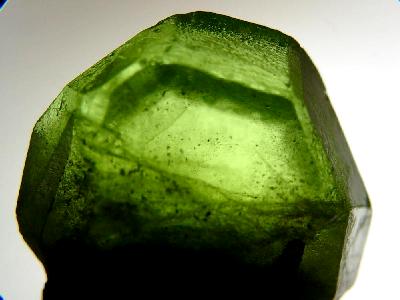
Olivine is a magnesium iron silicate, (Mg,Fe)₂SiO₄, that forms a continuous series between magnesium-rich forsterite and iron-rich fayalite. It is the main mineral of Earth's upper mantle, and its gem variety is peridot.
Olivine is a magnesium iron silicate, (Mg,Fe)₂SiO₄, that forms a continuous series between magnesium-rich forsterite and iron-rich fayalite. It is the main mineral of Earth's upper mantle, and its gem variety is peridot.
🪨 Geology Guide Specimen: Open Olivine (Peridot) in the CRV Science Rock & Mineral ID Guide to log the specimen, compare it with the other 8 mineral classes of Dana / Strunz Classes, and test your eye in LithoClade.
Mantle Mineral: What Happens to Olivine at Depth?
Olivine makes up most of the upper mantle, so peridotite and dunite are essentially olivine rocks. At about 410 kilometers depth it changes into a denser structure called wadsleyite, and at about 520 kilometers into ringwoodite, changes that produce seismic discontinuities used to map the Earth's interior.
Peridot and Beyond: Where Else Is Olivine Found?
Gem peridot, a green glassy variety, comes from volcanic rocks and from meteorites called pallasites, which contain olivine crystals set in iron-nickel metal. Olivine has also been found in lunar rocks, in asteroid and comet samples, and on Mars. Hawaii's Papakōlea beach has green sand made of olivine grains.
Weathering: Why Is Olivine Short-Lived?
Of the common silicates, olivine weathers fastest at the surface, so it rarely survives in old sediments. This is why it is studied for removing carbon dioxide by enhanced weathering; see silicate weathering and magnesium.
Olivine at a Glance
| Property | Value |
|---|---|
| Type / variety | (Mg,Fe)₂SiO₄ • Orthorhombic Nesosilicate |
| Composition | (Mg,Fe)₂SiO₄ (Solid solution between Forsterite Mg₂SiO₄ & Fayalite Fe₂SiO₄) |
| Geology Guide group | Minerals (8 Major Chemical Groups) |
| Mineral Group | Silicates |
| Mohs hardness | Mohs 6.5–7 |
| Texture / habit | Stubby orthorhombic prisms or sugary granular aggregates |
| Density | 3.27–3.37 g/cm³ (forsterite-rich) |
| Lustre and cleavage | Vitreous olive- to yellow-green lustre with conchoidal fracture |
| Geological setting | Upper mantle peridotites, basaltic lavas, and pallasite meteorites |
| Diagnostic feature (Geology Guide) | Glassy, olive- to bottle-green crystal (Mohs 6.5–7) with conchoidal fracture and high density (3.3 g/cm³) that dominates Earth's upper mantle and crystallizes first from cooling mafic magmas. |
| Formula | (Mg,Fe)₂SiO₄ |
| Gem variety | Peridot |
See Also
- Peridotite — the mantle rock made largely of olivine
- Dunite — rock of nearly pure olivine
- Silicate Weathering — the process that destroys olivine at the surface