Orthoclase
Orthoclase is a potassium feldspar, KAlSi₃O₈, a monoclinic framework silicate with a hardness of 6 that is the reference mineral for that number on the Mohs scale.
Orthoclase is a potassium feldspar, KAlSi₃O₈, a monoclinic framework silicate with a hardness of 6 that is the reference mineral for that number on the Mohs scale. Its name comes from the Greek for "straight fracture," after its two cleavage planes that meet at a right angle.
🪨 Geology Guide Specimen: Open Orthoclase Feldspar in the CRV Science Rock & Mineral ID Guide to log the specimen, compare it with the other 8 mineral classes of Dana / Strunz Classes, and test your eye in LithoClade.
Feldspars: Why Do They Matter?
Feldspars are the most abundant mineral group in Earth's crust. Orthoclase belongs to the alkali feldspars, along with microcline and the high-temperature sanidine, which differ in how silicon and aluminum are ordered in the lattice. It is common in granite, syenite and pegmatite, where it is salmon pink or cream.
Twins and Moonstone: What Does It Look Like?
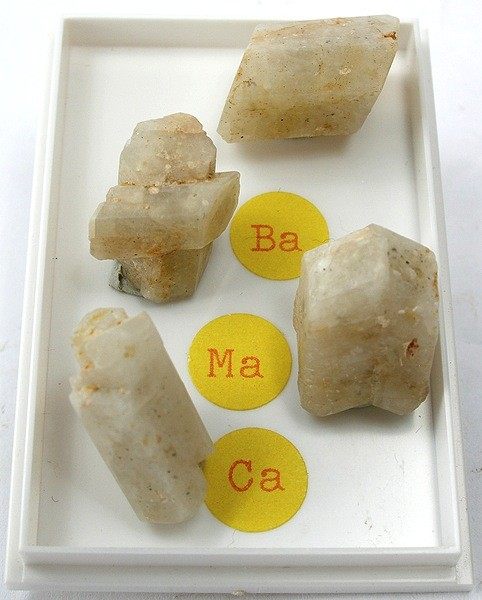
Orthoclase often forms Carlsbad twins, two crystals interpenetrating along a plane. The variety adularia, from tiny layered intergrowths, shows a soft blue-white sheen called adularescence and is cut as moonstone.
Weathering and Clay: What Happens at the Surface?
Feldspar reacts slowly with carbonic acid and water to form clay minerals such as kaolinite, releasing potassium, silica and bicarbonate. This is a main example of silicate weathering, which draws down carbon dioxide over geological time. The potassium released is essential to life; see potassium.
Orthoclase at a Glance
| Property | Value |
|---|---|
| Type / variety | KAlSi₃O₈ • Monoclinic Tectosilicate |
| Composition | KAlSi₃O₈ (Potassium Aluminum Framework Mineral) |
| Geology Guide group | Minerals (8 Major Chemical Groups) |
| Mineral Group | Silicates |
| Mohs hardness | Mohs 6 (reference standard for 6) |
| Texture / habit | Blocky monoclinic prisms, often showing intergrown Carlsbad penetration twins |
| Density | 2.55–2.63 g/cm³ |
| Lustre and cleavage | Salmon-pink or cream with two flat cleavage planes intersecting at exactly 90° |
| Geological setting | Felsic igneous plutons (granite, pegmatite, syenite) and high-grade gneisses |
| Diagnostic feature (Geology Guide) | Salmon-pink to cream blocky crystal (Mohs 6 reference standard) displaying two flat cleavage surfaces that meet at a crisp 90-degree right angle, often forming intergrown Carlsbad twins. |
| Formula | KAlSi₃O₈ |
| Cleavage | Two directions at 90° |