Labradorite
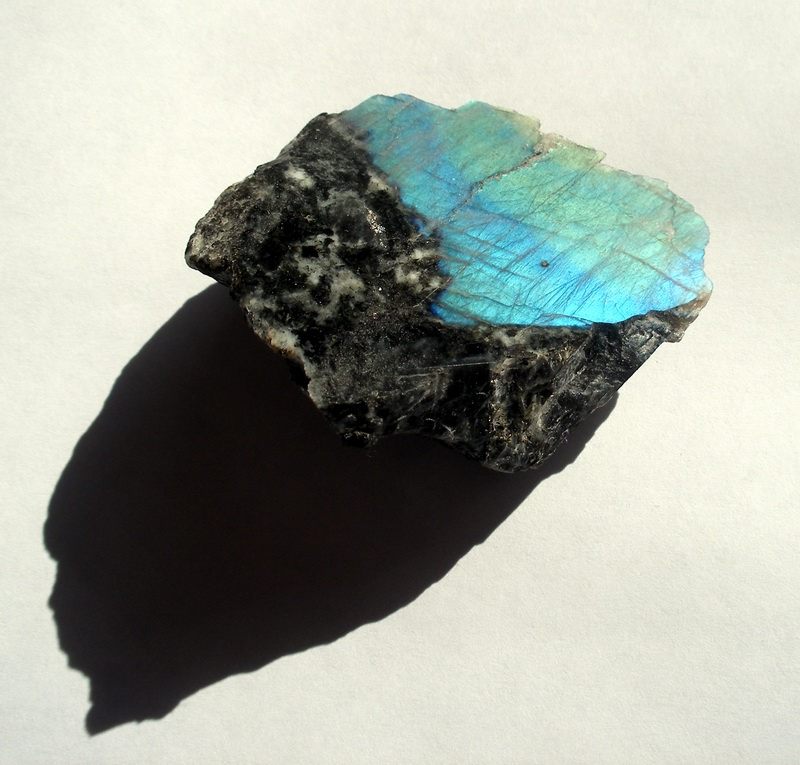
Labradorite is a calcium-rich plagioclase feldspar, with 50 to 70 percent of the anorthite end member, that is famous for flashes of blue, green and gold called labradorescence. It is named for the Labrador coast of Canada, where it was first described.
Labradorite is a calcium-rich plagioclase feldspar, with 50 to 70 percent of the anorthite end member, that is famous for flashes of blue, green and gold called labradorescence. It is named for the Labrador coast of Canada, where it was first described.
🪨 Geology Guide Specimen: Open Labradorite (Plagioclase) in the CRV Science Rock & Mineral ID Guide to log the specimen, compare it with the other 8 mineral classes of Dana / Strunz Classes, and test your eye in LithoClade.
The Plagioclase Series: Where Does Labradorite Fit?
Plagioclase feldspars form a solid solution from sodium-rich albite to calcium-rich anorthite, in which sodium-and-silicon is swapped for calcium-and-aluminum. Labradorite lies in the middle to calcium-rich side, and it is typical of mafic rocks. Twinning gives fine parallel striations on its cleavage faces.
Labradorescence: What Makes the Flash?
In some labradorite, very thin lamellae of two slightly different feldspar compositions form during slow cooling, a process called exsolution. They scatter and interfere with light so that the color changes with the viewing angle, giving the peacock-blue sheen that makes the stone popular for jewelry and carving.
Occurrence: Where Is It Found?
Labradorite is the main mineral of anorthosite and is common in gabbro and basalt. Famous gem-quality material comes from Labrador, Madagascar and Finland, where the very colorful variety is called spectrolite.
Labradorite at a Glance
| Property | Value |
|---|---|
| Type / variety | (Ca,Na)(Al,Si)₄O₈ • Triclinic Tectosilicate |
| Composition | (Ca,Na)(Al,Si)₄O₈ (50–70% Anorthite CaAl₂Si₂O₈ endmember) |
| Geology Guide group | Minerals (8 Major Chemical Groups) |
| Mineral Group | Silicates |
| Mohs hardness | Mohs 6–6.5 |
| Texture / habit | Tabular triclinic crystals with fine parallel polysynthetic twin striations |
| Density | 2.68–2.72 g/cm³ |
| Lustre and cleavage | Dark grey mass flashing brilliant peacock-blue and gold 'labradorescence' |
| Geological setting | Anorthosite plutons, gabbros, and basaltic lavas |
| Diagnostic feature (Geology Guide) | Dark smoky-grey feldspar crystal with fine ruled twin lines on its cleavage faces that erupts in brilliant flashes of electric peacock-blue, green, and gold light as the specimen is tilted. |
| Composition | 50-70% anorthite |
| Optical effect | Labradorescence |
See Also
- Anorthosite — the rock made largely of calcic plagioclase
- Orthoclase — the potassium feldspar
- Calcium — the element that defines calcic plagioclase