Phyllite
Phyllite is a fine-grained metamorphic rock between slate and schist, with a silky, shimmering sheen on its wavy foliation surfaces. The sheen comes from tiny flakes of white mica and chlorite that have grown slightly larger than those of slate.
Phyllite is a fine-grained metamorphic rock between slate and schist, with a silky, shimmering sheen on its wavy foliation surfaces. The sheen comes from tiny flakes of white mica and chlorite that have grown slightly larger than those of slate.
🪨 Geology Guide Specimen: Open Phyllite in the CRV Science Rock & Mineral ID Guide to log the specimen, compare it with the other 6 subgroups of Metamorphic, and test your eye in LithoClade.
Sheen: What Makes Phyllite Shimmer?
In slate the mica flakes are too small to reflect light individually. As temperature rises, the flakes of fine muscovite, sometimes called sericite, and chlorite grow larger and reflect as a satiny gloss across the foliation. The rock is still fine-grained, and individual crystals are barely visible.
Crenulations: Why Is the Surface Wavy?
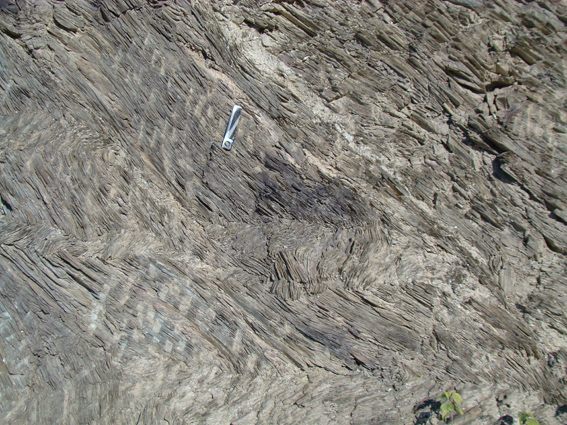
Phyllite often has a corrugated look, made by later small folds, called crenulations, in the first foliation. They record more than one episode of deformation, so phyllite is useful for unraveling the history of a mountain belt.
Grade Series: Where Does Phyllite Fit?
A shale that is metamorphosed progressively becomes slate, phyllite and then garnet muscovite schist as the micas grow and the rock coarsens. Phyllite marks the lower greenschist range, roughly 300 to 450 degrees Celsius.
Phyllite at a Glance
| Property | Value |
|---|---|
| Type / variety | Silky Sericite-Lustre Crenulated Metapelite |
| Composition | Fine-Grained Sericite (Muscovite) + Chlorite + Quartz (0.01–0.1 mm) |
| Geology Guide group | Metamorphic Rocks (Foliated, Granoblastic & High-P) |
| Rock Classification | Low-Grade Foliated (Slate & Phyllite) |
| Mohs hardness | Mohs 3–3.5 |
| Texture / habit | Wavy, corrugated foliation surfaces with microscopic crinkle folds |
| Density | 2.72–2.82 g/cm³ |
| Lustre and cleavage | Distinctive silky or satiny metallic sheen across cleavage surfaces |
| Geological setting | Regional orogenic belts at 300–420 °C (between slate and schist) |
| Diagnostic feature (Geology Guide) | Fine-grained, wavy-foliated rock whose rippled cleavage surfaces shimmer with a silvery-green satiny sheen from millions of newly recrystallized microscopic white mica flakes. |
| Typical minerals | Fine muscovite (sericite), chlorite and quartz |
| Grade | Lower greenschist |