Pinwheel Galaxy
The Pinwheel Galaxy (Messier 101, NGC 5457) is a large face-on spiral in Ursa Major, about 21 million light-years away and some 170,000 light-years across, noticeably wider than the Milky Way.
The Pinwheel Galaxy (Messier 101, NGC 5457) is a large face-on spiral in Ursa Major, about 21 million light-years away and some 170,000 light-years across, noticeably wider than the Milky Way. Pierre Méchain discovered it in 1781, and its lopsided arms and expansive star-forming regions make it one of the best-studied spirals outside the Local Group.
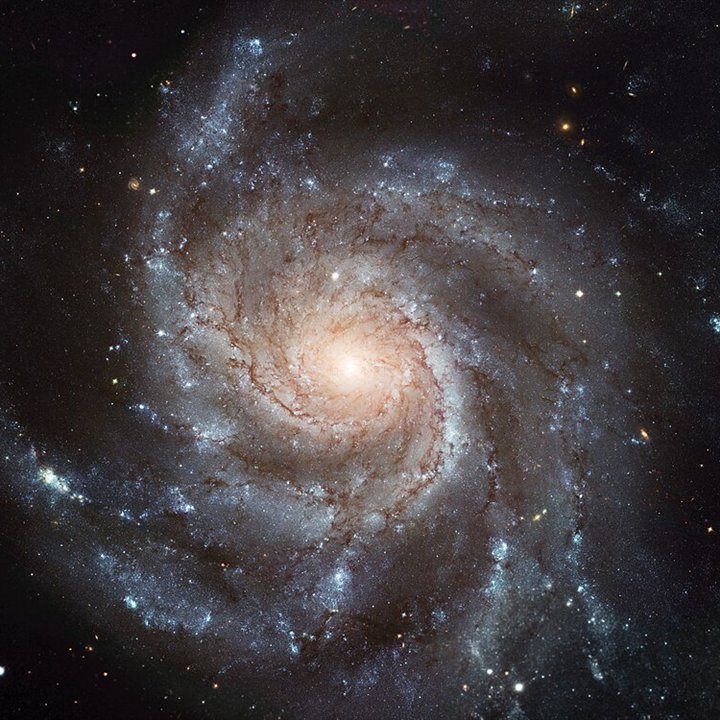
🔭 Galaxy Guide: Find Pinwheel Galaxy in the CRV Science Deep Sky Galaxy Guide to see its Hubble, JWST or ground-based image, the diagnostic clue used to classify it, and the Unbarred Spiral class it belongs to. Test your eye in the Deep Sky Classification game.
A Lopsided Disk: What Distorts the Pinwheel?
The arms on one side of M101 are crisper and more tightly packed than on the other, and the nucleus is offset from the disk's geometric center. Astronomers attribute this asymmetry to gravitational tides from nearby satellite galaxies such as NGC 5474, which has been tugged by the encounter itself. Mild interactions of this kind can warp disks and stir star formation without ever merging the galaxies.
Giant H II Regions: How Big Can a Stellar Nursery Get?
M101 hosts several giant H II regions, among them NGC 5461, NGC 5462 and NGC 5471, that dwarf the Orion Nebula in size and luminosity. Each is lit by thousands of high-mass young stars whose ultraviolet light ionizes surrounding hydrogen. Because they are bright and well separated in the face-on disk, they are standard targets for measuring how heavy-element abundance (metallicity) declines from the center of a spiral outward.
SN 2011fe: A Front-Row Type Ia Supernova
In August 2011 a Type Ia supernova, SN 2011fe, was caught within about a day of exploding. It was among the nearest and best-observed Type Ia events in decades, and the early data helped rule out a giant-star companion for the exploding white dwarf. Type Ia supernovae are the standard candles used to measure the expansion history of the universe, so every nearby example sharpens the distance scale.
Pinwheel Galaxy at a Glance
| Property | Value |
|---|---|
| Catalog designation | M101 • NGC 5457 |
| Constellation | Ursa Major |
| Distance | 21 million light-years |
| Hubble / morphological type | SAB(rs)cd |
| Galaxy Guide class | Unbarred Spiral Galaxy (SA) |
| Diameter | About 170,000 light-years |
| Cataloged | Pierre Méchain, 1781 |
| Image credit (Galaxy Guide) | NASA / ESA / K. Kuntz (JHU), F. Bresolin (UH), J. Trauger (JPL) |
Asymmetric *m* = 1 Tidal Kinematics, Disk Architecture & Group Interactions
Lopsided Fourier Harmonics and the NGC 5474 Encounter
Situated at a Cepheid and Tip of the Red Giant Branch (TRGB) distance of 6.4 to 6.7 megaparsecs (~21 million light-years) and viewed nearly face-on (i ≈ 18°), Messier 101 (NGC 5457, Arp 26) is a late-type spiral galaxy (SAB(rs)cd) whose optical diameter (D25 ≈ 28.8 arcminutes, or ~52 kiloparsecs / 170,000 light-years) spans 1.5 times that of the Milky Way. Despite a dark matter halo mass of Mtot ≈ (3–5) × 1011 M☉, M101 is nearly bulgeless: Hubble and Spitzer 3.6 μm photometry shows that its central pseudobulge accounts for under 2–3% of the stellar luminosity (M* ≈ 5 × 10¹⁰ M☉), with no classical r1/4 spheroid and an upper limit on any central black hole of MBH < 106 M☉.
Fourier harmonic decomposition of M101's stellar mass and neutral atomic hydrogen (H I) surface density (MH I ≈ 2.0 × 10¹⁰ M☉ mapped by the THINGS VLA survey) reveals a strong lopsided m = 1 mode (A1 / A0 > 0.3) superimposed on multi-armed m = 2, 3, and 4 spiral branches:
- Northeastern Compression vs. Southwestern Extension: On the northeastern side, the arms are tightly wound and truncated at a sharp H I cliff (R ≈ 25 kpc), accompanied by high-velocity H I gas complexes infalling at 70 to 150 km·s−1. On the southwestern quadrant, loosely wound arms extend past R > 35–40 kpc.
- Dynamical Origin in the M101 Group: Numerical simulations and deep Burrell Schmidt imaging (down to μB ≈ 29.5 mag·arcsec−2; Mihos et al. 2013) demonstrate that this m = 1 lopsidedness—and the recoil of M101's nucleus ~3 kpc northeast of its outer disk centroid—was excited ~200 to 300 million years ago when its dwarf companion NGC 5474 (lying 44′ / 85 kpc south-southeast, itself exhibiting an offset pseudobulge) passed through M101's outer halo.
Giant Extragalactic H II Complexes & Radial Metallicity Gradients
Super-Orion Nebulae: NGC 5461, NGC 5462, and NGC 5471
Sustaining a galaxy-wide star formation rate of SFR ≈ 3.0 to 4.0 M☉·yr−1, M101 houses over 1,200 cataloged H II regions, headed by six Giant Extragalactic H II Regions (GEHRs) assigned independent NGC numbers: NGC 5447, NGC 5450, NGC 5455, NGC 5461, NGC 5462, and NGC 5471. Located at R ≈ 25 kpc on the eastern edge of the disk, NGC 5471 spans ~800 parsecs and radiates an Hα luminosity of L(Hα) ≈ 2 × 1040 erg·s−1—roughly 200 times that of the 30 Doradus (Tarantula) Nebula and 5,000 times that of the Orion Nebula (M42). HST imaging resolves NGC 5471 and NGC 5461 into core Super Star Clusters containing hundreds of early O-type and Wolf-Rayet stars (Mcluster ≈ 105 M☉), alongside the Wolf-Rayet + black hole ultraluminous X-ray binary M101 ULX-1.
The Benchmark Radial Oxygen Abundance Gradient
Spanning radii from R = 1 kpc to R = 36 kpc, M101's H II regions calibrate the direct electron-temperature (Te) metallicity scale via auroral forbidden lines ([O III] 436.3 nm, [N II] 575.5 nm, [S III] 631.2 nm; Kennicutt, Bresolin, & Garnett 2003; Croxall et al. 2016). From the inner core to the metal-poor outer arms, the logarithmic oxygen abundance declines linearly with radius over a full order of magnitude:
12 + log(O/H) = (8.76 ± 0.04) − (0.029 ± 0.002) × (R / kpc) [or −0.83 dex / R25]
falling from 12 + log(O/H) ≈ 8.75 (~1.1 Z☉, Te ≈ 6,000 K) in the inner disk down to 12 + log(O/H) ≈ 7.80 (~0.13 Z☉, Te ≈ 13,500 K) in NGC 5471, confirming "inside-out" galactic disk assembly.
Supernova Laboratory: SN 2011fe (Type Ia) and SN 2023ixf (Type II)
M101 has hosted five historical supernovae (SN 1909A, SN 1951H, SN 1970G, SN 2011fe, SN 2023ixf) plus the luminous red nova M101 OT2015-1, headed by two landmark events:
- SN 2011fe (August 24, 2011): Discovered by the Palomar Transient Factory just ~11 hours after explosion and peaking at V = +9.9, SN 2011fe became the best-observed Type Ia thermonuclear supernova of the modern era. Early light curves by Nugent et al. (2011) constrained the progenitor radius to R* ≤ 0.02 R☉—proving it was a degenerate carbon-oxygen white dwarf—while X-ray, radio, and HST limits ruled out red giant companions.
- SN 2023ixf (May 19, 2023): Discovered by Koichi Itagaki in NGC 5461 and peaking at V ≈ +10.8, pre-explosion HST/Spitzer data identified a dusty pulsating red supergiant progenitor (Minit ≈ 12–17 M☉), while flash-ionization spectra of He II, C IV, and N IV lines revealed a dense circumstellar shell ejected in the final years before core collapse.
References
- Kennicutt, R. C., Jr., Bresolin, F., & Garnett, D. R. (2003). "The composition gradient in M101 revisited. II. Electron temperatures and implications for the nebular abundance scale." The Astrophysical Journal, 591(2), 801–820. doi:10.1086/375398
- Nugent, P. E., Sullivan, M., Cenko, S. B., Thomas, R. C., Kasen, D., Howell, D. A., ... & Kulkarni, S. R. (2011). "Supernova SN 2011fe from an exploding carbon-oxygen white dwarf star." Nature, 480(7377), 344–347. doi:10.1038/nature10644
- Mihos, J. C., Harding, P., Spengler, C. E., Rudick, C. S., & Feldmeier, J. J. (2013). "The Burrell Schmidt Deep Virgo Survey: Tidal debris, galaxy halos, and diffuse intragroup light in the M101 group." The Astrophysical Journal, 762(2), 82. doi:10.1088/0004-637X/762/2/82
- Jacobson-Galán, W. V., Dessart, L., Margutti, R., Chornock, R., Foley, R. J., Kilpatrick, C. D., ... & Filippenko, A. V. (2023). "SN 2023ixf in Messier 101: Photo-ionization of dense, close-in circumstellar material in a nearby Type II supernova." The Astrophysical Journal Letters, 954(2), L42. doi:10.3847/2041-8213/acf2ec