Whirlpool Galaxy
The Whirlpool Galaxy (Messier 51, NGC 5194) is a face-on grand-design spiral galaxy in Canes Venatici, roughly 30 million light-years away, locked in a gravitational encounter with its smaller companion NGC 5195.
The Whirlpool Galaxy (Messier 51, NGC 5194) is a face-on grand-design spiral galaxy in Canes Venatici, roughly 30 million light-years away, locked in a gravitational encounter with its smaller companion NGC 5195. In 1845 William Parsons, the 3rd Earl of Rosse, sketched its arms through his 72-inch "Leviathan" telescope, and M51 became the first object recognized as a spiral.
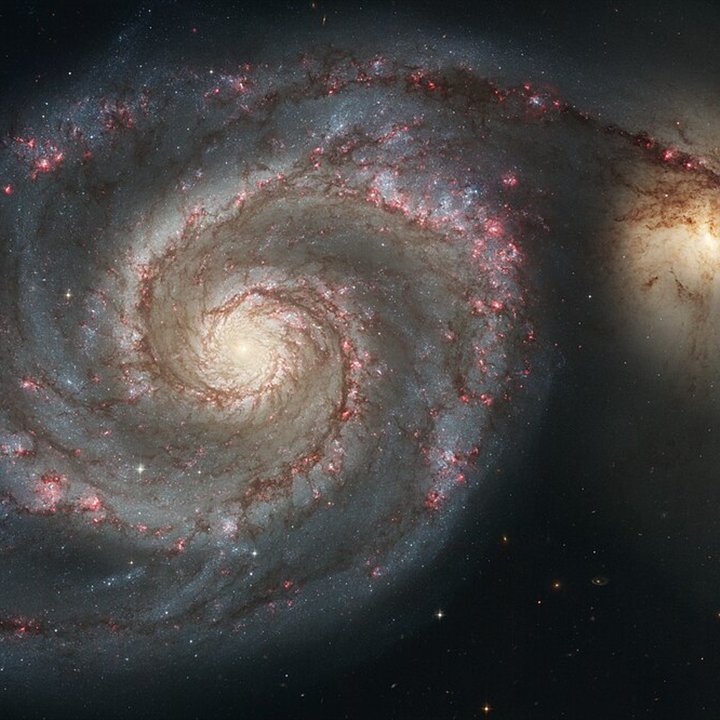
🔭 Galaxy Guide: Find Whirlpool Galaxy in the CRV Science Deep Sky Galaxy Guide to see its Hubble, JWST or ground-based image, the diagnostic clue used to classify it, and the Unbarred Spiral class it belongs to. Test your eye in the Deep Sky Classification game.
Grand-Design Structure: Why Does M51 Show Two Clean Spiral Arms?
Two sharply defined arms wind out from an unbarred core, which is why the galaxy is typed SA(s)bc pec: the "pec" marks a peculiar, interaction-distorted disk. Dust lanes trace the inner edge of each arm, where gas piles up in spiral density waves and collapses into new stars. Pink hydrogen-alpha knots mark giant H II regions around young, hot stars, and blue clusters line the arms.
The unusually crisp pattern is thought to be amplified by tides from the companion, since dynamical models of the pair point to one or more close passages within the last few hundred million years.
The Companion NGC 5195: A Galaxy Caught Mid-Encounter
NGC 5195 is a smaller, yellower galaxy sitting at the tip of one spiral arm, joined to M51 by a bridge of gas and stars. Its older stellar population contrasts with the star-forming disk of its larger neighbor. Interacting pairs like this show how encounters redistribute gas, trigger star formation and reshape disks over hundreds of millions of years.
Observing M51: Supernovae and Exoplanet Candidates
Charles Messier cataloged the Whirlpool in 1773, and it remains a showcase target for amateur and professional telescopes alike. Three supernovae have been seen in it in recent decades (SN 1994I, SN 2005cs and SN 2011dh), making it a laboratory for how different high-mass stars die. In 2021 astronomers reported a candidate planet transiting an X-ray binary in M51, a claim that still awaits confirmation.
Whirlpool Galaxy at a Glance
| Property | Value |
|---|---|
| Catalog designation | M51 • NGC 5194 |
| Constellation | Canes Venatici |
| Distance | 31 million light-years |
| Hubble / morphological type | SA(s)bc pec |
| Galaxy Guide class | Unbarred Spiral Galaxy (SA) |
| Companion | NGC 5195 |
| Cataloged | Charles Messier, 1773 |
| Image credit (Galaxy Guide) | NASA / ESA / S. Beckwith (STScI) & Hubble Heritage Team |
Spiral Density-Wave Mechanics, Galactic Shocks & Tidal Excitation
Lin–Shu Dispersion Relation and Roberts Galactic Shock Profiles
Situated at a distance of 8.58 ± 0.10 megaparsecs (~28 to 31 million light-years) and inclined at i ≈ 20° to the plane of the sky, Messier 51a (NGC 5194, paired with M51b / NGC 5195 as Arp 85) is the primary observational testbed for quasi-stationary spiral density wave theory formulated by C. C. Lin and Frank H. Shu (1964) and non-linear galactic shock theory developed by William W. Roberts (1969). In an axisymmetric disk with angular rotation rate Ω(R), epicyclic frequency κ(R), radial velocity dispersion σR, and surface mass density Σ0(R), tightly wound m = 2 bisymmetric spiral density perturbations of pattern speed Ωp and radial wavenumber k(R) obey the Lin–Shu WKB dispersion relation:
m2 [Ω(R) − Ωp]2 = κ2(R) − 2π G Σ0(R) |*k*(R)| ℱ + k2(R) cs2
where ℱ ≤ 1 is the stellar reduction factor and Toomre's parameter Q = κ σR / (3.36 G Σ0) ≈ 1.2–2.0 regulates local stability. Inside the corotation radius (RCR ≈ 5.5–6.5 kpc, where Ω(R) = Ωp), gas and stars overtake the spiral potential trough from behind (entering the concave inner side of each trailing arm). Because the perpendicular inflow velocity of cold gas (v⊥ ≈ 25–40 km·s−1) exceeds the effective magnetosonic sound speed (ceff ≈ 8–10 km·s−1), a standing galactic shock wave forms along the inner concave edge of both arms.
Spatial Offset of Multi-Wavelength Tracers Across the Spiral Arms
Interferometric mapping from the PAWS survey (PdBI Arcsecond Whirlpool Survey in CO J = 1–0 at 1″ / 40 pc resolution; Schinnerer et al. 2013), JWST (FEAST NIRCam and MIRI imaging), Hubble ACS, and VLA radio continuum reveals the spatial sequence predicted by density-wave shock compression as gas traverses an arm from its concave upstream edge to its convex downstream edge:
- Upstream Dust Lanes, Cold CO Ridges & Compressed B-Fields: Along the concave inner edge of each arm, the shock compresses gas by a factor of 5 to 10 into dark dust lanes (AV ≈ 2–6 mag) containing over 5 × 10⁹ M☉ of H2 organized into Giant Molecular Associations (M ≈ 107 M☉), aligned with 15–25 μG magnetic fields traced by polarized synchrotron emission and JWST MIRI 7.7/11.3 μm PAH filaments.
- Downstream Offset of 24 μm / Hα Star-Forming Regions: As compressed clouds drift downstream at (vgas − vpattern), gravitational collapse takes tSF ≈ 5 to 10 Myr before newborn O and B stars emerge. Consequently, Hα H II regions and 24 μm hot dust peaks are offset 100 to 400 parsecs downstream (toward the convex outer edge) relative to the CO ridge, followed further downstream by 20–100 Myr UV-bright star clusters.
Double-Passage Tidal Perturbation by NGC 5195
M51's m = 2 spiral arms (pitch angle ip ≈ 15°–21°) are kinematically driven by its S0/SB0 companion NGC 5195 (M5195 / M5194 ≈ 0.3–0.5). Hydrodynamical simulations by Salo & Laurikainen (2000) and Dobbs et al. (2010) show that reproducing both the counter-rotating H I tail (~90 kpc long; Rots et al. 1990) and the spiral bridge requires a bound double-passage orbit: NGC 5195 plunged from behind through M51's disk plane ~400 to 500 Myr ago, and crossed back across the northern arm 50 to 100 Myr ago, placing NGC 5195 ~15–25 kpc behind the northeastern tip of M51's disk.
Seyfert 2 Nucleus, Supernovae & Extragalactic X-Ray Binary Transit
Active Nucleus and Star Formation Budget
Across its 23-kiloparsec optical disk, NGC 5194 sustains a star formation rate of SFR ≈ 3.5 to 4.5 M☉·yr−1 and hosts a Compton-thick Type 2 Seyfert nucleus powered by an accreting black hole (MBH ≈ 106–107 M☉). VLBI and Chandra X-ray imaging resolve a parsec-scale H2O megamaser disk and a bipolar radio jet that inflates an 800-parsec southern X-ray and [O III] ionization bubble (kBT ≈ 0.5 keV).
Core-Collapse Supernova Triad (1994I, 2005cs, 2011dh) and M51-ULS-1b
Between 1994 and 2011, M51 hosted three core-collapse supernovae whose progenitors were constrained on pre-explosion Hubble images:
- SN 1994I (Type Ic): A stripped-envelope supernova 18″ southeast of the nucleus, arising from a C/O core stripped of H and He envelopes in a close binary.
- SN 2005cs (Type II-P): A low-luminosity plateau supernova whose pre-explosion HST ACS images identified a red supergiant progenitor of initial mass Minit ≈ 9 to 12 M☉.
- SN 2011dh (Type IIb): Caught within hours of shock breakout on May 31, 2011, pre-explosion HST imaging and post-fading UV observations confirmed an extended yellow supergiant progenitor (Minit ≈ 13 M☉, R ≈ 200 R☉) stripped by a hot binary companion.
In 2021, Rosanne Di Stefano et al. analyzed Chandra and XMM-Newton observations of the ultraluminous X-ray source M51-ULS-1, reporting a symmetric 3-hour X-ray eclipse (M51-ULS-1b) consistent with a Saturn-sized planet (Rp ≈ 0.7 RJup) orbiting an X-ray binary at ~0.4 AU.
References
- Toomre, A., & Toomre, J. (1972). "Galactic bridges and tails." The Astrophysical Journal, 178, 623–666. doi:10.1086/151823
- Salo, H., & Laurikainen, E. (2000). "A multiple encounter model of M51." Monthly Notices of the Royal Astronomical Society, 319(2), 377–392. doi:10.1046/j.1365-8711.2000.03650.x
- Schinnerer, E., Meidt, S. E., Pety, J., Hughes, A., Colombo, D., García-Burillo, S., ... & Kramer, C. (2013). "The PdBI Arcsecond Whirlpool Survey (PAWS). I. A cloud-scale/multi-wavelength view of the interstellar medium in a grand-design spiral galaxy." The Astrophysical Journal, 779(1), 42. doi:10.1088/0004-637X/779/1/42
- Di Stefano, R., Berndtsson, J., Urquhart, R., Soria, R., Kashyap, V. L., Carmichael, T. W., & Imara, N. (2021). "A possible planet candidate in an external galaxy detected through X-ray transit." Nature Astronomy, 5, 1297–1307. doi:10.1038/s41550-021-01495-w