Sunflower Galaxy
The Sunflower Galaxy (Messier 63, NGC 5055) is a spiral in Canes Venatici about 29 million light-years away, roughly 100,000 light-years across.
The Sunflower Galaxy (Messier 63, NGC 5055) is a spiral in Canes Venatici about 29 million light-years away, roughly 100,000 light-years across. It is the textbook example of a flocculent spiral, whose short, patchy arm fragments give the disk a petal-like texture rather than two sweeping arms.
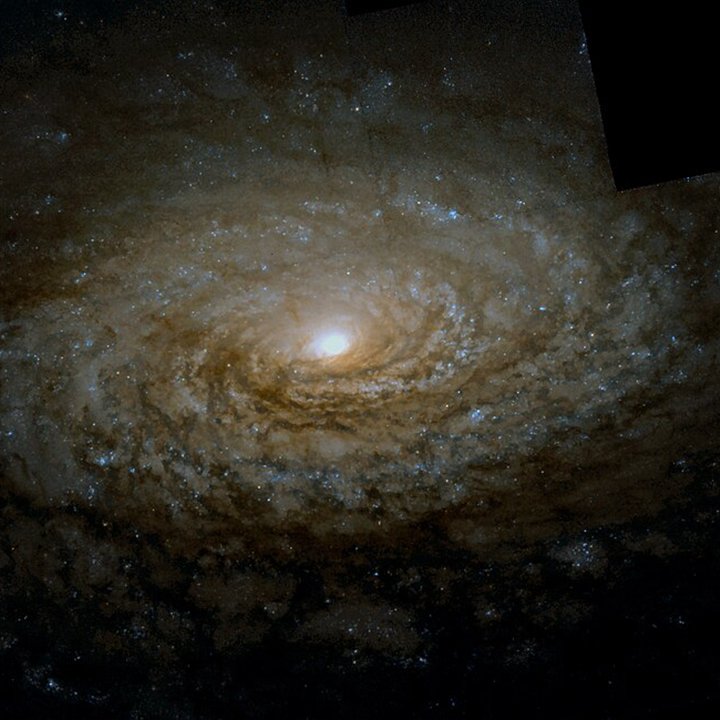
🔭 Galaxy Guide: Find Sunflower Galaxy in the CRV Science Deep Sky Galaxy Guide to see its Hubble, JWST or ground-based image, the diagnostic clue used to classify it, and the Unbarred Spiral class it belongs to. Test your eye in the Deep Sky Classification game.
Flocculent Versus Grand Design: Why Are M63's Arms Patchy?
Grand-design spirals such as M51 have long, continuous arms tied to density waves, often boosted by a companion or a bar. Flocculent spirals like M63 lack that organizing influence. Models suggest star formation propagates from cloud to cloud, and differential rotation shears the resulting bright patches into short arm segments, producing a woolly appearance.
Stellar Streams: Evidence of a Cannibalized Dwarf
Deep imaging in 2008 revealed faint arcs of stars in M63's outskirts, interpreted as the debris of a dwarf galaxy torn apart by tides and slowly absorbed. Such streams are fossil records of past mergers, and similar structures are known around the Milky Way and Andromeda.
Finding It: Nearby Groupmates and History
Pierre Méchain found M63 in 1779, and Charles Messier added it to his catalog soon after. It is the brightest member of a small group of galaxies in Canes Venatici, and the glow of its yellow core against bluer outer arms inspired the flower name.
Sunflower Galaxy at a Glance
| Property | Value |
|---|---|
| Catalog designation | M63 • NGC 5055 |
| Constellation | Canes Venatici |
| Distance | 29 million light-years |
| Hubble / morphological type | SA(rs)bc |
| Galaxy Guide class | Unbarred Spiral Galaxy (SA) |
| Spiral pattern | Flocculent |
| Cataloged | Pierre Méchain, 1779 |
| Image credit (Galaxy Guide) | ESA / NASA / Hubble |
Flocculent Spiral Physics, Swing Amplification & Differential Shear
Elmegreen Arm Class 3 and Local Gravitational Instabilities
Discovered by Pierre Méchain on June 14, 1779—the first deep-sky object found by Méchain and logged that same day by Charles Messier as M63 (NGC 5055)—the Sunflower Galaxy resides at a Tip of the Red Giant Branch (TRGB) distance of 8.87 ± 0.29 megaparsecs (~28.9 million light-years; McQuinn et al. 2017) in Canes Venatici, where it shares the M51/M63 Group with the Whirlpool Galaxy (~1.8 Mpc away). Inclined at i ≈ 55° to 59° and classified morphologically as SA(rs)bc, NGC 5055 serves alongside NGC 2841 as the archetype of a flocculent ("woolly" or patchy) spiral galaxy, categorized as Arm Class 3 in the 12-point morphological scheme of Debra Meloy Elmegreen and Bruce Elmegreen (1982, 1987).
Why does M63 display dozens of short, discontinuous, overlapping spiral arm segments in optical and ultraviolet light rather than two global grand-design arms? Two coupled physical mechanisms govern flocculent disk dynamics:
- Absence of a Global m = 2 Driver and Swing Amplification of Local Toomre Instabilities: Unlike barred spirals (where a central stellar bar torques the disk) or interacting pairs like M51 (where a large companion excites a global m = 2 density mode), M63 is unbarred and lacks a close companion. In its stellar disk, Toomre's radial stability parameter Q* = κ σR / (3.36 G Σ*) ≈ 1.8–2.5 suppresses global m = 2 modes, whereas the cold gas disk (MH I ≈ 9 × 10⁹ M☉, MH2 ≈ 5 × 10⁹ M☉) maintains a lower effective Qeff ≈ 1.0–1.3. Local gravitational instabilities and swing amplification (Toomre 1981) amplify higher-order azimuthal wavelets (m ≈ 6 to 15) with characteristic Jeans wavelengths of λJ ≈ 1 to 3 kpc.
- Stochastic Self-Propagating Star Formation (SSPSF) and Differential Shear: As modeled by Mueller & Arnett (1976) and Gerola & Seiden (1978), expanding OB stellar winds and supernova shells compress adjacent molecular clouds, triggering sequential bursts of star formation. Across M63's flat rotation curve (Vrot ≈ 190–210 km·s−1), differential angular rotation Ω(R) = Vrot / R shears any circular star-forming complex of radial width Δ*R* into a trailing spiral arc of pitch angle ip over time t:
cot ip(t) = −*R* (dΩ / d*R*) t = AOort t
where Oort's shear parameter AOort = −(1/2) R (dΩ/d*R*) ≈ 12–18 km·s−1·kpc−1. Within a single galactic rotation (~150 Myr), differential shear stretches each young stellar complex into a feathery spiral segment 2 to 5 kpc long before the OB stars fade.
Underlying Near-Infrared Two-Arm Density Wave
When M63 is imaged in the near-infrared K band (2.2 μm) or with the Spitzer Space Telescope IRAC 3.6 μm camera (Thornley 1996; Kendall, Kennicutt, & Clarke 2011)—which penetrates interstellar dust and traces the old, mass-dominant K- and M-giant stellar disk rather than young blue OB stars—a smooth, low-amplitude (~10–15% surface density contrast) two-armed (m = 2) spiral density wave emerges inside R < 8 kpc. Thus, M63 proves that optical flocculence reflects acoustic and gravitational turbulence in the cold gas layer rather than the absence of a stellar density wave.
Extended Warped H I Halo & Fossil Tidal Streams
The 80-Kiloparsec Warped H I Disk and Declining Rotation Curve
Deep 21-cm synthesis observations with the Westerbork Synthesis Radio Telescope (WSRT) by Battaglia et al. (2006) and the VLA THINGS survey (Walter et al. 2008; de Blok et al. 2008) revealed that M63's neutral atomic hydrogen disk extends out to RH I ≈ 40 kiloparsecs (~80 kpc / 260,000 light-years in diameter)—nearly four times the radius of the bright optical disk (R25 ≈ 11 kpc). Beyond the optical edge (R > 12 kpc), the H I disk develops a symmetric, kinematically regular warped outer ring whose position angle twists by ~20° while its circular rotation velocity drops gently from Vmax ≈ 212 km·s−1 at R = 8 kpc down to Vrot ≈ 175 km·s−1 at R = 40 kpc, constraining an enclosed dark matter halo mass of Mdyn(R < 40 kpc) ≈ 2.8 × 10¹¹ M☉. Moreover, deep GALEX ultraviolet (152/227 nm) imaging discovered Type 1 Extended UV (XUV) spiral arms of low-level star formation tracing this warped H I envelope far outside the optical edge.
The Chonis / Martínez-Delgado Giant Stellar Tidal Loop
In 2008–2011, deep wide-field surface photometry down to μR ≈ 28.5 mag·arcsec−2 by Taylor Chonis, David Martínez-Delgado, and collaborators uncovered a colossal system of faint stellar tidal arcs and loops arching up to 30 kiloparsecs (~100,000 light-years) above and around the western and northern halo of M63. Resolved subsequently into old red giant branch stars by the Hubble Space Telescope (GHOSTS survey), this giant stellar stream represents the fossil debris of a dwarf satellite galaxy (M* ≈ 108 M☉, metallicities [Fe/H] ≈ −1.2) tidally disrupted by M63 over the past ~1 to 2 billion years—demonstrating that even undisturbed-looking flocculent disks actively assemble their halos via hierarchical minor-merger cannibalism, which also excited the outer H I warp.
Nuclear Counter-Rotating Core & Supernova SN 1971I
Across its disk, NGC 5055 sustains a star formation rate of SFR ≈ 2.0 to 2.4 M☉·yr−1 and hosts a LINER / weak Type 2 AGN nucleus surrounded by a kinematically decoupled core: integral-field spectroscopy with the OASIS spectrograph by Blais-Ouellette et al. (2004) discovered a counter-rotating ionized gas and stellar core within the inner 300 parsecs, deposited by a past minor merger. In May 1971, the Type Ia supernova SN 1971I erupted in the southern inner spiral disk of M63, reaching peak photographic magnitude mpg = +11.8.
References
- Elmegreen, D. M., & Elmegreen, B. G. (1987). "Arm classifications for spiral galaxies." The Astrophysical Journal, 314, 3–9. doi:10.1086/165034
- Thornley, M. D. (1996). "Uncovering spiral structure in flocculent galaxies." The Astrophysical Journal, 469, L45–L48. doi:10.1086/310260
- Battaglia, G., Fraternali, F., Oosterloo, T., & Sancisi, R. (2006). "H I study of the warped spiral galaxy NGC 5055: A disk/dark matter halo offset?" Astronomy & Astrophysics, 447(1), 49–62. doi:10.1051/0004-6361:20053210
- Chonis, T. S., Martínez-Delgado, D., Gabany, R. J., Majewski, S. R., Hill, G. J., Gralak, R., & Trujillo, I. (2011). "A mega-cam survey of outer halo structures around M63: A faint tidal stream." The Astronomical Journal, 142(5), 166. doi:10.1088/0004-6256/142/5/166