Phantom Galaxy
The Phantom Galaxy (Messier 74, NGC 628) is a face-on grand-design spiral in Pisces, around 32 million light-years away.
The Phantom Galaxy (Messier 74, NGC 628) is a face-on grand-design spiral in Pisces, around 32 million light-years away. Its low surface brightness makes it notoriously hard to see through a small telescope, but deep Hubble and James Webb images show it as one of the cleanest spiral patterns in the sky.
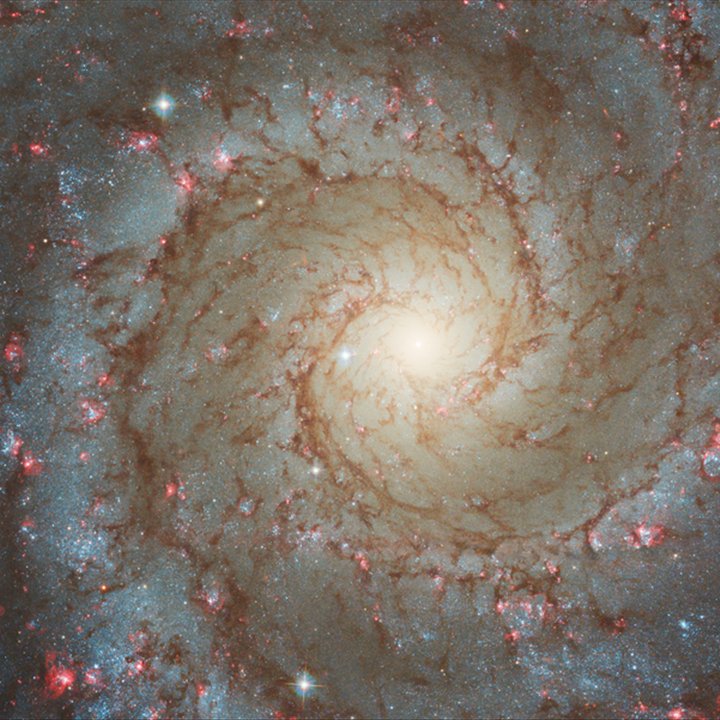
🔭 Galaxy Guide: Find Phantom Galaxy in the CRV Science Deep Sky Galaxy Guide to see its Hubble, JWST or ground-based image, the diagnostic clue used to classify it, and the Unbarred Spiral class it belongs to. Test your eye in the Deep Sky Classification game.
A Textbook Face-On Spiral: What Makes M74 So Useful?
Because M74 is seen nearly face-on and has no bar, its arms can be traced without confusion from foreshortening. Two main arms and several fainter ones wind from a small bright nucleus, with pink star-forming regions along them and dust lanes tracing the spiral shocks. Astronomers use it as a reference when comparing how stars form in different parts of a disk.
Webb and Hubble: Mapping Star Formation Cloud by Cloud
M74 is a flagship target of the PHANGS survey, which combines Hubble, JWST, ALMA and other facilities to link giant molecular clouds to the young star clusters they produce. Webb's infrared images, released in 2022, revealed an intricate web of gas and dust filaments and clusters hidden from optical light. Such maps test how quickly clouds turn gas into stars and how stellar feedback disperses them.
A Prolific Supernova Host
M74 has hosted several well-studied supernovae, including SN 2002ap, an unusually energetic stripped-envelope explosion, and SN 2003gd, a Type II-P event used to test distance measurements. With its face-on view, the galaxy is a convenient place to catch the explosions and study where in a spiral disk they occur.
Phantom Galaxy at a Glance
| Property | Value |
|---|---|
| Catalog designation | M74 • NGC 628 |
| Constellation | Pisces |
| Distance | 32 million light-years |
| Hubble / morphological type | SA(s)c |
| Galaxy Guide class | Unbarred Spiral Galaxy (SA) |
| Cataloged | Pierre Méchain, 1780 |
| Survey role | PHANGS multi-wavelength target |
| Image credit (Galaxy Guide) | ESA/Webb, NASA & CSA, J. Lee and the PHANGS-JWST Team |
Unbarred Grand-Design Spiral Architecture & H I Disk Kinematics
Low Inclination Geometry and Quiescent Spiral Density Waves
Discovered by Pierre Méchain in September 1780 and cataloged by Charles Messier on October 18, 1780, Messier 74 (NGC 628, the Phantom Galaxy) resides at a Tip of the Red Giant Branch (TRGB) distance of 9.8 ± 0.5 megaparsecs (~32 million light-years; Kreckel et al. 2017). M74 earns its "Phantom" moniker from its low average optical surface brightness (μB ≈ 23.5 mag·arcsec−2 across a ~30-kiloparsec disk), resulting from its nearly zero inclination to the plane of the sky (i = 6.5° to 8.7°). Because projection and internal dust self-absorption are minimized at i < 9°, M74 serves as the face-on reference galaxy for unbarred SA(s)c grand-design spiral structure.
Unlike the Whirlpool Galaxy (M51), whose m = 2 density wave is tidally driven by a close companion, M74 is the isolated primary galaxy of the small M74 Group (accompanied at >100 kpc by dwarf irregulars UGC 1176 and UGC 1195). Within its inner optical disk (R < 12 kpc, M* ≈ 2.2 × 10¹⁰ M☉, SFR ≈ 1.8 to 2.4 M☉·yr−1), two symmetric, logarithmically wound spiral arms (pitch angle ip ≈ 16°–18°) emerge from a small pseudobulge (n ≈ 1.5) without a central bar. Harmonic analysis of the velocity field places the corotation radius at RCR ≈ 5.5 to 7.0 kpc (pattern speed Ωp ≈ 31 ± 3 km·s−1·kpc−1), outside which the two main arms bifurcate into secondary spurs.
The Extended Warped H I Envelope
Very Large Array (VLA) 21-cm synthesis imaging from the THINGS survey (Walter et al. 2008) and Kamphuis & Briggs (1992) revealed that M74's neutral atomic hydrogen disk (MH I ≈ 1.1 × 10¹⁰ M☉) extends to RH I > 40 kiloparsecs—over three times the optical radius. Beyond R > 13 kpc, the inclination of the H I ring twists by 10°–15° in a coherent kinematic warp accompanied by two symmetrical H I arms and high-velocity complexes (vdev ≈ 50–100 km·s−1), indicating ongoing cold gas accretion from the group halo.
PHANGS Multi-Wavelength Synthesis: JWST, ALMA, VLT-MUSE & HST
The PHANGS-JWST Dust Web and Feedback-Driven "Phantom Bubbles"
As one of the 19 flagship targets of the PHANGS collaboration (Physics at High Angular resolution in Nearby Galaxies; Lee et al. 2023; Leroy et al. 2021), NGC 628 has been mapped at ~20–50 parsec resolution across ALMA CO(J = 2–1) interferometry, VLT/MUSE integral-field spectroscopy, HST UV-optical imaging, and JWST NIRCam (2.0–3.6 μm) plus MIRI (7.7, 10, 11.3, and 21 μm) infrared imaging.
The JWST MIRI mosaic of M74—targeting the 7.7 μm and 11.3 μm C–C and C–H bands of polycyclic aromatic hydrocarbons (PAHs) alongside 21 μm warm dust continuum—unveiled a porous filamentary architecture across the disk:
- Superbubbles and the "Phantom Void": Early O- and B-type stellar winds, radiation pressure, and clustered core-collapse supernovae sweep the interstellar medium into more than 1,700 circular and elliptical dust shells and superbubbles ranging from 30 parsecs up to the 1,000-parsec (3,300 light-year) southeastern "Phantom Bubble" analyzed by Barnes et al. (2023). Along the compressed rims of these expanding shells (vexp ≈ 10–25 km·s−1), triggered star formation ignites new embedded protostars detected at 21 μm.
- Molecular Cloud Lifecycles: Cross-correlating ALMA CO(J = 2–1) clouds (MH2,tot ≈ 3.2 × 10⁹ M☉) with MUSE Hα emission and JWST embedded clusters proves that Giant Molecular Clouds in M74 survive for 10 to 20 Myr before pre-supernova photoionization and OB stellar winds disperse the remaining molecular gas within 2 to 5 Myr of high-mass star breakout, limiting the cloud-scale star formation efficiency to εSF ≈ 5–10%.
- The Nuclear Star-Forming Ring: Within the central 500 parsecs, JWST and ALMA resolve a dust-depleted cavity surrounded by a circumnuclear ring of molecular clouds driven inward by an Inner Lindblad Resonance (ILR), hosting a nuclear star cluster (MNSC ≈ 107 M☉) and the ultraluminous X-ray source M74 X-1 (quasi-periodic oscillations at P ≈ 2 hours).
Supernova Progenitors & Relativistic Transients: SN 2002ap, SN 2003gd & SN 2013ej
M74 has hosted three benchmark core-collapse supernovae in the 21st century:
- SN 2002ap (Type Ic-BL "Hypernova"): Discovered on January 29, 2002, by Yoji Hirose in the outer southwestern disk, SN 2002ap displayed broad, blended Fe II, Si II, and O I absorption troughs indicating ejecta velocities of vej ≈ 30,000 km·s−1 (0.1*c*) and an explosion kinetic energy of EK ≈ (4–10) × 1051 ergs—classifying it as the nearest broad-lined Type Ic hypernova analogous to gamma-ray burst supernovae (SN 1998bw), powered by an asymmetric Wolf-Rayet/binary progenitor (Minit ≈ 20–25 M☉).
- SN 2003gd (Type II-P): Discovered in June 2003, archival pre-explosion Hubble WFPC2 and Gemini images analyzed by Smartt et al. (2004) directly resolved the progenitor star: an evolved M-type red supergiant of initial mass Minit = 8+4−2 M☉, confirming that Type II-P supernovae arise from moderate-mass red supergiants.
- SN 2013ej (Type II-P/L): Exploding in July 2013 in an inner spiral arm, pre-explosion HST ACS imaging established a red supergiant progenitor (Minit ≈ 12–15 M☉) surrounded by circumstellar dust.
References
- Smartt, S. J., Maund, J. R., Hendry, M. A., Tout, C. A., Gilmore, G. F., Mattila, S., & Benn, C. R. (2004). "Detection of a red supergiant progenitor star of a Type II-plateau supernova." Science, 303(5657), 499–503. doi:10.1126/science.1092967
- Mazzali, P. A., Deng, J., Maeda, K., Nomoto, K., Umeda, H., Hatano, K., ... & Filippenko, A. V. (2002). "The aspherical properties of the energetic Type Ic SN 2002ap as inferred from its nebular spectra." The Astrophysical Journal, 572(1), L61–L65. doi:10.1086/341504
- Kreckel, K., Blanc, G. A., Schinnerer, E., Groves, B., Adamo, A., Hughes, A., & Meidt, S. (2017). "A revised distance to NGC 628 using the Tip of the Red Giant Branch." The Astrophysical Journal, 834(2), 174. doi:10.3847/1538-4357/834/2/174
- Barnes, A. T., Watkins, E. J., Meidt, S. E., Kreckel, K., Sormani, M. C., Treß, R. G., ... & Williams, T. G. (2023). "PHANGS-JWST First Results: Multi-wavelength view of the 'Phantom' superbubble in NGC 628." The Astrophysical Journal Letters, 944(2), L22. doi:10.3847/2041-8213/aca7b9