Mice Galaxies
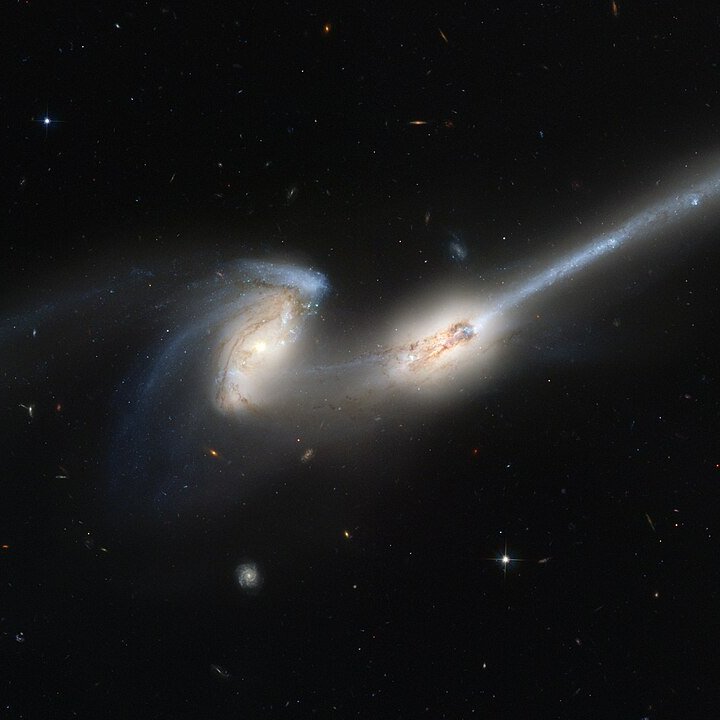
The Mice Galaxies (NGC 4676A and NGC 4676B, Arp 242) are two spiral galaxies in Coma Berenices, around 290 million light-years away, whose long tails give them the look of tiny mice. They are in the middle of an encounter that will end in a merger.
The Mice Galaxies (NGC 4676A and NGC 4676B, Arp 242) are two spiral galaxies in Coma Berenices, around 290 million light-years away, whose long tails give them the look of tiny mice. They are in the middle of an encounter that will end in a merger.
🔭 Galaxy Guide: Find Mice Galaxies in the CRV Science Deep Sky Galaxy Guide to see its Hubble, JWST or ground-based image, the diagnostic clue used to classify it, and the Interacting Merger class it belongs to. Test your eye in the Deep Sky Classification game.
Reading a Merger From Its Tails
Each galaxy has developed a long tail of stars and gas, stretching more than 100,000 light-years, produced by the tidal pull of the other. The tails are curved because the galaxies have already passed close once and are now swinging back toward each other.
Simulations and Images
Toomre and Toomre's 1972 models used this very pair as a test of their tidal-tail simulations. Hubble's Advanced Camera for Surveys imaged them in 2002, showing blue star clusters stretched along the tails.
The Final Merger
Eventually the cores will fall together to form a single, higher-mass galaxy, probably elliptical. Observing pairs at different stages, such as the Mice and the more advanced Antennae, allows astronomers to reconstruct the whole sequence.
Mice Galaxies at a Glance
| Property | Value |
|---|---|
| Catalog designation | NGC 4676A/B • Arp 242 |
| Constellation | Coma Berenices |
| Distance | 290 million light-years |
| Hubble / morphological type | Interacting Spiral Pair |
| Galaxy Guide class | Interacting & Merging Galaxies (Merger / Arp) |
| Arp number | Arp 242 |
| Image credit (Galaxy Guide) | NASA / H. Ford (JHU) / G. Illingworth (UCSC) / ACS Science Team |
Prograde Tidal Tail Mechanics & Projection Geometry
Toomre & Toomre's First Benchmark Model (1972)
Nicknamed "The Mice" by Soviet astronomer Boris Vorontsov-Velyaminov in the 1950s (VV 224) and cataloged by Halton Arp in 1966 as Arp 242, the interacting pair NGC 4676A (northern component, IC 819) and NGC 4676B (southern component, IC 820) sits at a recession velocity of vhel ≈ 6,610 km·s−1 (z = 0.02205, luminosity distance ~90 Mpc or 290 million light-years) in the outskirts of the Coma Cluster. In their 1972 paper "Galactic Bridges and Tails", Alar and Juri Toomre selected NGC 4676 as the first of four real-world galaxy pairs (alongside the Antennae, M51, and NGC 7252) to test whether Newtonian gravitational tides in a parabolic two-body encounter could reproduce observed filamentary tails without invoking magnetic fields or nuclear explosions.
Combined N-body/hydrodynamical modeling by Joshua Barnes (2004), Hibbard & Mihos (1995), and Privon et al. (2013) establishes that NGC 4676A and NGC 4676B are two roughly equal-mass barred or early-type spiral galaxies (Mhalo ≈ 4 × 10¹¹ M☉ each, separated by ~37 arcseconds or ~16 kiloparsecs in projection) undergoing a prograde-prograde parabolic encounter:
- First Pericentric Passage (t ≈ −160 to −180 Myr): Roughly 170 million years ago, the two disks swept past each other at a pericentric separation of rperi ≈ 12 to 18 kpc. Because both disks rotated in the same directional sense as their mutual orbital motion (spin-orbit inclination iA ≈ 15°–25° for NGC 4676A and iB ≈ 55°–65° for NGC 4676B), outer disk stars and H I gas experienced a sustained resonant quadrupole acceleration, launching two opposing tidal tails and a connecting intergalactic bridge.
- Line-of-Sight Projection Illusion: Why does the northern tail of NGC 4676A appear razor-straight and narrow (~45 kpc or 150,000 light-years long in projection), whereas the southern tail of NGC 4676B appears shorter, broader, and gently curved? As demonstrated by Toomre & Toomre (1972) and confirmed by VLA H I 21-cm and optical velocity curves, both tails are curved arcs in three-dimensional space. However, NGC 4676A's disk and tail are viewed nearly edge-on (i ≈ 75°–80° to our line of sight), causing its curved tidal streamer to project onto the sky as a needle-sharp linear spike, whereas NGC 4676B is viewed at an intermediate inclination (i ≈ 45°–50°), revealing the intrinsic curvature of its southern tidal arc.
Kinematic Reversal and Impending Second Infall
Spectroscopic velocity mapping along the northern tail of NGC 4676A reveals a smooth velocity gradient spanning Δ*v* ≈ 400 km·s−1 from tip to base, while the inner regions of both tails show kinematic turnaround points where tidally stripped material has reached its apocentric distance and is falling back onto the parent disks. Having just passed their mutual orbital apocenter (rapo ≈ 40–50 kpc), the two galaxy cores are now accelerating back toward each other for their second pericentric collision, which will occur in ~200 to 400 Myr and culminate in complete nuclear coalescence within ~500 Myr.
Star Cluster Populations, Shock-Driven Outflows & Multi-Wavelength Diagnostics
Hubble ACS Commissioning Imaging and Tail Star Formation
In April 2002, the newly installed Advanced Camera for Surveys (ACS) aboard the Hubble Space Telescope captured its First Light servicing-mission image of the Mice in B (F475W), V (F606W), and I (F814W) bands. De Grijs, Lee, and Clemencia Mora (2003) identified over 400 luminous Super Star Clusters (SSCs) (M ≈ 104–106 M☉) distributed not only across the main stellar disks and connecting bridge, but embedded all along the 45-kpc northern tidal tail of NGC 4676A and the southern tail of NGC 4676B.
Comparing the broadband spectral energy distributions of these clusters with dynamical simulations demonstrates that star cluster formation in the Mice was triggered synchronously at pericentric passage (t ≈ 150–200 Myr ago) and continues today (t < 10–30 Myr) inside compressed H I clouds (MH I,tot ≈ 7.5 × 10⁹ M☉) along the tidal tails. Near the northern tip of NGC 4676A's tail, self-gravitating gas clumps with velocity dispersions of σ ≈ 15–25 km·s−1 and oxygen abundances of 12 + log(O/H) ≈ 8.5 (~0.6 Z☉) form bound Tidal Dwarf Galaxy (TDG) progenitors.
Nuclear Starburst and Bipolar Superwind in NGC 4676A
While both galaxies host active star formation (combined infrared luminosity LIR ≈ 2.6 × 10¹¹ L☉, classifying Arp 242 as a Luminous Infrared Galaxy, or LIRG, with total SFR ≈ 15–25 M☉·yr−1), their internal gas distributions differ sharply:
- NGC 4676A (Northern Galaxy): Millimeter CO(J = 1–0) interferometry shows that bar-like tidal torques funneled over 6 × 10⁹ M☉ of cold molecular hydrogen (H2) into the central 2 kpc of NGC 4676A, fueling a dust-enshrouded circumnuclear starburst (AV > 5 mag). Integral-field spectroscopy by Wild et al. (2014) revealed that supernova and OB-star feedback from this nuclear starburst drives a bipolar galactic superwind expanding perpendicular to the edge-on disk of NGC 4676A at 300 to 400 km·s−1, lighting up two biconical Hα and [N II] emission nebulae heated by fast radiative shocks.
- NGC 4676B (Southern Galaxy): Contains an older, early-type SB0/a bulge flanked by a bar and two bright star-forming spiral arcs, with Chandra X-ray observations detecting diffuse thermal emission (kBT ≈ 0.5 keV) and weak low-luminosity AGN activity in both nuclei.
Cosmological Context in the Coma Supercluster
Because NGC 4676 shares the systemic redshift of the Coma Cluster (Abell 1656) (vComa ≈ 6,925 km·s−1) and lies at a projected distance of ~3.9° (~6.2 Mpc) from the cluster center, the Mice reside inside a filament of the Coma Supercluster infalling toward the cluster core. By the time the merged remnant of NGC 4676A/B enters the dense intracluster medium of Coma in ~2–3 Gyr, it will already have relaxed into a single early-type elliptical or S0 galaxy—illustrating how pre-processing via galaxy-galaxy mergers in cluster outskirts transforms late-type spirals into passive ellipticals before they ever reach a rich cluster core.
References
- Toomre, A., & Toomre, J. (1972). "Galactic bridges and tails." The Astrophysical Journal, 178, 623–666. doi:10.1086/151823
- Hibbard, J. E., & van Gorkom, J. H. (1996). "Cold gas and star formation in a merging galaxy sequence." The Astronomical Journal, 111(2), 655–695. doi:10.1086/117815
- Barnes, J. E. (2004). "Shock-induced star formation in a model of the Mice." Monthly Notices of the Royal Astronomical Society, 350(3), 798–808. doi:10.1111/j.1365-2966.2004.07725.x
- Wild, V., Rosales-Ortega, F., Falcón-Barroso, J., García-Benito, R., Gallazzi, A., González Delgado, R. M., ... & Ziegler, B. (2014). "The Mice at play in the CALIFA survey: A case study of a gas-rich merger between first passage and coalescence." Astronomy & Astrophysics, 567, A132. doi:10.1051/0004-6361/201321624