NGC 2207 and IC 2163
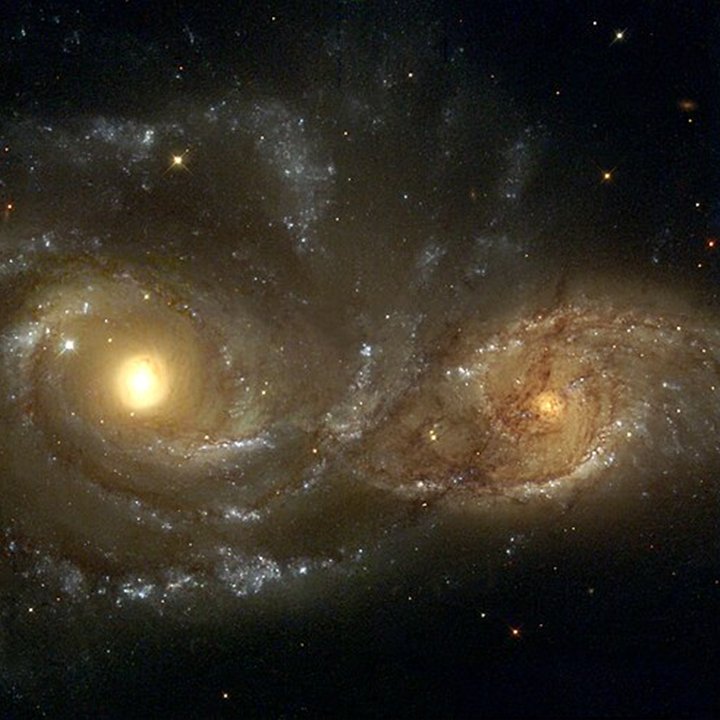
NGC 2207 and IC 2163 are a pair of spiral galaxies in Canis Major, about 80 million light-years away, caught in a slow grazing encounter. The larger NGC 2207 is passing the smaller IC 2163, whose gas and stars are being drawn into long arcs.
NGC 2207 and IC 2163 are a pair of spiral galaxies in Canis Major, about 80 million light-years away, caught in a slow grazing encounter. The larger NGC 2207 is passing the smaller IC 2163, whose gas and stars are being drawn into long arcs.
🔭 Galaxy Guide: Find NGC 2207 and IC 2163 in the CRV Science Deep Sky Galaxy Guide to see its Hubble, JWST or ground-based image, the diagnostic clue used to classify it, and the Interacting Merger class it belongs to. Test your eye in the Deep Sky Classification game.
A Grazing Encounter
IC 2163 is swinging past NGC 2207 and will eventually be pulled back, and the tidal forces have already created a long curved feature of stars and gas on the smaller galaxy's side, nicknamed the "eyelash". The galaxies are expected to merge in the distant future.
Hubble's View
The Hubble image released in 1999 shows dust lanes from NGC 2207 silhouetted against IC 2163 and bright knots of star formation. Several supernovae have been recorded in the pair in recent decades.
Learning From Pairs
Because the galaxies are spirals of unequal size, their interaction offers a test of models for minor mergers, the more common type in the universe.
NGC 2207 and IC 2163 at a Glance
| Property | Value |
|---|---|
| Catalog designation | NGC 2207 • IC 2163 |
| Constellation | Canis Major |
| Distance | 80 million light-years |
| Hubble / morphological type | SAB(rs)bc pec + SB(rs)c pec |
| Galaxy Guide class | Interacting & Merging Galaxies (Merger / Arp) |
| Type | Grazing spiral pair |
| Image credit (Galaxy Guide) | NASA / ESA & The Hubble Heritage Team (STScI) |
Ocular Galaxy Mechanics & Grazing Tidal Kinematics
The "Eyelid" Caustic of IC 2163 and the Elmegreen–Sundin Model
Discovered by John Herschel in 1835 (NGC 2207) and Herbert Howe in 1898 (IC 2163), the spiral pair NGC 2207 and IC 2163 lies at a recession velocity of vhel ≈ 2,740 km·s−1 (z = 0.00914; distance estimates span ~80 million light-years in the Galaxy Guide table up to ~114 million light-years / 35 Mpc for H0 = 70 km·s−1·Mpc−1). Unlike head-on collisional rings or advanced nuclear mergers, NGC 2207 and IC 2163 are caught in an early, nearly in-plane grazing encounter that defines the rare morphological class of ocular (eye-shaped) galaxies.
As analyzed by Bruce Elmegreen, Debra Meloy Elmegreen, Maria Sundin, and Curtis Struck (1995, 2000) using N-body and hydrodynamical models, the primary spiral NGC 2207 (SAB(rs)bc pec, diameter ~43 kpc, dynamical mass M2207 ≈ 2 × 10¹¹ M☉) has roughly two to three times the dynamical mass of its barred companion IC 2163 (SB(rs)c pec, located partially behind the eastern spiral arms of NGC 2207). Approximately 40 million years ago, IC 2163 swept counterclockwise behind NGC 2207 on a prograde, in-plane trajectory at a pericentric separation of rperi ≈ 15 to 20 kpc:
- Formation of the Ocular "Eyelids": During pericentric passage, the strong prograde tidal field of NGC 2207 exerted an impulsive radial pull Δ*v*R on the outer disk of IC 2163 while exerting a retarding gravitational torque on its orbital angular momentum. As the perturbed outer disk stars and gas of IC 2163 fell back inward toward a bar-like inner resonance, their streamlines intersected to form a sharp-pointed, oval ocular caustic (~12 × 6 kpc across) resembling a human eyelid, bounded by two shock-compressed rims where inward streaming velocities exceed 100 km·s−1.
- The Counter-Tidal "Eyelash" Streamers: Extending eastward from the pointed apex of IC 2163's ocular oval is a sweeping, 30-kiloparsec tidal tail split into parallel gaseous and stellar filaments—nicknamed the "eyelash"—along which neutral hydrogen (H I) and young star clusters stream outward at velocities spanning Δ*v* ≈ 150 km·s−1.
- Foreground Dust Silhouette in NGC 2207: Meanwhile, the perpendicular component of IC 2163's gravitational pull excited a grand-design m = 2 spiral wave and a vertical warped disk in NGC 2207. Because NGC 2207 lies in the immediate foreground along the line of sight, Hubble WFPC2 imaging resolves its spiral dust lanes in silhouette directly against the luminous ocular rim of background IC 2163, enabling direct measurement of the optical depth (τV ≈ 0.5–2.0) and radial scale length of dust in an outer spiral arm.
Multi-Wavelength Diagnostics: JWST, ALMA, Chandra & "Feature i"
JWST Mid-Infrared Dust Filaments and ALMA Molecular Shocks
In October 2024, the James Webb Space Telescope (JWST) combined MIRI mid-infrared (7.7–21 μm) imaging with Hubble ultraviolet and optical exposures of NGC 2207/IC 2163, following earlier submillimeter CO(J = 1–0 and 2–1) observations with ALMA by Kaufman et al. (2016). Along the northern and southern eyelids of IC 2163, ALMA maps a pair of shocked molecular ridges containing over 109 M☉ of cold H2 gas where radial streaming motions decelerate abruptly by ~100 km·s−1 across the ocular caustic. These shocks compress giant molecular clouds into a string of "beads on a string" star-forming complexes spaced by ~1.5 kpc along the eyelids, while JWST MIRI highlights warm polycyclic aromatic hydrocarbon (PAH) and silicate dust cavities carved out by newborn Super Star Clusters. Across the combined pair, the galaxy-wide star formation rate reaches SFR ≈ 20 to 24 M☉·yr−1 (comparable to forming two dozen solar-mass stars per year).
The Enigmatic Starburst Knot "Feature i" in NGC 2207
Roughly 12 kiloparsecs west of the nucleus of NGC 2207—at the tip of its western spiral arm—lies one of the most concentrated extragalactic starburst knots known: Feature i (discovered by Elmegreen et al. 2000). Contained within a compact core less than 100 parsecs across surrounded by a 1-kpc H II nebula, Feature i houses a dense super star cluster (M* > 106 M☉, age ~4 Myr) coupled with a dual radio-continuum core and bright 24 μm / MIRI infrared emission that alone accounts for ~12% of the entire 24 μm and radio luminosity of both galaxies combined. Furthermore, Chandra X-ray Observatory surveys by Mineo et al. (2014) identified 28 Ultraluminous X-ray Sources (ULXs) (LX > 1039 erg·s−1) across NGC 2207 and IC 2163—one of the highest ULX counts per unit stellar mass in the local universe—reflecting the intense ongoing production of high-mass X-ray binaries.
A Prolific Supernova Factory
Consistent with its elevated star formation rate of ~24 M☉·yr−1, the NGC 2207/IC 2163 system has hosted at least five well-documented supernovae since 1975 across a wide diversity of progenitor channels:
- SN 1975A: A sub-luminous Type Ia thermonuclear supernova in the outer eastern disk of NGC 2207.
- SN 1999ec: A stripped-envelope Type Ib core-collapse supernova in the spiral arms of NGC 2207 near the overlap zone with IC 2163.
- SN 2003H: A Type Ib pec supernova exploding directly in the interface bridge between the two galaxies.
- SN 2010jp (PTF10aaxi): A rare jet-driven Type IIn supernova in the far southern outer tidal region of the pair, exhibiting triple-peaked Hα emission lines with high-velocity wings at ±13,000 km·s−1 indicative of a relativistic bipolar jet.
- SN 2013ai: A hydrogen-rich Type II core-collapse supernova in the western spiral arm of NGC 2207.
Because the transient ocular phase of IC 2163 persists for only ~100 Myr before differential shear winds up the eyelid caustics, NGC 2207 and IC 2163 provide a rare snapshot of an early grazing encounter that will undergo two more pericentric passages before coalescing into an elliptical galaxy in ~1 billion years.
References
- Elmegreen, D. M., Kaufman, M., Brinks, E., Elmegreen, B. G., & Sundin, M. (1995). "The interaction between spiral galaxies IC 2163 and NGC 2207. I. Observations." The Astrophysical Journal, 453, 100–130. doi:10.1086/176375
- Elmegreen, B. G., Kaufman, M., Struck, C., Elmegreen, D. M., Brinks, E., Thomasson, M., ... & English, J. (2000). "Hubble Space Telescope observations of the interacting galaxies NGC 2207 and IC 2163." The Astronomical Journal, 120(2), 630–644. doi:10.1086/301485
- Mineo, S., Rappaport, S., Levine, A., Pooley, D., Steinhorn, B., & Homan, J. (2014). "A comprehensive X-ray and multiwavelength study of the colliding galaxy pair NGC 2207/IC 2163." The Astrophysical Journal, 797(2), 91. doi:10.1088/0004-637X/797/2/91
- Kaufman, M., Brinks, E., Elmegreen, B. G., Elmegreen, D. M., Struck, C., & Klaric, M. (2016). "ALMA observations of the ocular galaxy IC 2163: Molecular clouds and eyelid kinematics." The Astrophysical Journal, 831(2), 161. doi:10.3847/0004-637X/831/2/161