Antennae Galaxies
The Antennae Galaxies (NGC 4038 and NGC 4039, Arp 244) are two spiral galaxies merging in Corvus, about 45 million light-years away in the Galaxy Guide data (older estimates run to about 65 million).
The Antennae Galaxies (NGC 4038 and NGC 4039, Arp 244) are two spiral galaxies merging in Corvus, about 45 million light-years away in the Galaxy Guide data (older estimates run to about 65 million). Long tidal tails resembling insect antennae sweep out from the pair. William Herschel discovered them in 1785.
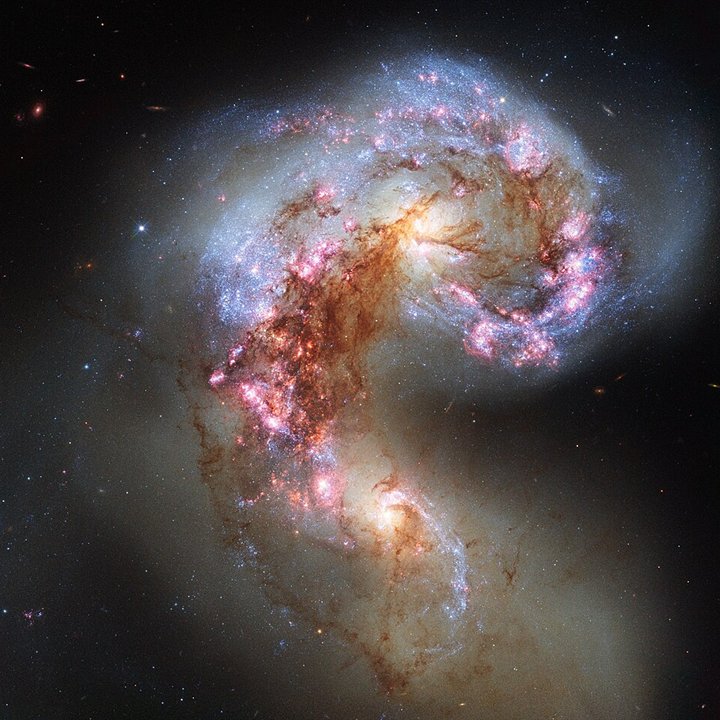
🔭 Galaxy Guide: Find Antennae Galaxies in the CRV Science Deep Sky Galaxy Guide to see its Hubble, JWST or ground-based image, the diagnostic clue used to classify it, and the Interacting Merger class it belongs to. Test your eye in the Deep Sky Classification game.
Tidal Tails: What Pulls Stars Into Streamers?
Gravitational tides stretch stars and gas away from each galaxy. In 1972 Alar and Juri Toomre showed with early computer simulations that a close encounter between two disk galaxies naturally produces such tails.
Starburst in the Overlap
Where the gas clouds of the two galaxies collide, a burst of star formation produces thousands of young star clusters, including super star clusters. Hubble, Chandra and ALMA have mapped these regions and the hot gas they heat.
Where Is It Going?
The cores are expected to merge within a few hundred million to a billion years, leaving a single elliptical galaxy. The Antennae are therefore a snapshot of how large ellipticals assemble, and they are a preview of the Milky Way's eventual merger with Andromeda.
Antennae Galaxies at a Glance
| Property | Value |
|---|---|
| Catalog designation | NGC 4038 • NGC 4039 (Arp 244) |
| Constellation | Corvus |
| Distance | 45 million light-years |
| Hubble / morphological type | Merger (SBm pec + SA(s)m pec) |
| Galaxy Guide class | Interacting & Merging Galaxies (Merger / Arp) |
| Arp number | Arp 244 |
| Discoverer | William Herschel, 1785 |
| Image credit (Galaxy Guide) | NASA / ESA / B. Whitmore (STScI) |
Dynamical Modeling of the Prograde Merger & Tidal Tail Kinematics
Toomre & Toomre Restricted Three-Body and N-Body Mechanics
The morphological architecture of NGC 4038/4039 serves as the canonical observational verification of gravitational tidal interaction theory developed by Alar and Juri Toomre (1972) and refined through self-consistent N-body/hydrodynamical simulations by Joshua Barnes (1988) and Karl et al. (2010). When two disk galaxies of comparable dynamical mass (M1 / M2 ≈ 1:1, with total halo masses of ~5 × 10¹¹ M☉ each) approach on a nearly parabolic orbit, the spatial gradient of the companion's gravitational potential across the victim disk generates a quadrupolar tidal acceleration field:
atidal(r) ≈ (G Mcomp / D3) [3 (r · D̂) D̂ − r]
where D is the instantaneous pericentric separation and r is the galactocentric radius vector of a disk star. In a prograde encounter, where the internal angular velocity Ω(r) of the stellar disk matches the orbital angular velocity Ωorb of the perturber near pericenter, disk stars experience a prolonged resonant gravitational impulse. This resonance unbinds stars and neutral atomic hydrogen (H I) from the outer disks of NGC 4038 and NGC 4039, launching two narrow, curved tidal tails that span ~20 arcminutes (~110 to 150 kiloparsecs end-to-end).
Orbital Chronology and the Interaction Overlap Zone
High-resolution H I 21-cm synthesis mapping with the Very Large Array (VLA) by Hibbard et al. (2001) indicates that the two progenitor spirals passed through first pericenter (rperi ≈ 10–15 kpc) roughly 400 to 600 million years ago. The northern tail originates from NGC 4038 (i ≈ 60°) and contains ~1.1 × 10⁹ M☉ of H I gas, whereas the longer southern tail (~65 kpc in projection) is drawn out from NGC 4039 (i ≈ 60°) and houses ~3.8 × 10⁹ M☉ of atomic gas, hosting a self-gravitating tidal dwarf galaxy (TDG) candidate near its tip. Dynamical friction between the dark matter halos subsequently caused the nuclei to plunge into a second close passage within the last 50 to 100 Myr. Between the two remnant nuclei (~6.5 kpc apart) lies a dust-obscured Interaction Overlap Region (~4 × 3 kpc across), where supersonic cloud collisions concentrate over 5 × 10⁹ M☉ of molecular hydrogen (H2).
Super Star Clusters, Multi-Wavelength Diagnostics & ISM Shock Physics
The Young Globular Cluster Population and Initial Cluster Mass Function
Deep optical and near-infrared imaging with the Hubble Space Telescope (WFPC2, ACS, and WFC3) led by Bradley Whitmore and François Schweizer resolved more than 10,000 compact, young Super Star Clusters (SSCs) distributed along the northern loop of NGC 4038, the western spiral arcs, and the dusty overlap zone. These SSCs exhibit half-light radii of Reff ≈ 1 to 4 parsecs and stellar masses spanning 104 to 5 × 10⁶ M☉, matching the structural density and velocity dispersions (σv ≈ 10–25 km·s−1) of ancient halo globular clusters. Spectroscopic age dating via Hα equivalent widths and Balmer breaks partitions the clusters into three cohorts:
- First-Passage Clusters (t ≈ 200–500 Myr): Roughly 100 luminous clusters formed during the initial pericentric sweep when the tidal tails were launched.
- Post-Infall Disk Clusters (t ≈ 20–100 Myr): Thousands of clusters tracing the shocked spiral rings of NGC 4038 as the galaxies fell back together.
- Overlap-Zone Embedded Clusters (t < 10 Myr): Nascent SSCs embedded inside high-extinction molecular knots (AV ≈ 5–40 mag), including the luminous complex WS80 (Knot B), which alone generates ~10% of the system's mid-infrared output (LIR ≈ 1010 L☉) and contains ~5 × 10⁶ M☉ of young stars.
Across all ages, the cluster mass distribution obeys a power-law Initial Cluster Mass Function (ICMF) of the form d*N* / d*M* ∝ M−2.0±0.1, while rapid gas expulsion by OB winds and supernovae unbinds ~80–90% of newly formed clusters per decade of log-age ("infant mortality").
ALMA Molecular Clouds, JWST Infrared Emission, and Chandra X-Ray Superbubbles
Interferometry with the Atacama Large Millimeter/submillimeter Array (ALMA) in CO(J = 1–0, 2–1, 3–2) resolves the overlap zone into dense Super Giant Molecular Clouds (SGMCs) with masses of 107 to 108 M☉ and turbulent velocity dispersions of 30 to 60 km·s−1. Turbulent shocks elevate the interstellar pressure to P / kB > 107 K·cm−3, raising the Jeans mass of collapsing cores and sustaining an integrated star formation rate of SFR ≈ 10 to 20 M☉·yr−1. James Webb Space Telescope (JWST) NIRCam and MIRI observations at 3.3 to 21 μm map polycyclic aromatic hydrocarbon (PAH) shells and fine-structure [Ne II] (12.8 μm) and [Ne III] (15.6 μm) emission excited by embedded O-star clusters. Simultaneously, the Chandra X-ray Observatory reveals a hot interstellar medium (kBT ≈ 0.3–0.8 keV) sculpted into kiloparsec-scale X-ray superbubbles enriched in α-elements (O, Ne, Mg, Si) by Type II supernovae (SN 1921A, SN 1974E, SN 2004gt, SN 2007sr, SN 2013dk), alongside over a dozen Ultraluminous X-ray Sources (ULXs) (LX > 1039 erg·s−1).
Cosmological Context, Distance Debate & Final Relaxation
Located in the NGC 4038 Group on the southern outskirts of the Virgo Supercluster, the Antennae have been the subject of an extragalactic distance debate: while HST Tip of the Red Giant Branch (TRGB) measurements by Saviane et al. (2008) yielded ~45 million light-years (13.3 Mpc, adopted in the Galaxy Guide table), Cepheid variables and the Type Ia supernova SN 2007sr (Schweizer et al. 2008; Riess et al. 2011) favor ~65 to 70 million light-years (20–22 Mpc). Over the next ~400 Myr, dynamical relaxation will merge NGC 4038/4039 into a rotationally supported r1/4-law elliptical galaxy.
References
- Toomre, A., & Toomre, J. (1972). "Galactic bridges and tails." The Astrophysical Journal, 178, 623–666. doi:10.1086/151823
- Whitmore, B. C., Zhang, Q., Leitherer, C., Fall, S. M., Schweizer, F., & Miller, B. W. (1999). "The luminosity function of young star clusters in 'the Antennae' galaxies (NGC 4038–4039)." The Astronomical Journal, 118(4), 1551–1576. doi:10.1086/301041
- Wilson, C. D., Scoville, N., Madden, S. C., & Charmandaris, V. (2000). "High-resolution imaging of molecular gas and dust in the Antennae (NGC 4038/39): Super giant molecular clouds." The Astrophysical Journal, 542(1), 120–127. doi:10.1086/309509
- Schweizer, F., Burns, C. R., Madore, B. F., Mager, V. A., Phillips, M. M., Freedman, W. L., ... & Suntzeff, N. B. (2008). "A new distance to the Antennae Galaxies (NGC 4038/39) based on the Type Ia supernova 2007sr." The Astronomical Journal, 136(4), 1482–1489. doi:10.1088/0004-6256/136/4/1482