Stephan's Quintet
Stephan's Quintet (HCG 92, Arp 319) is a compact group of galaxies in Pegasus, discovered by Édouard Stephan in 1877 and the first compact group ever found.
Stephan's Quintet (HCG 92, Arp 319) is a compact group of galaxies in Pegasus, discovered by Édouard Stephan in 1877 and the first compact group ever found. Four of the five galaxies lie around 290 million light-years away and interact; the fifth, NGC 7320, is a foreground galaxy only about 40 million light-years distant.
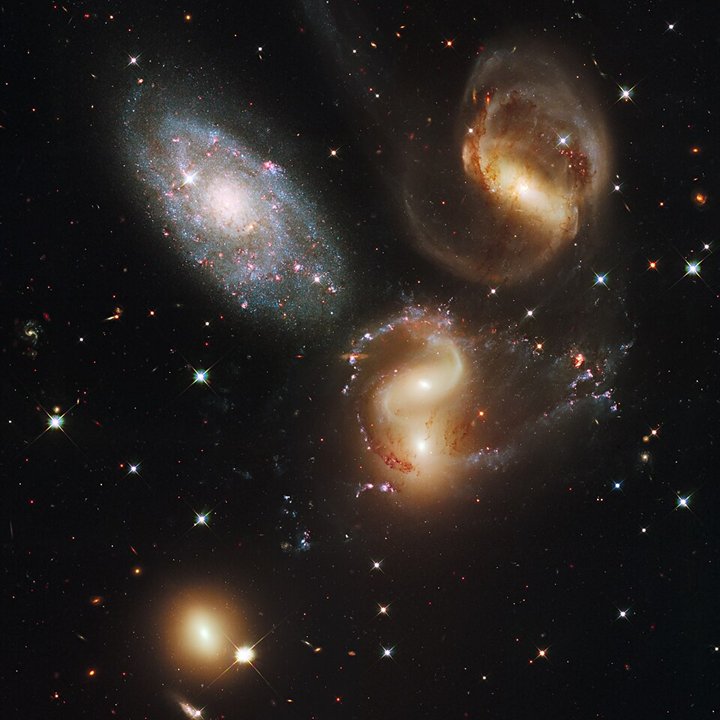
🔭 Galaxy Guide: Find Stephan's Quintet in the CRV Science Deep Sky Galaxy Guide to see its Hubble, JWST or ground-based image, the diagnostic clue used to classify it, and the Interacting Merger class it belongs to. Test your eye in the Deep Sky Classification game.
A Shock Front Between Galaxies
One galaxy, NGC 7318B, is plowing through the gas in the group, producing a large shock front detected in radio, X-ray and infrared light. Spitzer found unusually strong emission from molecular hydrogen in the shocked gas.
Webb's First Images
The group was among the first targets released from the James Webb Space Telescope in July 2022. The mosaic holds more than 150 million pixels and shows stellar streams, bright star-forming knots and an outflow from the active nucleus of NGC 7319.
Why Compact Groups Matter
Close groups like this reveal how galaxies grow by repeated encounters. Their interactions strip gas from members and heat it, creating the hot intragroup medium seen in X-rays.
Stephan's Quintet at a Glance
| Property | Value |
|---|---|
| Catalog designation | HCG 92 • Arp 319 |
| Constellation | Pegasus |
| Distance | 290 million light-years |
| Hubble / morphological type | Compact Interacting Group |
| Galaxy Guide class | Interacting & Merging Galaxies (Merger / Arp) |
| Group catalog | HCG 92 (Hickson Compact Group) |
| Foreground member | NGC 7320, about 40 million light-years away |
| Image credit (Galaxy Guide) | NASA / ESA / CSA / STScI (JWST & Hubble Composite) |
Compact Group Architecture, Redshift Discordance & Dynamical History
Visual Quintet vs. Physical Quartet (HCG 92)
Discovered visually by Jean-Marie Édouard Stephan on September 22, 1877, with the 80-cm Foucault reflector at Marseille Observatory, Stephan's Quintet (cataloged by Paul Hickson in 1982 as HCG 92 and by Halton Arp in 1966 as Arp 319) comprises five closely spaced galaxies within ~3.5 arcminutes in Pegasus. In 1961, Margaret and Geoffrey Burbidge measured the optical recession velocities of the five members, uncovering a redshift discrepancy that fueled decades of debate:
- The Foreground Interloper — NGC 7320 (vhel = 786 ± 20 km·s−1): The blue spiral NGC 7320 (SA(s)d) at the southwestern corner has a low recession velocity corresponding to a distance of ~39 to 45 million light-years (12–14 Mpc), confirmed by Hubble resolution of red supergiants, Cepheid variables, and the Tip of the Red Giant Branch (TRGB).
- The Physical Background Core (vhel ≈ 5,770–6,760 km·s−1): Four gravitationally interacting galaxies lie ~7 times farther away at a cosmological distance of ~290 million light-years (89–94 Mpc, z ≈ 0.0215):
- NGC 7317 (vhel = 6,599 km·s−1): An early-type E4 elliptical embedded in a diffuse halo of intragroup stars on the western edge.
- NGC 7318A (vhel = 6,630 km·s−1): A dust-rich peculiar elliptical/S0 galaxy near the group center.
- NGC 7318B (vhel = 5,774 km·s−1): A barred spiral galaxy (SB(s)bc pec) plunging through the group core from behind at a line-of-sight velocity difference of Δ*v* ≈ −850 to −1,000 km·s−1 relative to the intragroup medium.
- NGC 7319 (vhel = 6,747 km·s−1): A barred spiral (SB(s)bc pec) stripped of almost all its disk H I gas and hosting a Type 2 Seyfert active galactic nucleus.
- NGC 7320C (vhel = 5,985 km·s−1): Located ~4 arcminutes east of the core, this barred ring-like galaxy (SAB(s)0/a) shares the background group redshift and is connected to NGC 7319 by two parallel tidal tails, making HCG 92 a true quintet once NGC 7320C replaces foreground NGC 7320.
Sequential Tidal Stripping and the Two Tidal Tails
Combined N-body simulations by Renaud, Appleton, and Xu (2010) and VLA H I 21-cm synthesis imaging by Williams, Yun, and Verdes-Montenegro (2002) reconstruct a multi-stage collisional sequence spanning the past 500 Myr. Almost 100% of the cold neutral atomic hydrogen in Stephan's Quintet (~1010 M☉ of H I) has been stripped outside the optical bodies of the member galaxies into intergalactic space. First, ~400 to 500 Myr ago, NGC 7320C passed close to NGC 7319, pulling out the fainter, older Outer Southern Tail (which hosts cluster populations aged 150–500 Myr). Second, ~150 to 200 Myr ago, a second pericentric encounter stripped the brighter, narrower Young Northern Tidal Tail from NGC 7319, triggering the formation of over 150 young star clusters (t ≈ 5–50 Myr) and a candidate tidal dwarf galaxy (SQ-B) near its eastern curve.
The 40-Kiloparsec Intergalactic Shock Wave & H<sub>2</sub> Cooling Physics
Supersonic Intrusion of NGC 7318B
Within the past 20 to 30 million years, the high-velocity spiral NGC 7318B entered the group core for the first time, plowing at Vshock ≈ 800 to 1,000 km·s−1 into the pre-existing tidal H I filament left behind by NGC 7319 and NGC 7320C. This collision generated a curved, 40-kiloparsec-long (~130,000 light-year) intergalactic shock front situated between NGC 7318B and NGC 7319:
- Radio Synchrotron Ridge: Very Large Array (VLA) and LOFAR continuum maps reveal a ridge of non-thermal synchrotron emission where Fermi shock acceleration energizes relativistic electrons and amplifies intergalactic magnetic fields to B ≈ 10–15 μG.
- Chandra X-Ray Plasma: Chandra X-ray Observatory imaging detects a hot, shock-heated plasma ridge (kBT ≈ 0.6 keV, or T ≈ 7 × 10⁶ K) coinciding with the optical green [O III] / Hα filament, embedded within a 0.5 keV intragroup X-ray halo.
The Spitzer & JWST Molecular Hydrogen (H2) Cooling Surprise
In 2006, Philip Appleton and collaborators used the Spitzer Space Telescope Infrared Spectrograph (IRS) to discover that the 40-kpc X-ray shock ridge emits a luminous pure-rotational warm molecular hydrogen (H2) spectrum—specifically the 0–0 S(0) (28.2 μm) through S(5) (6.91 μm) mid-infrared quadrupole lines—with an integrated H2 luminosity exceeding L(H2) > 1042 erg·s−1, outshining the X-ray thermal emission of the shock by a factor of 10. How does fragile molecular hydrogen survive inside a 1,000 km·s−1 collision that heats ambient gas to 7 × 10⁶ K?
Observations with the James Webb Space Telescope (NIRCam and MIRI) and ALMA CO(J = 2–1) interferometry published by Appleton et al. (2023) resolved the physical mechanism: as the fast, low-density intergalactic shock sweeps over dense cold H I/H2 clumps, Kelvin-Helmholtz and Rayleigh-Taylor instabilities shred the clouds into thousands of dusty, cometary filaments. Within these dense clouds, the shock decelerates to slow, non-dissociative magnetohydrodynamic C-type and J-type shocks (vs ≈ 10–30 km·s−1), channeling the kinetic energy of NGC 7318B into turbulent dissipation and H2 ro-vibrational line cooling (Tgas ≈ 150–1,000 K) rather than thermal X-rays, while suppressing star formation through high turbulent velocity dispersion (σv > 50 km·s−1).
JWST NIRSpec/MIRI Diagnostics of the NGC 7319 Seyfert 2 Nucleus
At the northeastern corner of the group, NGC 7319 hosts an active Type 2 Seyfert nucleus powered by a supermassive black hole of mass MBH ≈ 2.4 × 10⁷ M☉ radiating at Lbol ≈ 1.6 × 1044 erg·s−1 (~4 × 10¹⁰ L☉, or ~5% of its Eddington limit). JWST NIRSpec and MIRI Integral Field Unit (IFU) spectroscopy resolved a dusty circum-nuclear torus and biconical radio jets that drive warm ionized outflows traced by high-excitation coronal lines ([Ne V] 14.3 μm, [O IV] 25.9 μm, [Mg V], [Fe VI]) and warm H2 gas at ±400 to 600 km·s−1.
References
- Hickson, P. (1982). "Systematic properties of compact groups of galaxies." The Astrophysical Journal, 255, 382–391. doi:10.1086/159838
- Williams, B. A., Yun, M. S., & Verdes-Montenegro, L. (2002). "The VLA H I observations of Stephan's Quintet (HCG 92)." The Astronomical Journal, 123(5), 2417–2431. doi:10.1086/339839
- Appleton, P. N., Xu, K. C., Reach, W., Dopita, M. A., Gao, Y., Lu, N., ... & Yun, M. S. (2006). "Powerful high-velocity dispersion molecular hydrogen associated with an intergalactic shock wave in Stephan's Quintet." The Astrophysical Journal, 639(2), L51–L54. doi:10.1086/502646
- Appleton, P. N., Guillard, P., Boulanger, F., Cluver, M. E., Ogle, P., Togi, A., ... & Xu, C. K. (2023). "The multiphase intergalactic medium in Stephan's Quintet seen by JWST and ALMA." The Astrophysical Journal, 951(2), 104. doi:10.3847/1538-4357/accbbf