Arp 273
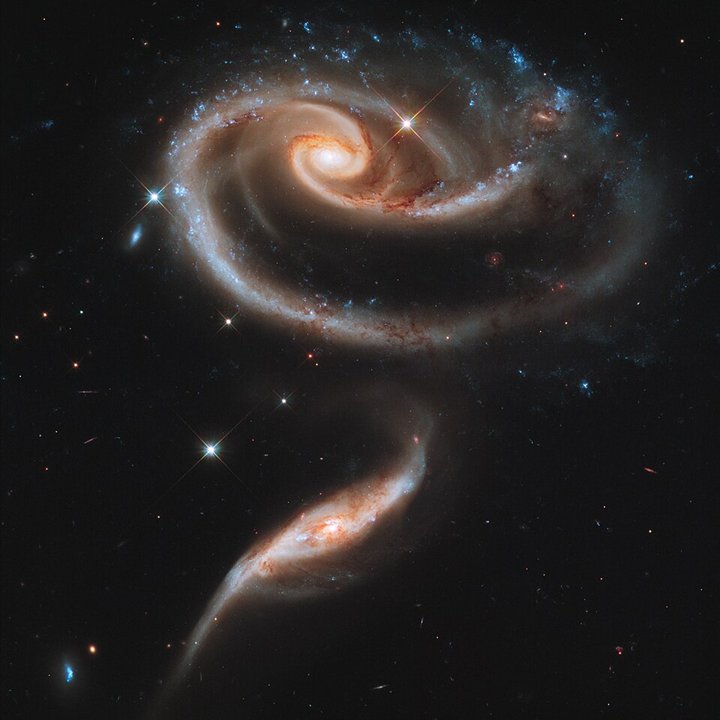
Arp 273 (UGC 1810 and UGC 1813) is a pair of interacting galaxies in Andromeda about 300 million light-years away, nicknamed the Rose Galaxies. Hubble released its picture in 2011 for the telescope's 21st anniversary.
Arp 273 (UGC 1810 and UGC 1813) is a pair of interacting galaxies in Andromeda about 300 million light-years away, nicknamed the Rose Galaxies. Hubble released its picture in 2011 for the telescope's 21st anniversary.
🔭 Galaxy Guide: Find Arp 273 in the CRV Science Deep Sky Galaxy Guide to see its Hubble, JWST or ground-based image, the diagnostic clue used to classify it, and the Interacting Merger class it belongs to. Test your eye in the Deep Sky Classification game.
A Rose Made of Gravity
The larger galaxy, UGC 1810, has been distorted into a rose-like form with a bright blue ring of young stars, thought to result from the smaller companion having passed through or close by its outer disk.
Halton Arp's Atlas of Peculiar Galaxies
Arp assembled 338 oddly shaped galaxies in his 1966 atlas, hoping to learn how unusual structures form. Many entries, including this one, turned out to be interacting systems, and the atlas now serves as a catalog of mergers in action.
What the Colors Show
Blue regions mark young hot stars formed in the encounter, while the yellow-white nucleus of UGC 1810 holds older stars. The color contrast helps astronomers date the interaction.
Arp 273 at a Glance
| Property | Value |
|---|---|
| Catalog designation | Arp 273 • UGC 1810 / UGC 1813 |
| Constellation | Andromeda |
| Distance | 300 million light-years |
| Hubble / morphological type | Interacting Pair (SA(s)b pec + SB pec) |
| Galaxy Guide class | Interacting & Merging Galaxies (Merger / Arp) |
| Catalog | Arp's Atlas of Peculiar Galaxies, 1966 |
| Image credit (Galaxy Guide) | NASA / ESA & the Hubble Heritage Team (STScI/AURA) |
Asymmetric Minor-Merger Dynamics & Off-Center Disk Penetration
Mass Ratio, Orbital Trajectory, and Tidal Arm Asymmetry
Situated at a cosmological redshift of z ≈ 0.025 (corresponding to a luminosity distance of ~100 Mpc or ~300 million light-years), Arp 273 comprises an unequal-mass pair of disk galaxies separated on the sky by roughly 1 arcminute (~30 kiloparsecs in projection): the face-on primary spiral UGC 1810 (cataloged morphologically as SA(s)b pec) and the nearly edge-on barred companion UGC 1813 (SBa pec or SBm pec). Photometric and rotation-curve mass decompositions indicate that UGC 1810 possesses a stellar and dark matter mass roughly five times larger (M1 / M2 ≈ 5:1) than UGC 1813, placing the encounter in the regime of an inclined intermediate-to-minor merger rather than an equal-mass collision.
Whereas a bullseye perpendicular impact through a galaxy's center produces a symmetric expanding ring (as in the Cartwheel Galaxy), N-body and smoothed-particle hydrodynamics (SPH) simulations of Arp 273 indicate that UGC 1813 plunged obliquely through the outer disk of UGC 1810 at a galactocentric impact parameter of Rimp ≈ 15 to 22 kpc roughly 250 to 400 million years ago. Because the companion intersected only one side of the primary's extended outer disk on a moderately inclined prograde trajectory, it excited a non-axisymmetric coupled m = 1 (lopsided) and m = 2 (bisymmetric) tidal perturbation:
- Outer Tidal Ring-Arm Loop: On the northern and western periphery of UGC 1810, stars and gas experienced a strong radial velocity kick during pericenter, rebounding outward to form an asymmetric, pseudo-ringed outer arm that wraps nearly 270° around the galaxy at radii of 20 to 35 kpc, creating the visual "rose petals."
- Intergalactic Tidal Bridge and Plume: On the southern edge facing UGC 1813, tidal stripping drew a faint, 30-kpc stellar and gaseous bridge connecting the outer arm of UGC 1810 directly toward the northern tip of UGC 1813, accompanied by a counter-tail extending southwest of the companion.
- Differential Disk Warping: Because outer disk orbits have lower vertical restoring forces (Σdisk(R) ∝ exp(−*R* / Rd)), the oblique passage of UGC 1813 tilted the outer orbital plane of UGC 1810 by 15° to 25° relative to its inner bulge and spiral disk, producing an integral-sign kinematic warp in H I 21-cm and Hα velocity fields.
Radial Inflow and Bar-Driven Starburst in UGC 1813
While UGC 1810 experienced primarily outer-disk distortion, the lower-mass intruder UGC 1813 endured a strong tidal torque across its stellar body during pericentric passage. Gravitational torques exerted by the potential well of UGC 1810 excited a central stellar bar in UGC 1813, removing angular momentum from the companion's gas (d*L*z / d*t* = −∂Φtidal / ∂φ < 0) and funneling cold atomic and molecular clouds inward into the central 1 to 2 kiloparsecs. Consequently, UGC 1813 exhibits a nuclear starburst buried inside its central bar, with two bright bipolar knots of ionized gas along its principal axis that outshine its underlying old stellar disk in Hα and ultraviolet light.
Multi-Wavelength Stellar Populations, UV-Optical Gradients & Supernovae
Hubble WFC3 Broadband Photometry and Star Formation Chronology
The Hubble Space Telescope Wide Field Camera 3 (WFC3) composite released in April 2011 combines three broadband filters—near-ultraviolet F390W (390 nm), blue-visual F475W (475 nm), and near-infrared F814W (814 nm)—with narrowband Hα imaging to isolate stellar populations by age. In UGC 1810, the inner bulge and spiral arms (R < 8 kpc) are dominated by an evolved, metal-rich population (t > 3–8 Gyr) of K- and M-type red giants emitting in F814W, bisected by dust lanes with visual extinction AV ≈ 1 to 3 magnitudes.
By contrast, the tidally detached northern arm of UGC 1810 gleams in the F390W ultraviolet band and GALEX far-ultraviolet (152 nm) maps. Along this outer arc, tidal shocks and shear instabilities triggered the collapse of giant H I clouds (MH I ≈ 107–108 M☉) into chains of luminous OB associations and young star clusters spaced quasi-regularly by 1 to 3 kpc (the Jeans fragmentation wavelength λJ = 2π cs2 / (G Σgas)). Spectral synthesis of the UV-optical colors indicates that star formation along the outer loop was ignited 10 to 100 Myr ago at several M☉·yr−1, while the nuclear starburst inside UGC 1813 has been sustained over the past 50 Myr at an elevated specific star formation rate (sSFR = SFR / M*).
Core-Collapse Supernovae in UGC 1810
The elevated birth rate of short-lived O and B stars (M > 8 M☉) across the tidally shocked spiral arms of UGC 1810 has been directly confirmed by two historical core-collapse supernovae recorded within its disk:
- SN 1962R: Discovered in December 1962 in the inner spiral structure of UGC 1810 at photographic magnitude ~16.2, providing one of the earliest transient markers in an Arp catalog galaxy prior to the publication of the Atlas of Peculiar Galaxies in 1966.
- SN 2008ip: Detected on December 31, 2008, at an offset of 16 arcseconds east and 22 arcseconds north of the UGC 1810 nucleus—directly along the tidally stretched outer northern arm. Optical spectroscopy with the Kast spectrograph and Hobby-Eberly Telescope identified SN 2008ip as a Type IIn supernova characterized by narrow Balmer emission cores (FWHM ≈ 150–300 km·s−1) superimposed on intermediate-width wings (~2,000 km·s−1), proving that a luminous blue variable (LBV)-like progenitor exploded inside a dense, pre-existing circumstellar shell shed just prior to core collapse.
Catalog Context & Future Dynamical Evolution
Compiled by Halton Arp in 1966 under "Double Galaxies with Connected Arms" (Arp 272–279), Arp 273 demonstrates how non-destructive off-center penetrations reshape galaxy morphology at z ~ 0.025. Because UGC 1813 remains gravitationally bound within the dark matter halo of UGC 1810, dynamical friction will decay the companion's orbit over the next 0.5 to 1.0 billion years, stripping UGC 1813 into tidal streams while heating UGC 1810 into a thicker, bulge-dominated S0 or early-type spiral galaxy.
References
- Arp, H. (1966). "Atlas of Peculiar Galaxies." The Astrophysical Journal Supplement Series, 14, 1–20. doi:10.1086/190147
- Zaritsky, D., Rix, H.-W., & Rieke, M. (1993). "The nature of the outer ring-like structures in spiral galaxies." Nature, 364(6435), 313–315. doi:10.1038/364313a0
- Smith, B. J., Struck, C., Hancock, M., Appleton, P. N., Charmandaris, V., & Reach, W. T. (2007). "The Spitzer Spirals, Bridges, and Tails Interacting Galaxy Survey: Interaction-induced star formation in the mid-infrared." The Astronomical Journal, 133(3), 791–817. doi:10.1086/510350
- Bournaud, F., Jog, C. J., & Combes, F. (2005). "Galaxy interactions and minor mergers: How lopsidedness and asymmetric rings form in spiral disks." Astronomy & Astrophysics, 437(1), 69–85. doi:10.1051/0004-6361:20042036