Red Lionfish
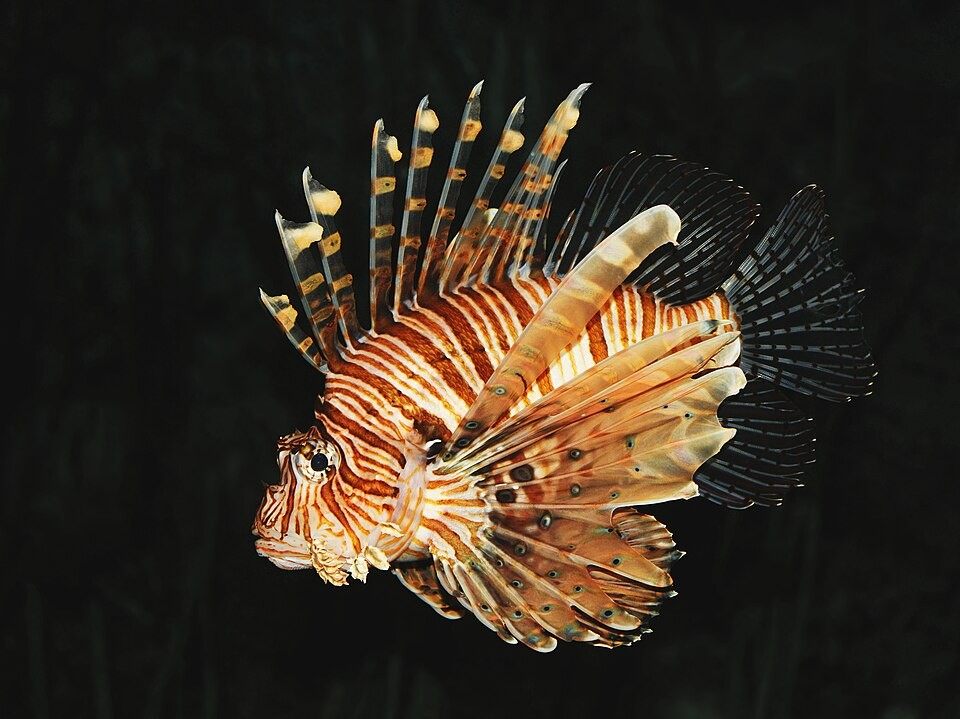
The red lionfish (Pterois volitans) is a striped, venomous reef fish of the Indo-Pacific that has become a major invader in the western Atlantic and Caribbean. It has flowing fins and thirteen venomous spines.
The red lionfish (Pterois volitans) is a striped, venomous reef fish of the Indo-Pacific that has become a major invader in the western Atlantic and Caribbean. It has flowing fins and thirteen venomous spines.
🧬 Field Guide Specimen: Open Red Lionfish in the CRV Science Field Guide to log the specimen, see its place among the Vertebrates lineages in the Cladogram Explorer, and test your recall in the Red List conservation game.
An Invasion Starting in the 1980s
Lionfish were introduced to Florida waters through the aquarium trade, and by the 2000s they had spread throughout the Caribbean and the Gulf of Mexico. Having no native predators, they have reached high densities.
Impact on Reefs
Lionfish eat large numbers of small reef fish and crustaceans, and experiments showed that a lionfish can reduce young native fish on a reef by a large fraction in a few weeks. This may hamper reef recovery, since many of these fish graze algae.
Control by Eating Them
Divers cull lionfish in derbies, and fishermen sell them for food, since the venom is in the spines and not in the flesh. Culling in key areas can reduce local damage.
Red Lionfish at a Glance
| Property | Value |
|---|---|
| Scientific name | Pterois volitans |
| Kingdom | Animalia |
| Phylum | Chordata |
| Class | Actinopterygii |
| Order | Scorpaeniformes |
| Family | Scorpaenidae |
| Field Guide group | Marine and Freshwater Fish |
| Diagnostic feature (Field Guide) | Elongated dorsal spines delivering potent neuromuscular venom, fan-like pectoral fins with zebra-striped aposematic patterns. |
| IUCN Red List status | Least Concern (LC), assessed 2016 |
| Venomous spines | Thirteen dorsal spines |
| Invasive range | Western Atlantic and Caribbean |
See Also
- Staghorn Coral — a reef affected by invaders
- Cane Toad — another invasive species