Serpentinite
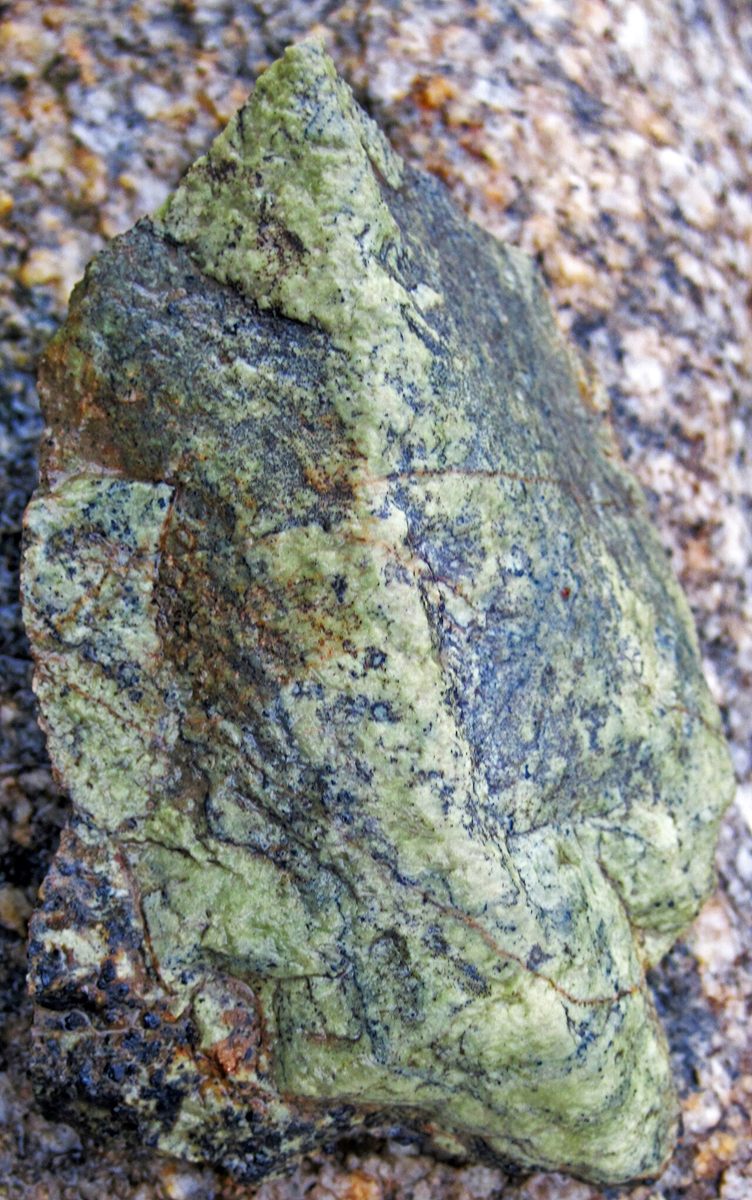
Serpentinite is a mottled green rock made mostly of serpentine minerals, formed when water reacts with olivine and pyroxene in mantle rock. Its waxy, snakeskin-like look gives it its name.
Serpentinite is a mottled green rock made mostly of serpentine minerals, formed when water reacts with olivine and pyroxene in mantle rock. Its waxy, snakeskin-like look gives it its name.
🪨 Geology Guide Specimen: Open Serpentinite in the CRV Science Rock & Mineral ID Guide to log the specimen, compare it with the other 6 subgroups of Metamorphic, and test your eye in LithoClade.
Serpentinization: How Does Peridotite Become Serpentinite?
When seawater or other fluids infiltrate peridotite, olivine and pyroxene react to form serpentine minerals, antigorite, lizardite and chrysotile, plus magnetite and hydrogen gas. The reaction releases heat, expands the rock and lowers its density from about 3.3 to roughly 2.5 grams per cubic centimeter.
Subduction Water: Why Does It Matter?
Serpentinite carries water into subduction zones, and when it breaks down at depth the water is released into the overlying mantle, helping trigger volcanic arc melting. It also hosts jadeitite and other high-pressure rocks.
Serpentine Soils: Why Is Life Different There?
Soils on serpentinite are low in calcium and high in magnesium, nickel and chromium, so they support specialized and often unique plant communities. Serpentine is California's state rock, though chrysotile, a fibrous form of serpentine, is an asbestos mineral and a health hazard.
Serpentinite at a Glance
| Property | Value |
|---|---|
| Type / variety | Hydrated Antigorite–Lizardite Ultramafic Rock |
| Composition | >90% Serpentine Group Minerals (Antigorite, Lizardite, Chrysotile: Mg₃Si₂O₅(OH)₄) + Magnetite |
| Geology Guide group | Metamorphic Rocks (Foliated, Granoblastic & High-P) |
| Rock Classification | Hydrothermal & Fault Zone |
| Mohs hardness | Mohs 3–4.5 |
| Texture / habit | Mottled, scaly, slickensided surfaces with mesh-textured veinlets |
| Density | 2.50–2.65 g/cm³ |
| Lustre and cleavage | Waxy or greasy mottled dark-green to apple-green snakeskin appearance |
| Geological setting | Seawater hydrothermal alteration of mantle peridotite at mid-ocean ridges & suture zones |
| Diagnostic feature (Geology Guide) | Mottled apple- to dark-olive-green rock with a waxy, snakeskin-like lustre and polished, slippery 'slickenside' surfaces, formed when heated seawater hydrates upper-mantle olivine and pyroxene. |
| Main minerals | Antigorite, lizardite and chrysotile |
| Density | About 2.5 g/cm³, lower than its peridotite parent |
See Also
- Peridotite — the parent rock
- Soapstone — a talc-rich relative
- Jadeitite — a rock formed in serpentinite channels