Staghorn Fern
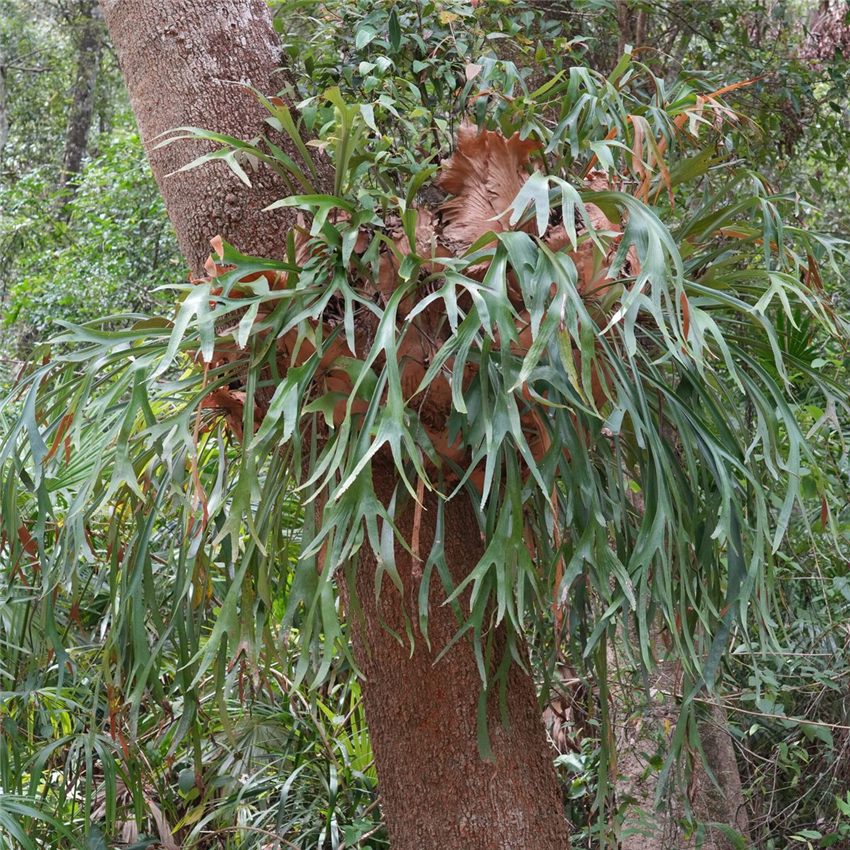
The staghorn fern (Platycerium bifurcatum) is an epiphytic fern of Australia and New Guinea that grows on tree trunks and branches rather than in soil. Its antler-shaped fronds give it its name.
The staghorn fern (Platycerium bifurcatum) is an epiphytic fern of Australia and New Guinea that grows on tree trunks and branches rather than in soil. Its antler-shaped fronds give it its name.
🧬 Field Guide Specimen: Open Staghorn Fern in the CRV Science Field Guide to log the specimen, see its place among the Diaphoretickes lineages in the Cladogram Explorer, and test your recall in the Red List conservation game.
Two Kinds of Fronds
Rounded, papery shield fronds clasp the host tree and trap falling leaves and moisture, building a mass of humus that feeds the plant. The upright antler-like fronds carry the spore-producing patches and photosynthesize.
Ferns Reproduce Without Seeds
Like all ferns, the plant releases spores that grow into tiny, independent gametophytes, which produce eggs and sperm. Fertilization requires water, and the fertilized egg develops into a new frond-bearing plant. Ferns are vascular plants that diverged from seed plants hundreds of millions of years ago.
An Epiphyte, Not a Parasite
The fern uses the tree only as a place to live and takes no nutrients from it. It absorbs water and minerals from rain, mist and organic debris.
Staghorn Fern at a Glance
| Property | Value |
|---|---|
| Scientific name | Platycerium bifurcatum |
| Kingdom | Plantae |
| Phylum | Tracheophyta |
| Class | Polypodiopsida |
| Order | Polypodiales |
| Field Guide group | Diaphoretickes: Plants & Algae |
| Diagnostic feature (Field Guide) | Dimorphic fronds: sterile basal shield fronds clasping trees and fertile branched antler fronds bearing sori. |
| Growth form | Epiphyte |
| Order | Polypodiales |