Trachyte
Trachyte is a pale, fine-grained volcanic rock made mostly of alkali feldspar, with little or no quartz. It is the extrusive counterpart of syenite, and its name comes from the Greek word for 'rough,' after the gritty feel of its surface.
Trachyte is a pale, fine-grained volcanic rock made mostly of alkali feldspar, with little or no quartz. It is the extrusive counterpart of syenite, and its name comes from the Greek word for "rough," after the gritty feel of its surface.
🪨 Geology Guide Specimen: Open Trachyte in the CRV Science Rock & Mineral ID Guide to log the specimen, compare it with the other 7 subgroups of Igneous, and test your eye in LithoClade.
Rough Texture: How Does Trachyte Get Its Name?
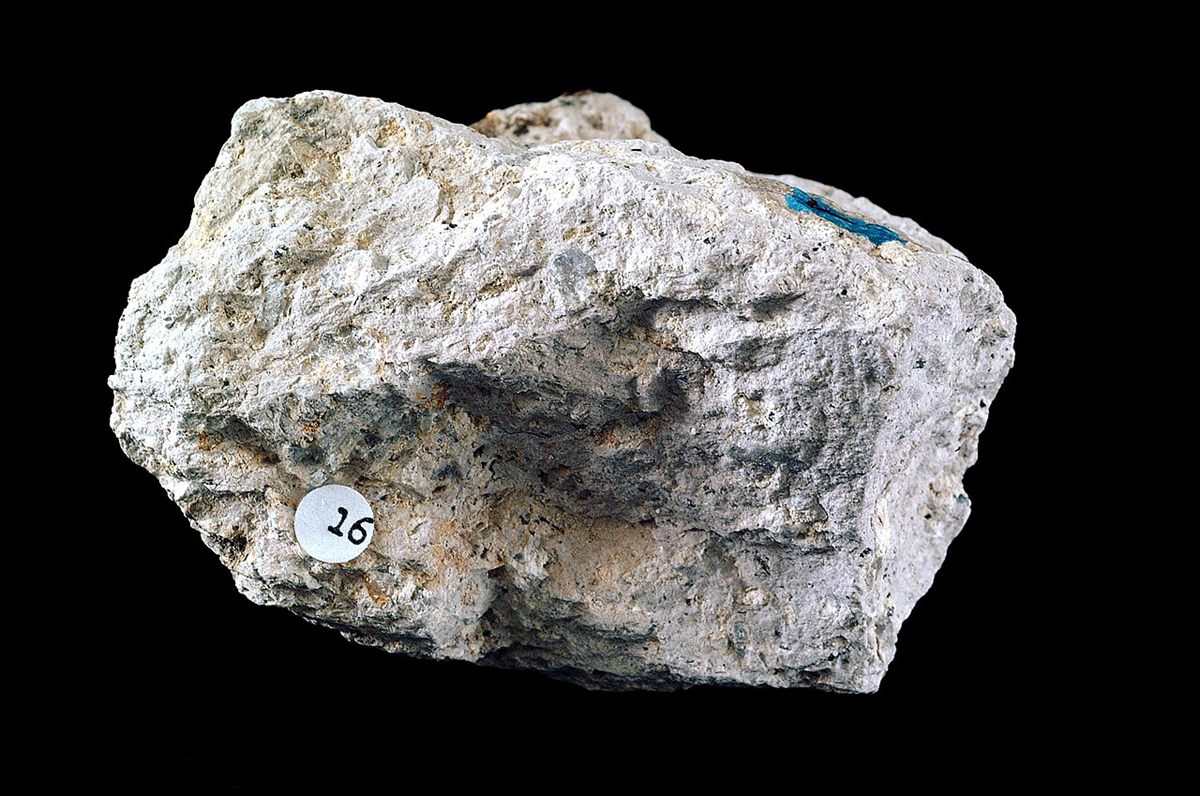
Tiny tabular feldspar crystals in the groundmass line up with the direction of flow, a fabric called trachytic texture. Small gas cavities and the projecting crystal ends make the broken surface rough, like sandpaper. Large glassy phenocrysts of sanidine are common.
Alkaline Volcanism: Where Does Trachyte Erupt?
Trachyte occurs at continental rifts and ocean-island volcanoes, where alkaline magmas evolve by fractional crystallization. It is found in places such as the East African Rift and the Canary Islands, usually as part of a series that runs from basalt through trachyte.
Viscous Lava: How Does It Shape the Landscape?
Trachytic lava is much more viscous than basalt, so it forms thick domes, short stubby flows and explosive deposits. Some large eruptions near Naples, for example, produced widespread trachytic tuffs that were later quarried as building stone.
Trachyte at a Glance
| Property | Value |
|---|---|
| Type / variety | Sanidine-Phyric Alkaline Trachyte |
| Composition | Alkali Feldspar (Sanidine microlites & phenocrysts) + Biotite/Clinopyroxene |
| Geology Guide group | Igneous Rocks (Plutonic & Volcanic) |
| Rock Classification | Intermediate (Diorite–Andesite) |
| Mohs hardness | Mohs 6 |
| Texture / habit | Porphyritic with flow-aligned feldspar microlites |
| Density | 2.55–2.70 g/cm³ |
| Lustre and cleavage | Rough, sandpaper-like fracture surface with tabular sanidine |
| Geological setting | Continental rifts and ocean-island volcanoes |
| Diagnostic feature (Geology Guide) | Pale grey-to-tan volcanic lava with a rough surface feel and large, glassy tabular sanidine feldspar phenocrysts aligned parallel to flow directions in a quartz-poor groundmass. |
| Name origin | Greek trachys, "rough" |
| Plutonic equivalent | Syenite |