Andesite
Andesite is a grey, fine-grained volcanic rock with roughly 57 to 63 weight percent silica, the characteristic lava of subduction-zone volcanoes. It is named for the Andes, where it forms many of the great stratovolcanoes.
Andesite is a grey, fine-grained volcanic rock with roughly 57 to 63 weight percent silica, the characteristic lava of subduction-zone volcanoes. It is named for the Andes, where it forms many of the great stratovolcanoes.
🪨 Geology Guide Specimen: Open Andesite in the CRV Science Rock & Mineral ID Guide to log the specimen, compare it with the other 7 subgroups of Igneous, and test your eye in LithoClade.
Arc Volcanism: Why Does Andesite Erupt Above Subduction Zones?
Water released from the sinking slab lowers the melting point of the overlying mantle, producing basaltic magma that rises into the crust. There it cools, partly crystallizes, melts and mixes with crustal rock, and evolves toward andesite. This is why andesite is so strongly associated with the volcanic arcs of the Pacific Ring of Fire.
Textures: Why Is Andesite Often Porphyritic?
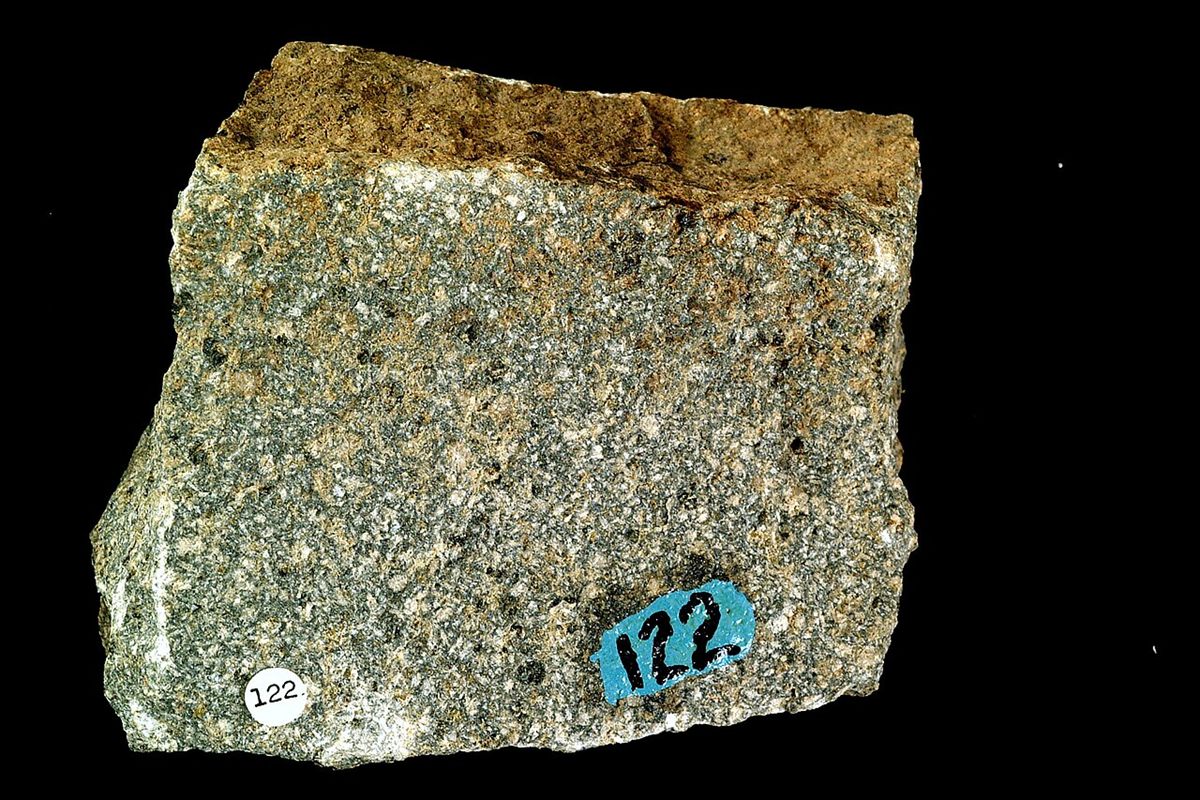
Many andesites have visible plagioclase, pyroxene and hornblende crystals set in a fine groundmass. The large crystals grew slowly in a magma chamber, and the groundmass formed quickly after eruption. Zoned plagioclase crystals record repeated changes in the magma, including mixing of hotter and cooler batches.
Stratovolcanoes: What Do Andesitic Volcanoes Look Like?
Andesitic volcanoes are steep-sided cones built of alternating lava flows and fragmental deposits. Because the lava is sticky and gas-rich, eruptions can be explosive, and these volcanoes account for much of the world's volcanic hazard, from the Andes and Cascades to Japan and Indonesia.
Andesite at a Glance
| Property | Value |
|---|---|
| Type / variety | Porphyritic Plagioclase Andesite |
| Composition | 52–63% SiO₂ • Zoned Plagioclase + Pyroxene/Hornblende Phenocrysts |
| Geology Guide group | Igneous Rocks (Plutonic & Volcanic) |
| Rock Classification | Intermediate (Diorite–Andesite) |
| Mohs hardness | Mohs 6 |
| Texture / habit | Porphyritic with medium-grey fine groundmass |
| Density | 2.65–2.80 g/cm³ |
| Lustre and cleavage | Rectangular white feldspar laths in matte grey matrix |
| Geological setting | Convergent-margin stratovolcanoes (named after the Andes) |
| Diagnostic feature (Geology Guide) | Medium-grey volcanic rock peppered with rectangular white plagioclase laths and stubby black hornblende needles set in a fine-grained groundmass, signifying a two-stage cooling history. |
| Named for | The Andes mountains |
| Plutonic equivalent | Diorite |