Vanadinite
Vanadinite is a lead chlorovanadate, Pb₅(VO₄)₃Cl, a mineral that forms brilliant red hexagonal crystals in the weathered zones of lead deposits. It is a minor ore of vanadium and a favorite collector's mineral.
Vanadinite is a lead chlorovanadate, Pb₅(VO₄)₃Cl, a mineral that forms brilliant red hexagonal crystals in the weathered zones of lead deposits. It is a minor ore of vanadium and a favorite collector's mineral.
🪨 Geology Guide Specimen: Open Vanadinite in the CRV Science Rock & Mineral ID Guide to log the specimen, compare it with the other 8 mineral classes of Dana / Strunz Classes, and test your eye in LithoClade.
Fiery Red Hexagons: How Do You Recognize It?
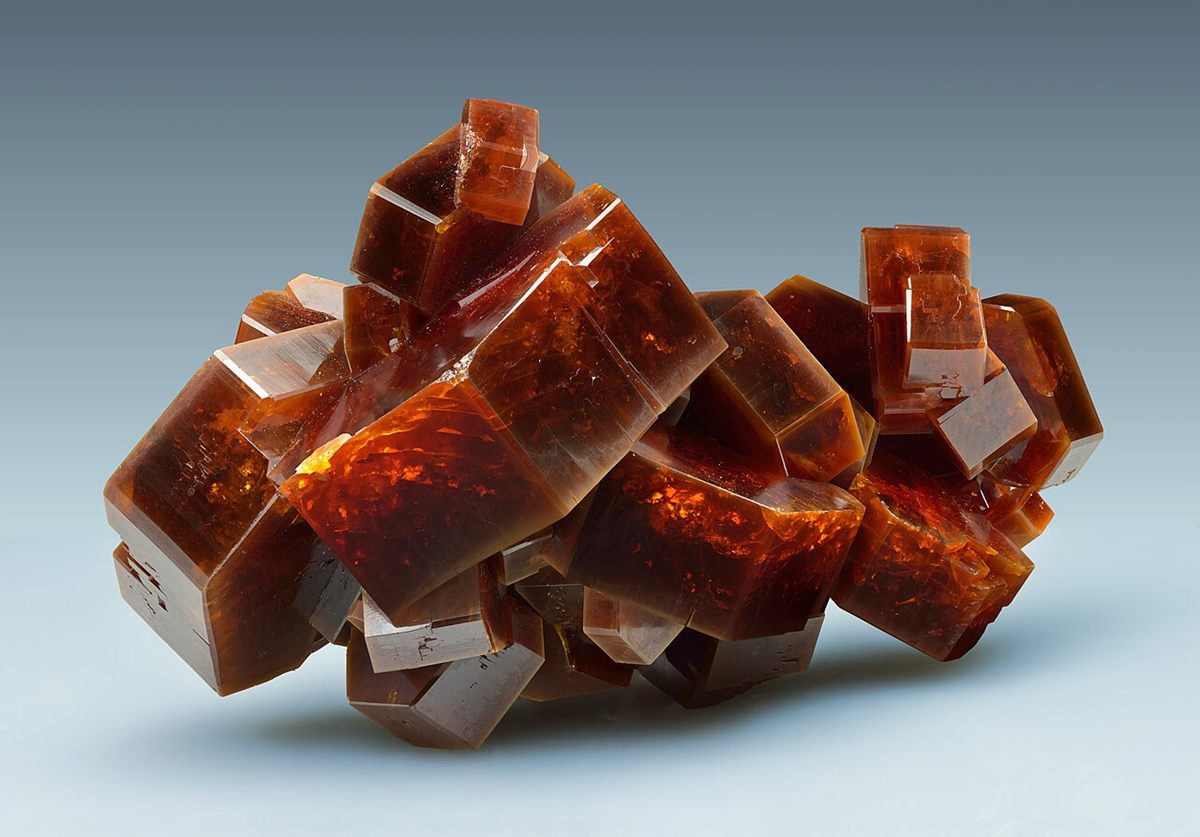
Vanadinite grows as sharp hexagonal prisms and flat wafers, crimson to orange, with a resinous to adamantine luster, a hardness of about 3 and a density near 6.9 grams per cubic centimeter. It often sits on white barite or dark manganese oxide.
Arid Oxidation Zones: Where Does It Form?
Like pyromorphite, vanadinite forms where lead ores weather in dry climates, with vanadium brought in by groundwater. Classic specimens come from Mibladen, Morocco, and from Arizona.
Vanadium: What Is the Story of the Element?
Vanadium was first reported in 1801 from a Mexican lead ore and was rediscovered and named in 1830 after the Norse goddess Vanadis, for its colorful compounds. It is mostly used to strengthen steel. See vanadium.
Vanadinite at a Glance
| Property | Value |
|---|---|
| Type / variety | Pb₅(VO₄)₃Cl • Hexagonal Lead Chlorovanadate |
| Composition | Pb₅(VO₄)₃Cl (73.1 wt% Lead, 10.8 wt% Vanadium) |
| Geology Guide group | Minerals (8 Major Chemical Groups) |
| Mineral Group | Phosphates & Vanadates |
| Mohs hardness | Mohs 2.75–3 |
| Texture / habit | Sharp, flat tabular 6-sided hexagonal wafers and short prisms |
| Density | 6.88 g/cm³ (very heavy) |
| Lustre and cleavage | Brilliant resinous-to-adamantine fiery crimson-red to orange-red hexagons |
| Geological setting | Arid oxidation zones of lead-bearing deposits (e.g., Mibladen, Morocco; Arizona) |
| Diagnostic feature (Geology Guide) | Fiery crimson- to ruby-red, razor-sharp 6-sided hexagonal wafers (Mohs 3, density 6.88 g/cm³) with a brilliant resinous-adamantine flash perched on dark manganese or white barite matrix. |
| Formula | Pb₅(VO₄)₃Cl |
| Color | Crimson to orange |
See Also
- Pyromorphite — the lead phosphate with the same structure
- Vanadium — the element in vanadinite
- Galena — the lead sulfide it weathers from