Pyromorphite
Pyromorphite is a lead chlorophosphate, Pb₅(PO₄)₃Cl, a dense, vivid green mineral with hexagonal crystals that belongs to the apatite group. The name comes from the Greek for 'fire form,' because a melted fragment crystallizes again on cooling.
Pyromorphite is a lead chlorophosphate, Pb₅(PO₄)₃Cl, a dense, vivid green mineral with hexagonal crystals that belongs to the apatite group. The name comes from the Greek for "fire form," because a melted fragment crystallizes again on cooling.
🪨 Geology Guide Specimen: Open Pyromorphite in the CRV Science Rock & Mineral ID Guide to log the specimen, compare it with the other 8 mineral classes of Dana / Strunz Classes, and test your eye in LithoClade.
Barrel-Shaped Crystals: How Do You Recognize It?
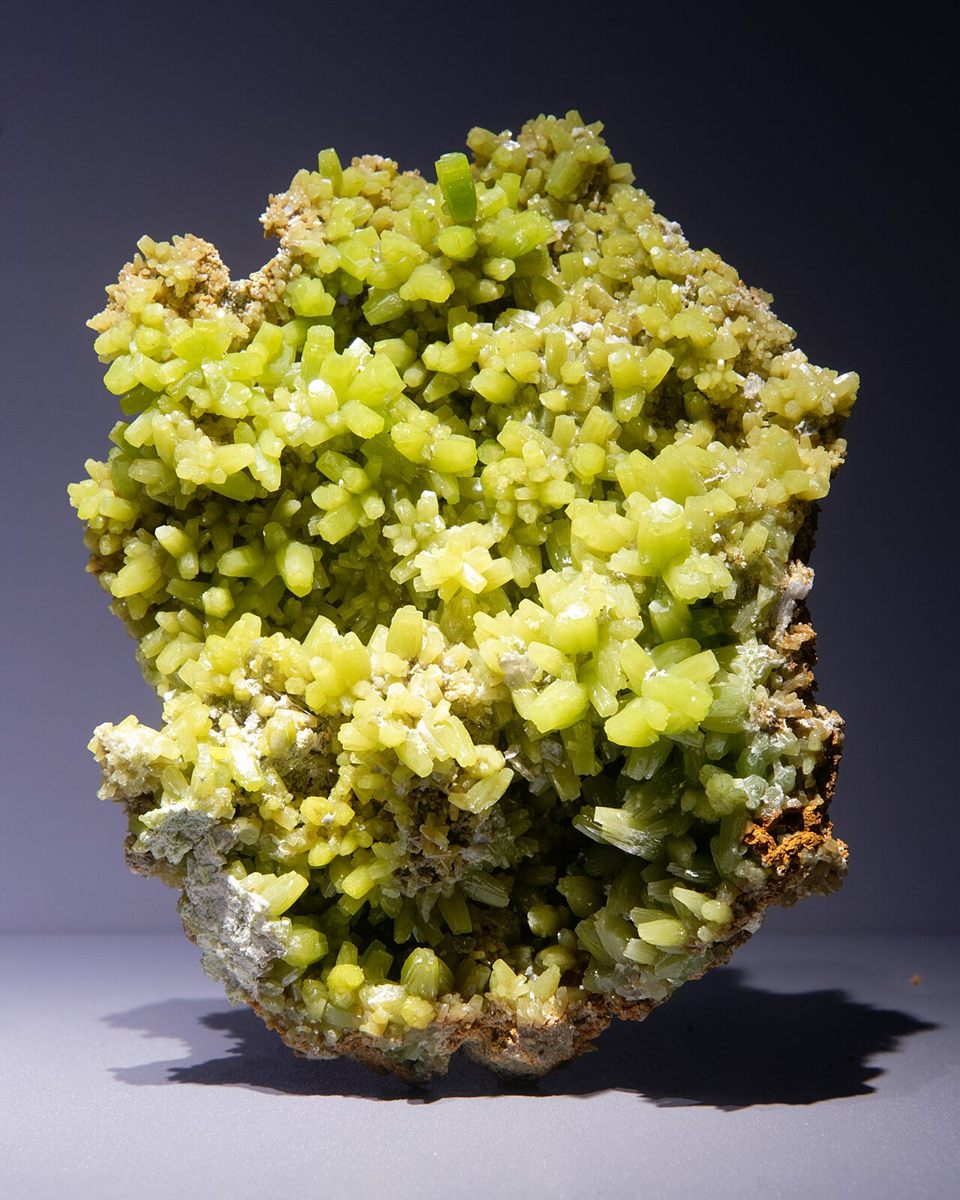
Pyromorphite forms barrel-shaped hexagonal prisms, often hollow at the ends, in bright green, yellow or brown crusts. At about 7 grams per cubic centimeter it is much heavier than most green minerals because of its high lead content, and its hardness is 3.5 to 4.
Oxidized Lead Deposits: Where Does It Form?
Pyromorphite forms in the weathered zone of lead ores such as galena, when lead released by oxidation combines with phosphate from groundwater. It shares its structure with apatite and vanadinite.
Locking Lead: Why Is It Useful?
Pyromorphite is very insoluble, so adding phosphate to contaminated soil to make it has been tested as a way to fix lead in a stable form. It is a useful example of a mineral being used to reduce pollution. See lead.
Pyromorphite at a Glance
| Property | Value |
|---|---|
| Type / variety | Pb₅(PO₄)₃Cl • Hexagonal Lead Chlorophosphate |
| Composition | Pb₅(PO₄)₃Cl (76.4 wt% Lead • Isostructural with Apatite & Vanadinite) |
| Geology Guide group | Minerals (8 Major Chemical Groups) |
| Mineral Group | Phosphates & Vanadates |
| Mohs hardness | Mohs 3.5–4 |
| Texture / habit | Hopper-topped, barrel-shaped 6-sided hexagonal prisms in dense drusy crusts |
| Density | 7.04 g/cm³ (extremely dense) |
| Lustre and cleavage | Greasy-to-adamantine vivid Granny-Smith apple-green or chartreuse prisms |
| Geological setting | Oxidized upper zones of lead sulfide ore veins |
| Diagnostic feature (Geology Guide) | Dense clusters of vivid apple-green to chartreuse, barrel-shaped 6-sided hexagonal prisms with hollow 'hopper' tops that feel remarkably heavy (density 7.04 g/cm³) due to their 76% lead content. |
| Formula | Pb₅(PO₄)₃Cl |
| Density | About 7 g/cm³ |
See Also
- Vanadinite — the lead vanadate with the same structure
- Galena — the sulfide source of the lead
- Lead — the metal in pyromorphite