Apatite
Apatite is a group of calcium phosphate minerals, Ca₅(PO₄)₃(F,Cl,OH), with hexagonal crystals and a hardness of 5, the standard for that number on the Mohs scale.
Apatite is a group of calcium phosphate minerals, Ca₅(PO₄)₃(F,Cl,OH), with hexagonal crystals and a hardness of 5, the standard for that number on the Mohs scale. It is the main phosphorus mineral of the crust and the mineral of tooth enamel and bone. The name comes from the Greek for "to deceive," because it was so often mistaken for other gems.
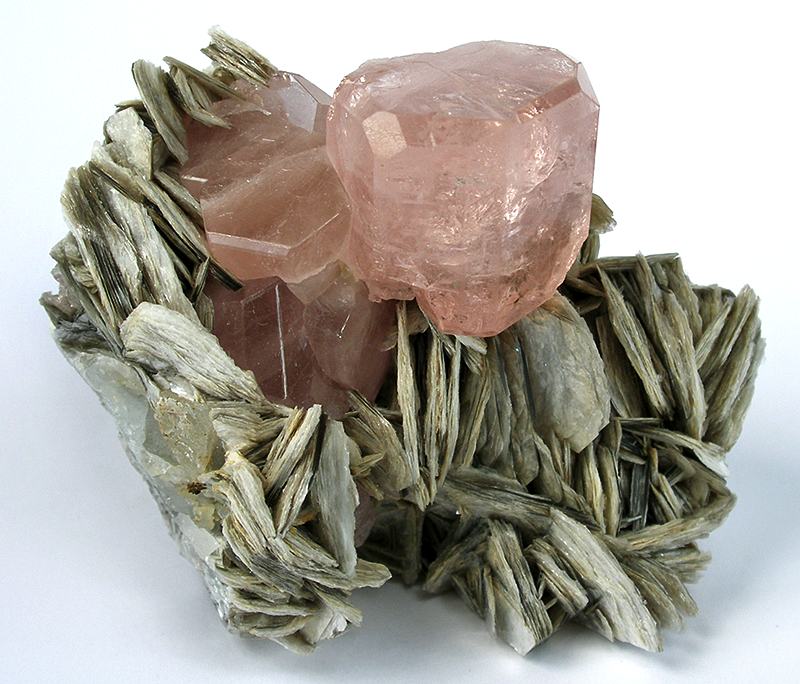
🪨 Geology Guide Specimen: Open Apatite (Fluorapatite) in the CRV Science Rock & Mineral ID Guide to log the specimen, compare it with the other 8 mineral classes of Dana / Strunz Classes, and test your eye in LithoClade.
Fluor-, Chlor- and Hydroxyapatite: What Are the Varieties?
The three varieties differ in the ion that fills one site: fluorine, chlorine or hydroxide. Fluorapatite is the most common in rocks and is often sea-green, golden or blue as a gem. Bone and tooth enamel are made of a form of hydroxyapatite, and fluoride in toothpaste turns the surface into the more acid-resistant fluorapatite.
Occurrence: Where Does Apatite Form?
Apatite is a common minor mineral in igneous rocks and pegmatites, and it forms large sedimentary beds called phosphorites in marine basins. Its dating by radioactive decay also makes it useful to geologists.
Fertilizer: Why Is Phosphate Rock So Important?
Most mined apatite is converted to phosphate fertilizer, because phosphorus is an essential nutrient that often limits plant growth. Phosphate rock is a finite resource, so its supply is a long-term concern for food production. See also fluorite.
Apatite at a Glance
| Property | Value |
|---|---|
| Type / variety | Ca₅(PO₄)₃(F,Cl,OH) • Hexagonal Calcium Phosphate |
| Composition | Ca₅(PO₄)₃(F,Cl,OH) (Calcium Halo/Hydroxy-Anion Complex) |
| Geology Guide group | Minerals (8 Major Chemical Groups) |
| Mineral Group | Phosphates & Vanadates |
| Mohs hardness | Mohs 5 (reference standard for 5; scratched by steel knife, scratches fluorite) |
| Texture / habit | 6-sided hexagonal prisms terminated by flat basal planes or pyramids |
| Density | 3.15–3.20 g/cm³ |
| Lustre and cleavage | Vitreous-to-subresinous sea-green ('asparagus stone'), golden-yellow, or neon-blue |
| Geological setting | Igneous accessory mineral, pegmatites, phosphorite beds, and vertebrate tooth enamel/bone! |
| Diagnostic feature (Geology Guide) | Glassy sea-green, golden-yellow, or neon-blue six-sided hexagonal prism that defines Mohs hardness 5 (softer than beryl or quartz, harder than fluorite) and forms the exact mineral framework of vertebrate tooth enamel and bone. |
| Formula | Ca₅(PO₄)₃(F,Cl,OH) |
| Biological role | Mineral of bone and tooth enamel |