Turquoise
Turquoise is a hydrated copper aluminum phosphate, CuAl₆(PO₄)₄(OH)₈·4H₂O, an opaque blue to green mineral that has been valued as a gemstone for thousands of years. The name comes from the French for 'Turkish,' because the stone reached Europe through Turkey.
Turquoise is a hydrated copper aluminum phosphate, CuAl₆(PO₄)₄(OH)₈·4H₂O, an opaque blue to green mineral that has been valued as a gemstone for thousands of years. The name comes from the French for "Turkish," because the stone reached Europe through Turkey.
🪨 Geology Guide Specimen: Open Turquoise in the CRV Science Rock & Mineral ID Guide to log the specimen, compare it with the other 8 mineral classes of Dana / Strunz Classes, and test your eye in LithoClade.
Robin's-Egg Blue: What Gives Turquoise Its Color?
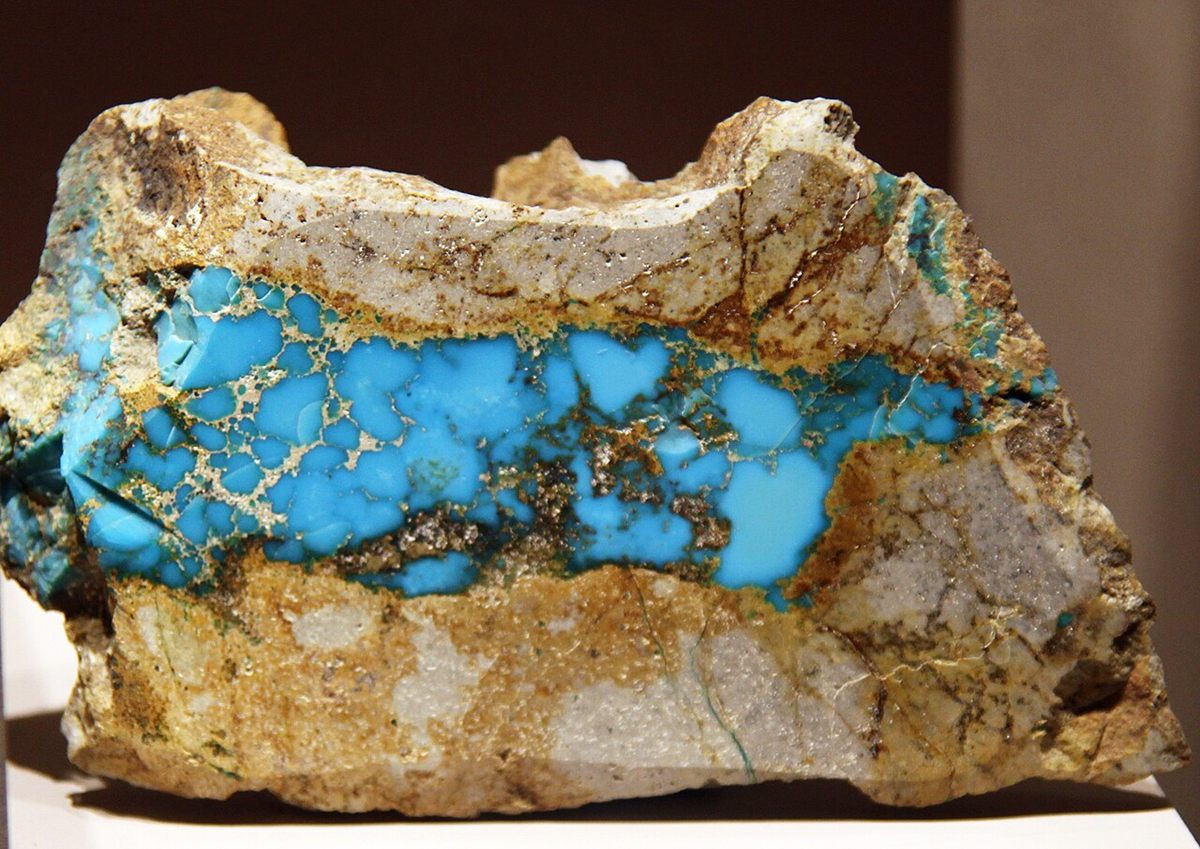
Copper gives the blue and iron shifts it toward green. Turquoise forms microcrystalline masses, nodules and veins, with a waxy luster and a hardness of 5 to 6, and it is porous enough to be stabilized or dyed when cut. Brown or black veins of the host rock, called matrix, run through many stones.
Arid Weathering: Where Does It Form?
Turquoise forms near the surface in dry regions, where phosphate-bearing water reacts with aluminum-rich rock and copper minerals, often in altered volcanic rocks. Famous sources include Iran, the Sinai Peninsula and the southwestern United States.
Cultural History: Why Was It Prized?
Egyptians mined turquoise in Sinai over 5,000 years ago, and it was central to jewelry and ceremonial objects in Persia, Tibet and the Americas, as in the work of the Navajo and Pueblo peoples. See apatite for another phosphate mineral and phosphorus.
Turquoise at a Glance
| Property | Value |
|---|---|
| Type / variety | CuAl₆(PO₄)₄(OH)₈·4H₂O • Triclinic Phosphate |
| Composition | CuAl₆(PO₄)₄(OH)₈·4H₂O (Hydrated Copper–Aluminum Complex) |
| Geology Guide group | Minerals (8 Major Chemical Groups) |
| Mineral Group | Phosphates & Vanadates |
| Mohs hardness | Mohs 5–6 |
| Texture / habit | Dense cryptocrystalline nodules and vein fillings, often laced with dark host-rock 'spiderweb' matrix |
| Density | 2.60–2.90 g/cm³ |
| Lustre and cleavage | Waxy-to-subvitreous opaque robin's-egg sky-blue to greenish-blue |
| Geological setting | Arid weathering zones where phosphorus-bearing meteoric water alters aluminum- and copper-rich volcanic rocks |
| Diagnostic feature (Geology Guide) | Opaque, waxy-lustred robin's-egg sky-blue to blue-green nodule (Mohs 5–6) veined with brown limonite matrix, formed where arid groundwater leaches copper and aluminum through fractured volcanic host rocks. |
| Formula | CuAl₆(PO₄)₄(OH)₈·4H₂O |
| Name origin | French turquoise, "Turkish" |