Fluorite
Fluorite is calcium fluoride, CaF₂, an isometric mineral with a hardness of 4, the standard for that number on the Mohs scale. It forms glassy cubes in purple, green, blue and yellow, and many specimens glow under ultraviolet light.
Fluorite is calcium fluoride, CaF₂, an isometric mineral with a hardness of 4, the standard for that number on the Mohs scale. It forms glassy cubes in purple, green, blue and yellow, and many specimens glow under ultraviolet light.
🪨 Geology Guide Specimen: Open Fluorite in the CRV Science Rock & Mineral ID Guide to log the specimen, compare it with the other 8 mineral classes of Dana / Strunz Classes, and test your eye in LithoClade.
Color and Cleavage: How Do You Recognize It?
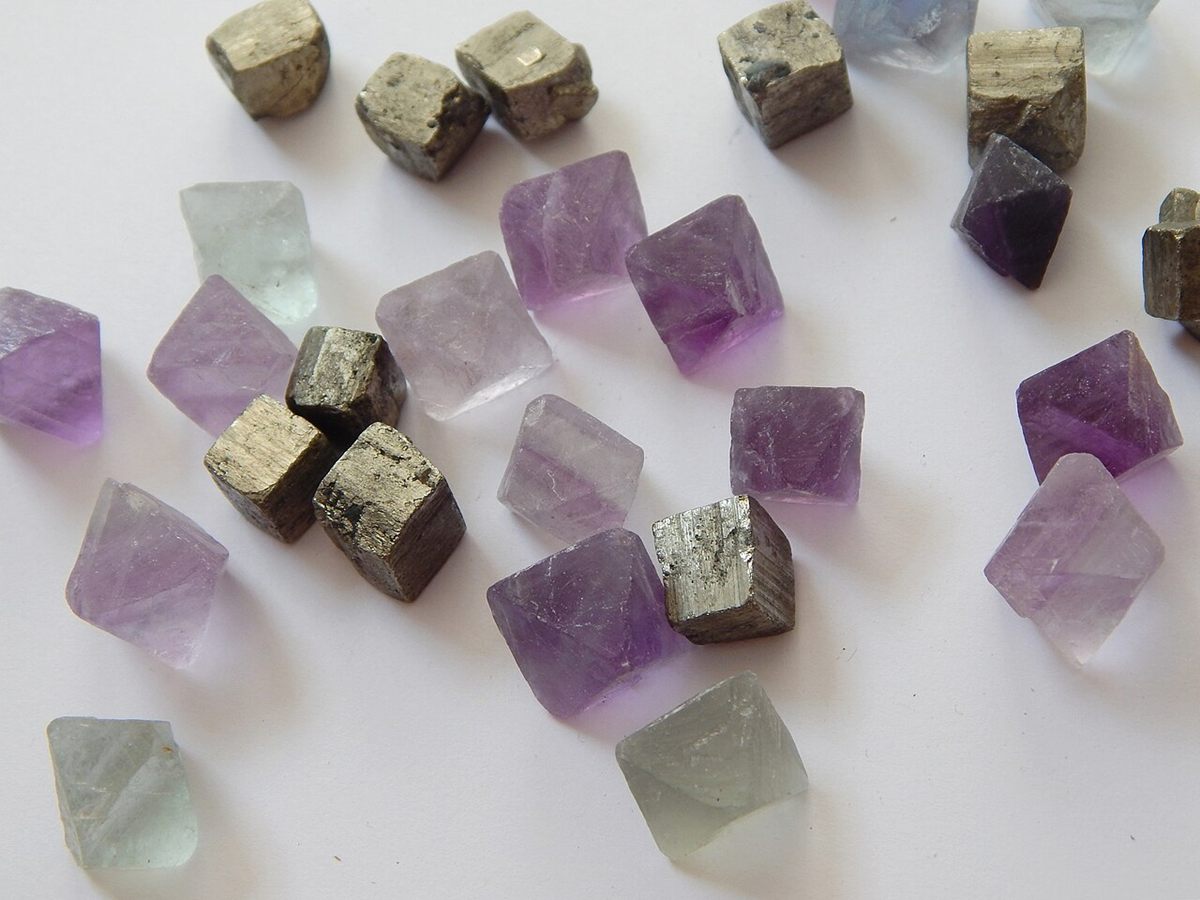
Fluorite is found in a wide range of colors from impurities and defects in the crystal. It has four directions of perfect cleavage, so a cube can be split into an octahedron, and it is soft enough for a steel knife to scratch.
Fluorescence: What Did It Name?
Many fluorites emit visible light, often violet-blue, when exposed to ultraviolet light. The 19th-century scientist George Stokes named this phenomenon fluorescence after the mineral, whose own name comes from the Latin for "to flow," because it was used as a flux in smelting.
Uses: Flux and Fluorine
Fluorite is a source of fluorine, used for refrigerants, plastics and hydrofluoric acid, and a flux in steelmaking. It forms in hydrothermal veins, often with galena and sphalerite, and in pegmatites. See fluorine and calcium.
Fluorite at a Glance
| Property | Value |
|---|---|
| Type / variety | CaF₂ • Isometric Calcium Fluoride |
| Composition | CaF₂ (51.3 wt% Calcium, 48.7 wt% Fluorine) |
| Geology Guide group | Minerals (8 Major Chemical Groups) |
| Mineral Group | Halides |
| Mohs hardness | Mohs 4 (reference standard for 4) |
| Texture / habit | Sharp isometric cubes (often penetration-twinned) and cleaved octahedra |
| Density | 3.18 g/cm³ |
| Lustre and cleavage | Glassy purple, green, blue, or yellow cubes with PERFECT 4-directional octahedral cleavage; glows violet-blue under UV light |
| Geological setting | Hydrothermal veins, carbonate-hosted deposits, and granitic pegmatites |
| Diagnostic feature (Geology Guide) | Glassy purple, emerald-green, or golden isometric cubes that define Mohs hardness 4, cleave across all eight cube corners into symmetric octahedra, and gave the phenomenon of UV 'fluorescence' its name. |
| Formula | CaF₂ |
| Cleavage | Four directions, octahedral |