Azurite
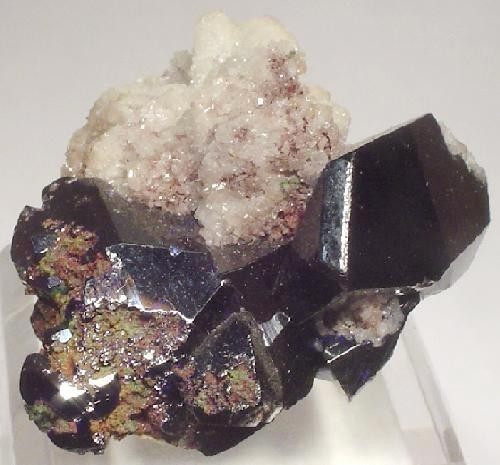
Azurite is a deep blue copper carbonate hydroxide, Cu₃(CO₃)₂(OH)₂, with monoclinic crystals and a hardness of 3.5 to 4. It forms in oxidized copper deposits and slowly alters to green malachite.
Azurite is a deep blue copper carbonate hydroxide, Cu₃(CO₃)₂(OH)₂, with monoclinic crystals and a hardness of 3.5 to 4. It forms in oxidized copper deposits and slowly alters to green malachite.
🪨 Geology Guide Specimen: Open Azurite in the CRV Science Rock & Mineral ID Guide to log the specimen, compare it with the other 8 mineral classes of Dana / Strunz Classes, and test your eye in LithoClade.
Intense Blue: How Does It Form?
Like malachite, azurite grows from carbonate-rich groundwater in the weathered zone of copper deposits. It forms where there is more dissolved carbon dioxide, and so it needs a little more carbonate in the water than malachite does. Its crystals make rosettes and blades of deep blue.
Azurite to Malachite: Why Do Blue Specimens Turn Green?
Where the carbon dioxide level or the humidity changes, azurite can alter to malachite. The change is often seen as a green rind on blue crystals, and in some specimens malachite completely replaces azurite crystals while retaining their shape.
Pigment and Prospecting: What Is It Used For?
Ground azurite was a major blue pigment in medieval and Renaissance painting before synthetic blues were made, though it can turn greenish with age. Because both stones indicate copper at depth, they are old prospecting guides, and azurite is about 55 percent copper.
Azurite at a Glance
| Property | Value |
|---|---|
| Type / variety | Cu₃(CO₃)₂(OH)₂ • Monoclinic Copper Carbonate |
| Composition | Cu₃(CO₃)₂(OH)₂ (55.3 wt% Copper) |
| Geology Guide group | Minerals (8 Major Chemical Groups) |
| Mineral Group | Carbonates |
| Mohs hardness | Mohs 3.5–4 |
| Texture / habit | Tabular monoclinic blades, radiating rosettes ('suns'), or drusy crusts |
| Density | 3.77–3.89 g/cm³ |
| Lustre and cleavage | Intense electric Prussian-blue vitreous blades; sky-blue streak; fizzes in HCl |
| Geological setting | Oxidized supergene zones of copper deposits (often altering into green malachite) |
| Diagnostic feature (Geology Guide) | Intense, deep Prussian- to azure-blue monoclinic blades and rosette clusters (Mohs 3.5–4) that leave a lighter sky-blue streak, effervesce in dilute acid, and gradually weather into green malachite. |
| Formula | Cu₃(CO₃)₂(OH)₂ |
| Streak | Light blue |