Chalcopyrite
Chalcopyrite is a copper iron sulfide, CuFeS₂, with a brass-yellow metallic luster that tarnishes to iridescent blues and purples. It is the most important copper ore mineral.
Chalcopyrite is a copper iron sulfide, CuFeS₂, with a brass-yellow metallic luster that tarnishes to iridescent blues and purples. It is the most important copper ore mineral.
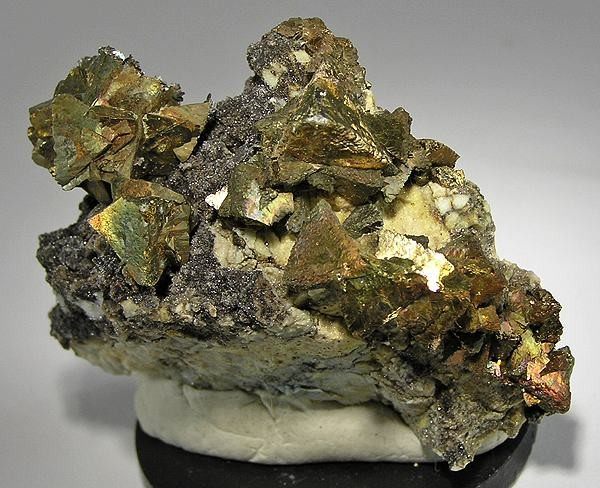
🪨 Geology Guide Specimen: Open Chalcopyrite ('Peacock Ore') in the CRV Science Rock & Mineral ID Guide to log the specimen, compare it with the other 8 mineral classes of Dana / Strunz Classes, and test your eye in LithoClade.
Brass-Yellow and Peacock: How Do You Recognize It?
Chalcopyrite is softer than pyrite, at 3.5 to 4, and a steel knife scratches it. Its streak is greenish black, and its deeper yellow tarnishes quickly to an iridescent film that gives the nickname "peacock ore." Crystals are small wedge-shaped tetragonal forms, but most is massive.
Copper Ore: Where Does It Occur?
Chalcopyrite forms in porphyry copper deposits, large bodies of fractured rock around granitic intrusions, as well as in volcanic massive sulfides and hydrothermal veins. Only about a third of the mineral is copper, so ore is mined in huge tonnages and concentrated by flotation.
Weathering: Where Do the Colorful Copper Minerals Come From?
Chalcopyrite at a Glance
| Property | Value |
|---|---|
| Type / variety | CuFeS₂ • Tetragonal Copper–Iron Sulfide |
| Composition | CuFeS₂ (34.6 wt% Copper, 30.4 wt% Iron, 34.9 wt% Sulfur) |
| Geology Guide group | Minerals (8 Major Chemical Groups) |
| Mineral Group | Sulfides |
| Mohs hardness | Mohs 3.5–4 (softer than pyrite; easily scratched by a steel knife) |
| Texture / habit | Wedge-shaped tetragonal disphenoids or brassy massive aggregates |
| Density | 4.10–4.30 g/cm³ |
| Lustre and cleavage | Deep brass-yellow metallic lustre tarnishing to iridescent purple/blue/green; greenish-black streak |
| Geological setting | Porphyry copper deposits, volcanogenic massive ores, and hydrothermal veins |
| Diagnostic feature (Geology Guide) | Deep brass-yellow metallic mineral that is softer than pyrite (Mohs 3.5–4, scratched by a steel knife), forms wedge-shaped tetragonal crystals, and tarnishes into dazzling iridescent peacock purples and blues. |
| Formula | CuFeS₂ |
| Nickname | Peacock ore |